The editor’s opinion from Marketplace, Northeast Wisconsin’s business magazine. (Obligatory disclaimer: Most hyperlinks go to outside sites, and we’re not responsible for their content. And like fresh watermelon, peaches, pineapple, grapefruit, tomatoes and sweet corn, hyperlinks can go bad after a while.)

June 30, 2008

Analysis of the Day

Forbes.com’s Rich Karlgaard (hey, I wonder if he’s related) on the real losers if Barack Obama gets elected president — to wit, most of the readers of Marketplace:
Here’s how Obama’s tax war will play out: The corporate executive, the $2 million-a-year law partner, the successful small business owner — along with hedge-fund billionaires — will consult lawyers. They concoct a strategy to strip their taxable income to the lowest legal levels. They will make up for lost compensation in other ways — perks, deferred income, whatever. The rich are not stupid. They did not get rich by being suckers.

The $300,000 W-2 earner, on the other hand, will be in a world of hurt. There will be no place to hide. …

Suppose Obama sets the top income tax rate at 40%, starting at $200,000. Suppose he also blows away the roof on FICA taxes, currently 7.65% capped at $97,500 (if my figures are right). Thus, the $300,000 W-2 earner who lives in California or New York will see his last earned dollar taxed in 55% range.

This will be before property and sales tax.

Today's $100,000 to $150,000 W-2 earners, who might be snickering at the fate of their $300,000 W-2 peers, will themselves be pushed into Obama’s $200,000 killing zone in a few years. That's what inflation will do.

Occasions of sin

Those of you who subscribe to the Milwaukee Journal Sentinel (which, like Marketplace, is published by Journal Communications) may have been following the saga of Milwaukee Ald. Michael McGee Jr., who now faces federal prison time after he was convicted of charges of bribery, extortion, attempted extortion and failure to file a financial form on a wire transfer of $15,000.


One of the crimes for which McGee was convicted was shaking down store owners in his district, soliciting payments so that the store owners could keep their liquor licenses. The Milwaukee Common Council allows an aldermanic veto over the issuing or renewal liquor licenses in aldermanic districts, known euphemistically as “aldermanic privilege.”


WTMJ radio‘s Charlie Sykes (WTMJ is also part of Journal Communications) came up with what he called “a radical idea“ that really isn’t: “Instead of banning aldermanic privilege being used in the issuing of liquor licenses, how about simply banning liquor licenses being granted by politicians?” In other words, why give aldermen the privilege of deciding who gets to have, and who cannot have, a liquor license?


It may be surprising in a state with such a vigorous brewing history, but, to quote a history of early liquor laws on the Wisconsin court system Web site, “Wisconsin was torn by battles over alcohol during its early years,” particularly when the state’s first settlers, New Englanders who were teetotalers, ran into the German immigrants who enjoyed beer even during the work day. (Those were the days.) Then came Prohibition, the most spectacularly stupid joint effort of Congress and state legislatures in our nation’s history.


Current liquor laws (including our three-tier distribution system) date back to the end of Prohibition in 1933. (Technically, Prohibition lasted less long in Wisconsin, because the law enforcing Prohibition didn’t pass until 1921, and state voters approved a 1926 referendum allowing beer manufacturing, and a 1929 referendum repealing the 1921 law.) For some reason, federal and state powers of the time couldn’t imagine going back to the old laws that existed before Prohibition, so they created multiple layers of laws protecting people who enjoy alcohol from themselves. State law, for instance, allows municipalities to issue one liquor license per 500 residents. (Ephraim is the only dry municipality in Wisconsin, by the way.)


Tavern owners may not have intended this to happen, but liquor licenses are a form of what economists call “rent-seeking” — using government to make money instead of through trade or production of wealth. In this case, the liquor license limit means that only a set number of businesses are allowed to make money through the sale of alcohol for on-premise consumption. Tavern owners compete only among themselves; if you want to get into the tavern business, and your municipality has issued as many liquor licenses as allowed by law, your choices are (1) buy an existing bar or (2) go elsewhere.


The issuing of liquor licenses is a political act. It may be a more obvious political act in Milwaukee, but the city council or village or town board approves liquor licenses. (Some communities have a board that reviews liquor license applications and gives recommendations of approval or disapproval, but the city council gets the last word.) As we’ve seen with McGee in Milwaukee, giving individuals veto power over liquor licenses is a temptation to corruption. I doubt “aldermanic privilege” is so blatant elsewhere, but I wonder how many city councils would go ahead and approve a liquor license in an area where that area’s alderman opposed the license, for whatever (legitimate or illegitimate) reason.


So what (other than "that's the way we've always done it") is the rationale for political bodies’ issuing liquor licenses? What, for that matter, is the rationale for the 500-population-per-liquor-license limit? Why should the issuing of liquor licenses not be an administrative act, like a driver’s license, available to whoever wants one, with the market deciding who succeeds and who fails? As with a driver’s license, someone who gets too many points (for giving underage drinkers alcohol, or getting too many police calls, etc.) could lose their liquor license. Moreover, as Sykes pointed out, taking the liquor license out of city council hands doesn’t mean that tavern locations couldn’t be controlled through zoning. (That's the counter to those who claim that unlimited liquor license availability would lead to a bar on every street corner; the other is that, as with everything else, the market, rather than artificial government control, would decide how many bars a municipality should have.)


McGee’s case is an example of motive (getting money from business owners) meeting opportunity (the availability of his vote or veto). As with campaign financing, the way to curb abuses by elected officials is through limiting the authority of our elected officials. Since limiting their authority is up to elected officials, converting liquor licensing from a political process into an administrative procedure isn’t likely to happen, because, as we all know, politicians are loath to give up their own power. Which doesn’t mean that discussing it is a radical idea.


June 27, 2008

This writer has watched too much TV

I am not a person who reflexively believes the way things used to be is better than the way things are today. For one thing, history, good or bad, does not go backwards. (Then again, a Barack Obama presidency may bring back the good old days of Jimmy Carter-level taxation.)

I am, for better or worse, a child of the TV generation. When our oldest son, Michael, started watching TV, it amused us greatly that he was watching the same PBS shows, “Sesame Street” and “Mister Rogers’ Neighborhood,” that we watched growing up. (It wouldn’t surprise me, though I don’t remember it, if I watched episode number one of “Sesame Street,” portions of which, of course, can be viewed on YouTube.) I’m sure pediatricians or psychologists would be horrified to learn that, when I was seven years old, I was a religious watcher of “Hawaii Five-O,” on CBS Tuesdays at 7:30 p.m. and then, once the “Family Hour” was instituted, 8 p.m. (More on Five-O later.)


Cable TV has been a bonanza (not to be confused with “Bonanza”) of old TV over the years, having taken on what broadcast stations used to do during off-network hours. (Old reruns on broadcast TV have largely been replaced by original-run syndicated programming.) One highlight of going to my in-laws was the ability to watch weekend reruns of “Emergency!” and "The Green Hornet," which at the time were on channels we didn’t get where we lived. On a different weekend in southwest Wisconsin, another channel was showing a marathon of the old cartoon show “The Banana Splits,” with four people costumed as lifesize stuffed animals. (I apologize in advance for inserting the theme music, “Tra-la-la La-la-la-laaa tra-la-la la-la-la-laaaaaa,” into your brain for the next several days.) One of the voice talents on the show was the great ventriloquist Paul Winchell, who gained anonymous notice later as the voice of Tigger and Dow Bathroom Cleaner’s “scrubbing bubbles.” TNT used to have a morning segment called “Lunchbox TV,” featuring reruns of “Starsky and Hutch,” “CHiPs” and “Kung Fu.”


While my early watching was usually cartoon-related (the next time I write on old TV, I might focus on old locally based cartoon shows, such as "Circus 3" in Madison, and old locally based bad horror movie shows, such as WGBA-TV's "Chiller Theater," hosted by Ned the Dead), most of my TV watching has been in some variation of the action/adventure genre. Early on, I developed a two-pronged formula as to whether the series was worth my watching: (1) cool wheels, well before I could drive (including, in the case of “Star Trek,” space vehicles), and (2) cool theme music, before I’d developed appreciation for music. That might be the only explanation for why I watched “The A-Team,” although George Peppard did appear to be having the time of his life as the head of said A-Team.


For us old TV buffs, WBAY-TV’s RTN has been a godsend. RTN’s local daytime schedule includes one of the great dramas, “The Fugitive” (the finale of which was the highest rated TV show in history until someone shot J.R. Ewing), plus “The Streets of San Francisco,” “The Rockford Files” (a series I thought as a nine-year-old was edgy because the title character said “damn” and “hell” a lot), “Get Smart” (two words: Mel Brooks) and “Hogan’s Heroes” (ironically, many of the actors were survivors of or escapees from Nazi Germany), with “Ironside,” “Hawaii Five-O,” “Magnum P.I,” and “Mission: Impossible” on weeknights, and “The Wild Wild West” (a science fiction Western, if that makes any sense) and “It Takes a Thief” on weekends.
(It is the opposite of ironic, whatever that is, that a WBAY digital channel is rebroadcasting shows that originally were on WBAY when it was a CBS affiliate, including “Get Smart” in its last season, “Hogan’s Heroes,” “Hawaii Five-O,” “Perry Mason,” “Magnum P.I.,” “Mission: Impossible” and “The Wild Wild West.”)

If I were programming “Steve TV,” using the aforementioned formula, the program schedule would include:

  • Hawaii Five-O” (9 p.m. weeknights), which has the best opening sequence, bar none, in the history of TV. It was “Miami Vice” 15 years before “Miami Vice,” crime in lush locales. The irony is that, if you ask any Hawaii tourism official of the 1970s, “Hawaii Five-O” did more than almost anything to attract tourism to Hawaii, even though the show depicted the state as riven with crime and even espionage. (One of the stars once pointed out that if the show had been realistic, Five-O would have solved every crime the state has ever had about halfway through the series.)
  • Magnum P.I.” (10 p.m. weeknights), which replaced “Hawaii Five-O” on the CBS schedule using the same Hawaii studios “Five-O” used. Star Tom Selleck was a star worth emulating in the 1980s, although no one at my part-time newspaper job was impressed when, one day, I drove to work in my mother’s red Chevy Camaro (the closest thing I could find to a Ferrari 308GTSi) wearing a Hawaiian shirt. Like “Hawaii Five-O,” the depiction of Hawaii, where everything grows all year and frost is the name of an old poet, makes those in the less-than-great white north pine for tropical climates.
  • Emergency!”, one of the many Jack Webb productions. This one was different from Webb’s “Dragnet” and “Adam-12” (which I religiously watched before “Hawaii Five-O”) in that it lasted an hour and wasn’t about Los Angeles police. It was about Los Angeles County firefighters and paramedics, complete with a cool rescue squad truck, and the paramedics got to do all kinds of dangerous things in the wonderful (though noticeably smoggy) southern California climate, supported by doctors at an L.A.-area hospital. (Why this series has not been remade in the post-9/11 era, where there is much more interest in emergency services as TV show themes, is beyond me.)
  • Starsky and Hutch,” a series about two hip plainclothes detectives who drove around in a vehicle guaranteed not to attract bad-guy attention, a red Ford Gran Torino with a huge white Nike-like swoosh on the side. (Similar to the “Magnum P.I.” Ferrari.) The first season, where the title characters were cops instead of social workers with badges as they became later in the series, featured theme music by Lalo Schifrin, who, though he didn’t compose many TV themes or movie scores, composed some great ones, including “Mission: Impossible,” “Mannix,” “Bullitt” and “Dirty Harry.”
I’m a fan of the more obscure series too. “It Takes a Thief” (Sundays at 11 p.m. on RTN) starred Robert Wagner as a rich jewel thief who steals things for the government. (And you thought stealing stuff for the government was limited to the Internal Revenue Service and the Department of Revenue.) The classic theme music was from jazz composer Dave Grusin. I doubt anyone remembers another Jack Webb offering, “Chase,” which featured not just cool theme music but, in the same series, a fast car, a helicopter, a motorcycle and a police dog. (Nirvana for pre-teen boys.) A couple years later, NBC-TV replayed a one-season series, “Hawk,” about a half-American Indian New York City police detective, because of its star, who, 10 years after the series first aired on ABC, was the top-grossing box office star in the U.S. — Burt Reynolds. Even more obscure was a series I remember watching, though I remember almost nothing about it — “Bearcats,” about two guys “looking for adventure” around the turn-of-the-century West, traveling from place to place in an old Stutz Bearcat.

How do we know these and other TV series were superior to much of what’s on TV today? Because Hollywood keeps remaking TV of the ‘60s and ‘70s as movies, even series that were not perhaps crying out to be redone as movies, such as “The Incredible Hulk.” Since the 1980s, we have seen the movie returns of “The Untouchables,” “Mission: Impossible” (star/producer Tom Cruise is about to be bounced off the series due to his bizarre recent behavior, from what I read), “The Saint” (think of the original British TV series as Roger Moore’s audition to replace Sean Connery as James Bond), “The Avengers” (perhaps the worst remake, because while Uma Thurman was a fine replacement for Diana Rigg, Ralph Fiennes is no Patrick Macnee), “The Wild Wild West” (again victimized by bad casting, because Will Smith reminds no one of original star Robert Conrad), “I Spy,” “The Mod Squad,” “Charlie’s Angels,” "S.W.A.T.," “Starsky and Hutch,” and, this summer, “Get Smart,” an unappreciated classic in its time, and, based on reviews, unappreciated by critics now, though not by moviegoers. Dick Wolf, the creator of the “Law & Order” franchise, brought back “Dragnet” for two seasons as a one-hour drama, but although I enjoyed it (hearing the announcement “sentenced to death by lethal injection” at the end was a particular thrill), few other viewers apparently did.


Most of those remakes are not popular among the series’ original fans. In the case of “Starsky and Hutch,” which was on FX earlier this week, the producers made fun of the original series, and if you do that, you’re making fun of the original series’ fans, whether or not the original premise strained credulity. The movie casting of Ben Stiller as Starsky and Owen Wilson as Hutch was just ridiculous. (Having Hutch sing “Don’t Give Up on Us,” the only successful single of original costar David Soul, was a nice touch, though.) If you watch any remake directed by Brian De Palma (who redid “The Untouchables” and the first “Mission: Impossible”), you know that any similarity between the original and De Palma’s remake is limited to the title.


Most of the remakes miss the spirit of the originals, which were created in the old Television Code days, when writers and directors couldn’t go nearly as far as TV goes today and thus had to be more inventive. The quality of most series usually drops the longer the series goes on (particularly “Star Trek,” most of the third season of which could qualify as the worst program in the history of entertainment) when, as a Star Trek chronicler once put it, format becomes formula. At some point, the powers that be in TV entertainment decided that what viewers wanted was more reality — flawed heroes, storylines unresolved after just one episode, social commentary, and more downer episode endings — when, not to be Pollyanniaish about it, most viewers want escapism out of their entertainment. (This is probably not an original theory, but the more grim the daily news is, I’d suggest, the more escapism people want.) Call me a philistine, but the longer the classic series “M*A*S*H” went, the less interested I was in it as the series became more socially profound and less funny. (The fact the series lasted approximately four times as long as the actual Korean War didn’t help either.) A series that was supposed to emulate “Emergency!”, “Third Watch,” was unwatchable because the creators (who formerly worked on “ER”) decided instead to foist enough angst on each character to make them, or the viewer, look for their stash of cyanide tablets.

A lot of fans of old series (many of whom expand on the original through writing fan fiction) want to bring back their favorite series, only to be disappointed by the failure of the comeback (proposals to bring back “Hawaii Five-O” have languished for more than a decade) or to be disappointed in the comeback, since obviously different people (namely actors, writers and producers) are involved. History, good or bad, does not go backwards, even on TV.

June 26, 2008

The (third) party pooper

About this time in a race for high office, it is commonplace to rue the dearth of “quality” candidates, and to pine for an alternative for each party’s final candidates.

Some pine for an alternative to the Democratic Party and the Republican Party. We have, of course, a lot more than two parties; officially the Democratic and Republican parties are joined by the Wisconsin Green Party, the Libertarian Party and the Constitution Party.

Our Founding Fathers — and, for that matter, the founders of Wisconsin — did not intend for our country or our state to be a two-party system. (In fact, political parties aren’t mentioned at all in the U.S. Constitution.) The Democratic Party dates back to Thomas Jefferson, and it was in existence when Wisconsin joined the Union in 1848. The Republican Party was formed in Ripon six years later from, in part, the old Whig Party.

Third parties (the catchall name for parties not named Democratic or Republican) are prominent in our state’s political history, as entertainingly chronicled by the Wisconsin Policy Research Institute's Christian Schneider. Everyone who graduated from a Wisconsin high school knows about Wisconsin's Progressive Party (as opposed to Theodore Roosevelt's Progressive Party), first a part of the Republican Party, then a separate party that essentially supplanted the Democratic Party for much of the first half of the 20th century, and then part of the Democratic Party. Milwaukee has had three Socialist Party mayors.

Schneider notes that George W. Bush could have won Wisconsin in both 2000 and 2004 given that his margin of defeat to Al Gore was much smaller in both elections than the total number of third-party presidential votes. (In 2000, Gore won by 5,708 votes, which is less than 5 percent of the total of votes cast for third-party or independent candidates, including Libertarian Harry Browne, Reform candidate Pat Buchanan, Natural Law Party candidate John Hagelin, Socialist Workers Party candidate James E. Harris, Workers World Party candidate Monica Moorehead, Ralph Nader, Constitution Party candidate Howard Phillips, and write-ins.) As for 2008, the New Republic’s Tucker Carlson wrote a frequently amusing account of following around Republican presidential candidate Ron Paul, who served as a third-party candidate during the Republican primary.

(Trivia question: Who is Albert Schmedeman? Trivia answer: Between 1900 and 1958, he was the only Democratic governor of Wisconsin, serving one two-year term from 1933 to 1935. “Fighting Bob” La Follette’s sons, Robert Jr. and Phil, were Republican, respectively, U.S. senator and governor, switching to the Progressive Party in the 1934 election.)

Minnesota had its own experience with a third party governor when professional wrestler-turned-suburban mayor Jesse Ventura was elected governor in 1998, running on the Reform Party ticket, before affiliating himself with the Independence Party of Minnesota. (You may recall that the Reform Party was created by H. Ross Perot so he could run for president in 1992. Apparently, Ventura never received the Reform Party’s imprimatur, and after 2000, when archconservative Buchanan got the Reform Party’s presidential nomination, Ventura didn’t want it.)

Ventura was almost completely useless in office for the obvious reason that beleaguers all third-party candidates: He had no base of support in the Minnesota Legislature. Having to cobble together coalitions on every issue when there is no one else with your own party label requires political savvy at the bare minimum. This is the most convincing evidence of those who claim that third-party votes are wasted. To get elected is not enough, something that Ventura learned.

As has been pointed out before, third parties usually serve to hurt incumbents; Perot helped Bill Clinton get elected in 1992 (and then prevented Clinton from getting to 50 percent of the vote in 1996), Nader helped George W. Bush get elected in 2000, and Republicans are concerned that Libertarian Bob Barr will siphon off votes that otherwise would go to John McCain this fall. In Wisconsin, Libertarian Ed Thompson managed to pull enough votes away from Republican Gov. Scott McCallum to put Democrat Doyle in the Executive Residence. (Schneider isn’t sure of that conclusion, but I am; there isn’t another persuasive explanation as to how Doyle could be elected governor with just 45 percent of the vote, in the same way that Clinton was elected president with 43 percent of the vote.)

Third parties obviously have the right to exist, but, as Democrats will tell you, not only do they usually fail in their electoral goals, but their presence often backfires on their political goals. Only rabid left-wingers and Nader could claim that there were no significant differences between Gore and Bush in 2000, and the word "traitor" was one of the nicer words Democrats used to describe Nader after 2000. Few political observers think Nader, who is running this year, will have much effect on this year's race, which could be a sign that Barack Obama is sufficiently left-wing to appease most Democrats. More people think Barr, formerly a Republican congressman, will affect McCain's vote totals, given the (inaccurate) perception that McCain's not really a conservative.

In 2010, Wisconsin could have, besides Democratic and Republican candidates for governor, a Wisconsin Greens candidate to the left of the Democrat, a Constitution Party candidate to the right of the Republican, and a Libertarian who's not really a moderate but whose views could fall on the left (social issues) or right (economic issues) of the political spectrum. In an election for governor, the other three's presence wouldn't have much impact on the race, which makes you wonder what the point of a third-party candidacy is. Ed Thompson might have believed there was little difference between Doyle and McCallum, but no one who pays attention to politics argued that in 2002.

The point of a third-party candidacy, of course, is to assert that the big two parties are inadequate — too conservative or too liberal, or whatever it was Perot was arguing in the 1990s. (The point can also be to stick it to your former party, as U.S. Sen. James Jeffords of New Hampshire did by resigning from the GOP, or as U.S. Sen. Joe Lieberman did by bolting the Democrats and then getting the ultimate revenge by getting reelected anyway. Jeffords, Lieberman and socialist "independent" Bernie Sanders of Vermont caucus with the Senate Democrats anyway.) Third-party activists seem to argue that it's too much work to make the Republican Party more conservative and less of a me-too party, as supporters of Barry Goldwater did to Ronald Reagan's benefit, or to make the Democratic Party more centrist and electable, as the Democratic Leadership Council did to Clinton's benefit.

I'll believe the Wisconsin Green, Libertarian or Constitution parties are viable political parties when one of their number has an office in the State Capitol.

June 25, 2008

Prestegard for governor!

The genesis of this piece comes from two places. The first was when I wrote to the administrator of a survey that asked the question of whom the survey-taker would prefer for president. The response I got was: “I’d rather it be you than who we have now!” Very kind.

The second was a comment in opposition to my point of view in “Patrolling the state budget,” in which the writer suggested, “I think we need to see your name on the ballot for Governor so that you can fix all the shortcomings you point out. Or, perhaps you are just satisfied to sit back and take shots at what other people are doing?” (As opposed to every other opinionmonger, apparently.)

There are several really good reasons why I won’t run for governor, or any other office, in my lifetime. First, running for office is contrary to the ethics code of Journal Communications, my employer, so I’d have to choose between this job and running for an office I would be far from certain of attaining. That’s particularly important given that I lack the means of independent wealth to have employment not be an issue. (Today’s campaign finance laws prevent the kind of approach Ronald Reagan used to become governor of California in 1966 and Eugene McCarthy used to run for president in 1968 — using a few large donors to bankroll your campaign.) I’ve already had one political campaign experience at well below the state level; I told people I wanted to finish either first or last, and, well, I got my wish, due probably in part to my refusal to sound like a politician. I didn’t mind losing, and I wouldn’t mind losing another race, although it would be tough to disappoint the (insert single-digit number here) people who would work for my election.

I’m reasonably certain that my political worldview isn’t in the mainstream of the Wisconsin Republican Party. Tommy Thompson wasn’t a fiscal conservative (then again, with a constantly growing economy, one can get away with not being a fiscal conservative), and there seem to be at least as many RINOs (Republicans In Name Only) as Republicans with actual GOP principles in the Legislature, and almost no libertarian-leaning Republicans in this state. (I could run for the nomination of the Republican Party and the Libertarian Party, I suppose.) I’m even more certain that my political worldview isn’t in the mainstream of Wisconsin political thought, which, as I’ve argued before, favors government and income-redistributing levels of taxation. I don’t have a problem telling those who reflect that mainstream that they’re wrong, but telling someone they’re wrong does not usually compel that person to vote for you.

I’m pretty certain I don’t want to inflict on my family — or myself, for that matter — the kind of silly personal scrutiny that accompanies candidates for statewide office. (I can just imagine some snarky Capital Times, Isthmus or Shepherd Express columnist making fun of my weight, my hair, my facial hair, my footwear, my inability to keep my lunch and my clothing separate, my complicated sentence structure, my personality quirks, etc.) Running for office would probably be a great exercise plan — a state senator once told me he lost 28 pounds campaigning door-to-door one summer — but the thought of being driven around the state by someone else, even in a Janesville-built E85-powered Chevrolet Suburban, for an entire spring, summer and fall, not to mention the next four years, is antithetical to my nature. (Driving myself around the state would be much more fun.) And the presence of this blog and my writings of the past 23 years means that I have a record of sorts, and I’m sure opponents and the media (assuming they wouldn’t be the same group) would relish the opportunity to use certain of my past writings — such as, say, “A modest tax proposal” — to demonstrate the rabid-eyed conscienceless Nazi wannabee they’d accuse me of being. (Then again, Thompson’s 1986 GOP rival described him as a “two-bit hack from Elroy,” which worked pretty well for Thompson.)

The purpose of this ego-enhancing mental exercise is to point out that there needs to be a sea change in the Wisconsin Republican Party, and a gubernatorial candidate is the obvious person to lead the change. For too long, the state GOP has seemed to represent the same things Democrats did, except of a slightly smaller scope with slightly lower levels of taxation. The failure of the Taxpayer Bill of Rights, enactment of which should be policy plank number one for the fiscal conservative, is all the proof you need, particularly given that all that tax limits do is limit increases in taxation.

Moreover, this state is a fiscal disaster area, thanks to the contributions of both parties. If our elected officials want to stop Wisconsin from becoming, in the words of one state representative, “Alabama with high taxes,” the state needs to get on the road to eliminating, not obscuring with accounting tricks, the state’s structural and accrual budget deficits, and the later the fix occurs, the harder it will be. At the same time, to increase taxes to balance the budget is a nonstarter in this tax hell of ours.

So here’s plank number one: If I am elected governor (and the world doesn’t end immediately after that), I will pledge that, before reelection time, the state budget will be in complete balance — on a cash basis (which is all that state law requires) and accrual basis and structurally. A governor can do that since Wisconsin governors have the most broad veto power of any governor in the U.S.

But lest I be accused of being partisan or a superlegislator, I’d give the Democratic and Republican leaders of both houses of the Legislature this deal: In order to balance the budget by June 30 of the next gubernatorial election year, I would let those four decide how to do it, with the goal of eliminating all the budget deficits by the June 30 before election day, three fiscal years from inauguration day. The conditions: No tax increases, no general fee increases, no long-term debt increases where they’re clearly not appropriate (bonding for road projects is like buying a house with a mortgage, but state government borrows too much), and any deficit that is not cut will be cut by my veto pen. Since there hasn’t been an overridden gubernatorial veto in recent memory, I’m certain the veto-created budget cuts would stick.

This would require, based on the state’s current financial condition, a budget cut totaling about 16 percent of state general fund spending — probably two-thirds in the first budget cycle after the election, with the remaining third in the budget cycle before re-election. That will require, for instance, reducing federally mandated spending to the bare federally required minimum, reducing the number of state employees, eliminating some things that state government now does, and merging government operations where mergers will lead to savings. As I said before, the longer the state waits, the bigger the cuts will have to be.

Once the budget deficits are eliminated, then the real work can begin to make (here comes plank number two) the state’s economy as recession-proof as possible. (Wouldn’t it be interesting to grade governors based on growth in gross state product?) That includes a combination of personal income tax decreases (I’d prefer a single-rate system), eliminating the corporate income tax as it applies to business activity in Wisconsin, cutting the size and scope of state and local government (which would have to be part of the deficit elimination process anyway — I’d like to be known as someone who left office with a smaller statute book than when I took office — and is the best form of campaign finance reform) enforced by tax and spending limits applied to all levels of government, improving schools through expanding public and private school choice statewide, promoting Wisconsin-made products through promoting free trade, and improving the state’s energy infrastructure.

Other things are important too — creating a state rainy-day fund with actual money in it (the state’s fund is currently at $65 million, a bit less than the almost $1 billion states average), eliminating state agencies’ ability to create laws through regulation (creating law is the job of the Legislature, not unelected bureaucrats), and other enhancements of individual liberty (for instance, legalizing concealed-carry) and property rights. (I’d love to move the Upper Peninsula from Michigan into Wisconsin where it belongs, but that may be impractical.)

This thought exercise, or at least the sentiments in it, may strike readers as radical. But we in Wisconsin have done things the old bigger-government-is-better way for decades. And the result has been lower-than-average personal income and higher-than-average taxes. It's hard not to conclude that state government is broken, based on what you read here and elsewhere. I would say we are long overdue for a new approach — if not by me (and it won't be by me), than by someone else.

(P.S. For those horrified by this vision of what I would espouse if I were running for governor: Relax. I'm too busy to run.)

Just what people in disaster areas want to see

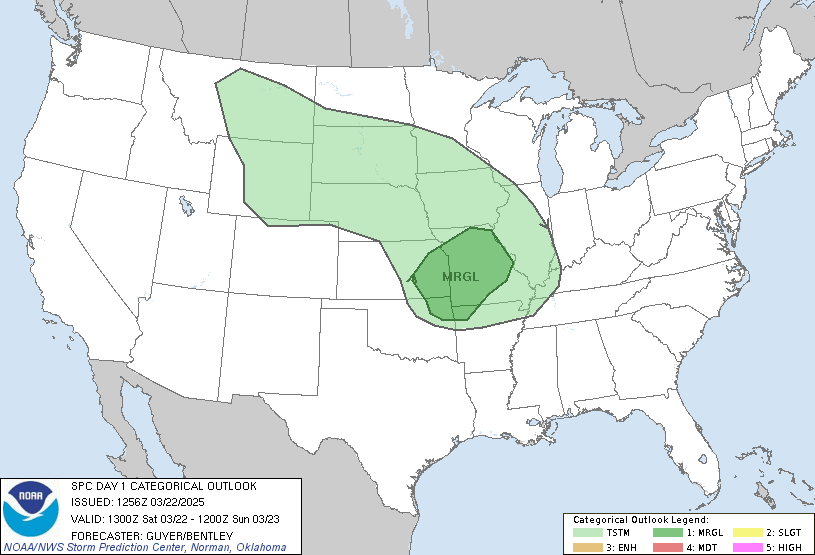
Notice the National Weather Service Storm Prediction Center's severe weather forecasts for today, Thursday and Friday. You may have observed they have an annoying tendency to be accurate these days.

The line from the Milwaukee/Sullivan weather office’s Hazardous Weather Outlook gives one pause: “Spotter activation may be needed through Friday evening.”

June 24, 2008

Hysterical News Story of the Day

The headline on this Associated Press story gives it away: “Everything seemingly is spinning out of control.” Based on this story, one hopes suicide hotlines are well staffed.

This story is an example either of the lack of fortitude of American culture today, or the excessive self-centeredness of American culture today — the idea that we are unique not just in the world, but in world history, that no one has ever dealt with anything worse than what we deal with today — or probably both. Why, as the story notes, “a barrel-scraping 17 percent of people surveyed believe the country is moving in the right direction,” the least since the survey in question began … in 2003.

That’s right. No previous generation in American history has ever had to deal with high gas prices, or bad weather, or or an ugly-looking presidential race. Any presidential scholar knows that Barack Obama and John McCain and their supporters are pikers compared with those who worked in, say, the presidential campaigns of 1796 (“His Rotundity” John Adams, accused of wanting to marry off one of his sons to one of King George III’s daughters to create an American monarchy, vs. Thomas Jefferson, described as “a mean-spirited, low-lived fellow, the son of a half-breed Indian squaw, sired by a Virginia mulatto father”), 1800 (by now, Adams had come to have “hideous hermaphroditical character,” and of Jefferson opponents wrote, “Great God of compassion and justice, shield my country from destruction”), 1828 (when one of the big issues was the wives of candidates Andrew Jackson and John Quincy Adams), 1860 (Abraham Lincoln, “horrid-looking wretch, sooty and scoundrelly in aspect, a cross between the nutmeg dealer, the horse-swapper and the nightman,” vs. Stephen Douglas, said to be “about five feet nothing in height and about the same in diameter the other way,” with only the Union itself at stake), 1876 (to get Rutherford Hayes all the Electoral College votes they could, the GOP agreed to end Reconstruction, which led to all the evils of the Jim Crow South), 1884 (Grover Cleveland, who fathered a child while he was not married, vs. James Blaine, who concluded a letter admitting to shady railroad dealings with the advice “Burn this letter!”, which was not followed) and 1928 (Republicans claimed the existence of a secret tunnel from New York City to the Vatican, through which the pope would advise Democratic candidate Al Smith).

No previous generation in American history has ever had to deal with inflation, or unemployment, or a weak dollar. No previous generation in world history has ever had to deal with the results of bad weather. Woe is us. One wonders what would happen in this country if we ever actually really had bad times, of the scope of the Great Depression.

The ridiculousness of this state of mind boggles the mind. My grandmother, who died last year at age 98, lived through, in her adult lifetime, the Great Depression and World War II, in addition to divorcing one husband and burying two others, and experiencing the death of her first grandchild before he reached two years old. My parents started a family in the midst of the bad days of the Cold War; they have vivid memories of the Berlin Wall crisis and the Cuban missile crisis, when there was good reason for thinking our way of life — maybe their actual lives — had just days remaining.

I was a history minor in college. After that, one of my duties at various newspapers I worked at was compiling that staple of small-town newspapering, the old-time news column. This was more interesting than I thought it would be at the time, because newspapers of the past serve as primary history, providing a window into popular thought of the time. Newspapers of the late 1930s were pretty foreboding reading as they chronicled our descent into the second world war of that generation. Newspapers of the 1940s not only noted war dead and injured, but increasing rationing, with every kind of raw material being diverted to the war effort. Newspapers of the 1960s were equally foreboding reading as opinion writers wondered what was becoming of a country where assassinations and riots were becoming commonplace.

Amity Shlaes’ book on the Great Depression and Franklin Roosevelt’s failures in dealing with it, The Forgotten Man, points out that many Americans in the 1930s saw the Great Depression as the new normal, not an economic downturn (though steep) caused and worsened by bad policy. In January 1938, with, after nearly five years of the New Deal, unemployment at 17.4 percent and the Dow Jones Industrial Average at 121, Shlaes writes, "There was a new sense of permanence about the Depression. Being poor was no longer a passing event — it was beginning to seem like a way of life. Roosevelt's prophecies about America seemed to be coming true — the country might be like old Europe, frontierless, something out of Dickens."

The one rational note in the AP story, from American University historian Allan J. Lichtman, points out that “the U.S. has endured comparable periods and worse, including the economic stagflation (stagnant growth combined with inflation) and Iran hostage crisis of 1980; the dawn of the Cold War, the Korean War and the hysterical hunts for domestic Communists in the late 1940s and early 1950s; and the Depression of the 1930s.”


You’ll note that we did in fact survive two World Wars, the seemingly-endless Great Depression, the Cold War and Jimmy Carter’s presidency. (My wife and I were born when Lyndon Johnson was president, and LBJ is someone whose legacy has gone decidedly downhill as time passes.) I suspect our country will even survive a Barack Obama presidency, though I am not eager to experience one. Gasoline prices of $4 per gallon, slow economic growth and Brett Favre’s retirement are not, I believe, a sign of the end times.

(For your future reference, the
end times will arrive on either Sept. 29 or Nov. 11, 2011, or sometime in 2012, or perhaps 2014, or 2016, or 2017, or 2023, or October 2028, or 2034, or 2038, or 2060, or 2076. Then again, the end-of-the-world predictions of 1925, 1954, 1990, 1997, 2000, 2001 and 2006 did not come to pass, nor did any of these predictions. Perhaps you should read Matthew 24:36 and Matthew 24:42 for further guidance.)

The flip side of this is that anyone expecting things to radically improve as the result of the election of any particular candidate in November is in for a dramatic disappointment. Our lives are still mostly up to us, or at least up to us in the really important areas. The mass media helps to make things seem worse than they actually are due to its focus on the coasts, which are subject to more economic ups and downs than those of us in flyover country. (The East and Gulf coasts also are subject to hurricanes.)

Life is shorter than we all think it is, and to waste a moment thinking about twaddle like this AP story is to spend a moment you’ll never get back.

Update: For those who pay attention to end-of-the-world predictions, this site suggests you not be in “southwest California” July 8. What is their evidence? Why, the fact that Florida beat Ohio State for the NCAA Division I football and basketball national championships.

June 23, 2008

Analysis of the Day

Robert Novak in the Washington Post about what should be the Republican Party’s 2008 contract with America, the entitlement reform plan of U.S. Rep. Paul Ryan (R–Janesville). The punch line:

Actually, to embrace Ryan's Roadmap requires more political insight than courage. … His constituents, who sent liberal Democrat Les Aspin to Congress for 22 years, are legendary “Reagan Democrats” who have soured on the GOP. Ryan believes they are far ahead of politicians in their alarm over entitlements. “Do we have the guts to act?” asks Ryan.

Ryan fears potential national disaster is ahead because we “will exceed the European extent of government and bring our economy to extinction.” He foresees the U.S. government share of the economy rising from 20 percent to a calamitous 40 percent by the time his three children (ages 3, 4 and 6) reach their 30s, requiring a doubled tax rate.

Temper Tantrum of the Month

Certainly, political party conventions are not the place to hear measured, thoughtful, two-way dialogue about the issues of the day.

But U.S. Rep. Steve Kagen (D–Appleton) apparently was channeling his inner two-year-old when he made this comment at the Democratic Party Convention in Stevens Point earlier this month: “They don’t belong in Washington, they don’t belong in our statehouses, they don’t belong in our local governments for centuries to come for what they’ve done to our country.” (Brought to you by The Appletonian.)

So are we to expect that Comrade Kagen will introduce a bill in the next Congress to arrest, try and imprison all Republicans? Or will he be satisfied with introducing a constitutional amendment to ban the Republican Party?

Kagen apparently is insufficiently intelligent or lacks enough sense to figure this out, so I’ll give him a piece of advice that costs much less than $3.899 per gallon: Democrats do not win elections in the Eighth Congressional District by getting out only the Democratic vote. For Kagen to win re-election, he will have to get Republican-leaning voters to vote for him. Kagen’s aforementioned burst of verbal diarrhea is not only unbecoming of a congressman, it is far beneath his constituents, at least half of whom are sympathetic toward the Republican Party.

June 20, 2008

Take me out to the ballgames

Any new parent learns quickly that your life doesn’t belong to you once you reach the delivery room. (Hospital delivery rooms probably should have a sign over the entrance: “Abandon Hope All Ye Who Enter Here.”)

One proof of that comes when your children reach the age to have activities of their own. Their schedule becomes your schedule, in part because none of our kids are old enough to drive, and in part because, after all, one parental obligation is attending your children’s events and getting otherwise involved.

Here was the week of June 9 at the Prestegards, incorporating only the periods when I was at home:
  • Monday: Soccer for Dylan (age 5) and Michael (age 8) starting at 5:30.
  • Tuesday: Shockingly, nothing was scheduled, other than dinner, laundry and getting kids to bed.
  • Wednesday: Following his last (half) day of school, baseball for Michael at 6 p.m. (With my wife working evenings, I had to get all three kids to his game, a process similar to herding cats, pushing pasta forward, or trying to figure out Barack Obama’s position on trade.)
  • Thursday: There was supposed to be baseball practice for Michael, but that got flooded out. So instead, we cleaned up the water in our basement, not exactly an athletic activity, though it is hard work.
  • Friday: Baseball for Michael at 6 p.m.
  • Saturday: Baseball practice for Michael at 8 a.m., followed by four baseball games in Beaver Dam starting at 11:30 a.m.
  • Sunday: Go to church, mow the grass, cookout with friends and their two daughters.
As hectic as that schedule appears, it is likely to get worse in future years. Dylan’s only sport this summer is soccer; he becomes eligible for T-ball next year if he wants to play. At 2, Shaena isn’t eligible for any sport other than watching her brothers and distracting her parents from watching her brothers. Summer school, including a session on football, starts in Ripon next week, Michael had a basketball camp this week and will have tennis lessons starting next week, the boys will be attending church camp, Michael has Cub Scout camp in July, our church has visitors from Costa Rica coming in July, there will be visits to grandparents … you get the picture. (For all I know, your schedule may be more hectic than this.) Weeks like the previously listed week might be why my wife and I enjoy watching “Hawaii Five-O” at 9 p.m. — not for the great stories or acting, but because it is the first opportunity to sit down with the kids in bed.

Having never lived in other parts of the U.S., I don’t know if areas of longer good weather try to compress this much into this relatively short window of time, less than three months between the end of school and the beginning of the next school year. (Regarding global climate change, if it improves Wisconsin’s weather, I’m all for it.) The aforementioned schedules don’t include any of those “enrichment” activities parents you read about in the Wall Street Journal or New York Times push on their kids — tutoring, language courses, long-term sleepaway camps, etc. — with the goal of getting into one of the élite colleges. (Our children are responsible for their own lives once they leave home.) Kids need to have time for things like riding bikes, playing in the park, squirting each other with water, and the long-term project of driving their parents insane.

Baseball is the star attraction this summer. In addition to the youth league team Michael’s on, another team of eight-year-old players has been formed in Ripon with the goal of, ultimately, improving the skills of the Ripon players who will be taking the field starting in the spring of 2016. This team played four games in Beaver Dam last Saturday, leaving the four Prestegards (Dylan was with his grandparents), plus all the other Ripon players and their parents, grandparents and other fans covered with a mix of suntan lotion, bug spray, dust, sand and sweat, semi-dehydrated by the sun and wind.

(For those of you unfamiliar with high school sports, this concept originated in Wisconsin with the state’s winningest basketball coach, Jerry Petitgoue of Cuba City. When Petitgoue was named coach at Cuba City in 1972, he determined that, for his players to have the skills he wanted them to have by the time they played for him, he and others needed to teach his future varsity players those skills as early as possible — as in first grade. By the time his players were freshmen at CCHS, those who were part of the entire program learned together how to play, with more skills and techniques added each year. Given that Petitgoue has won more than 700 games and three state championships in 37 years at Cuba City, I’d say he has a pretty good system. Other coaches think so, because his “feeder system” is now emulated in practically every team sport across Wisconsin and beyond.)

The upshot of this is that Michael will play at least 15 baseball games this summer (he has to miss one for church camp), which is five fewer than high school players are allowed to play. The great thing is that this is entirely his idea — my policy is to never ask him if he wants to practice; he does it or asks me to play catch himself. I’ve seen enough “Little League parents” over the years to know that that is not the way to conduct yourself as a parent. The only thing I insist on is that when he does baseball things, he do them the right way — particularly with his debut as a pitcher this summer.

(I’m living proof that athletic talent skips generations. My father was a member of his high school’s state champion half-mile relay team. My brother was a varsity swimmer in high school, and managed to juggle summer swimming and baseball. Other than two years sitting on the bench of my high school’s boys volleyball team and about four weeks sitting on the bench of a freshman basketball team, my talents were in … the band. Given this, you’d think that my body parts would had less hard mileage than your typical high school athlete, but then again I had five years in the University of Wisconsin Marching Band, which is definitely hard mileage. Also, I’m now 43, and there are few 43-year-old professional athletes.)

Of course, when the child gets involved, the parent has to get involved too, beyond just showing up. My generation grew up with fathers as coaches and mothers as chauffeurs, since women’s athletics had not formally arrived on the scene. (The mother of one of Michael’s teammates recently commented about how her son resisted her batting advice, which seems shortsighted other than the usual kids-ignoring-their-parents dynamic.) This summer, notwithstanding my absence of athletic talent, I’ve assisted with both of Michael’s teams. As a result, every joint on my right arm now makes noise, and I was limping around for a while after doing something to my left hamstring.

Then again, as Vince Lombardi said, you’ve got to be able to play with the little hurts.

Up next: Cardinals “at” Pirates at Murray Park in Ripon Friday at 6:15 p.m.

June 19, 2008

How to beat Democrats in November

At last, Republicans may have figured out a way to beat Democrats in November:

Focus on gas prices. (Or, as Investors Business Daily calls it, make the initials GOP stand for "Get Our Petroleum.")

The $3.949 that as of today appears on gas station signs in the Fox Cities, more so than any economic slowdown, is what voters will focus on in November. For most consumers, I think the biggest issue they face is not economic uncertainty with their jobs, it is how much gas prices affecting their lives, in that not only are gas prices making driving more expensive, they are making most things we buy more expensive.

It is true, as noted here before, that two major contributors to high oil prices are increased worldwide demand and the weakened dollar. But our current policies of drilling nowhere that we’re not drilling now within our borders are making things worse.

President Bush Wednesday threw the issue back in the hands of the Democratic-controlled Congress by pushing Congress to approve drilling offshore and in the Arctic National Wildlife Reserve, moving on development of oil shale, and allowing easier expansion of existing oil refineries.

“I know the Democratic leaders have opposed some of these policies in the past,” said Bush, who added that if Congress heads to their July 4 recess without taking action, Congress will need to explain why “$4 a gallon gasoline is not enough incentive for them to act. And Americans will rightly ask how high gas prices have to rise before the Democratic-controlled Congress will do something about it.”

One of those Democrats controlling Congress is U.S. Rep. Steve Kagen, M.D. (D–Appleton), who is getting hammered, and rightly so, by his Republican opponent, John Gard, for Kagen’s unusual combination of futile gestures and let-them-eat-cake attitude.

Kagen has been a complete dunce on the subject of high gas prices, and in ways that his more-conservative-than-he-is constituents probably are having trouble understanding. Just this year, he has (1) commanded Bush to stop making Strategic Petroleum Reserve purchases, something that, now that SPR purchases have stopped, has had zero apparent effect on gas prices; (2) got the House of Representatives to sign on to his idea to solve the gas price problem by suing OPEC, a truly moronic proposal; and (3) brought in Rep. Collin Peterson (D–Minnesota), chair of the House Agriculture Committee, to deliver the Jimmy Carteresque news that “We needed these higher prices to force us to change our ways.”

(Embarrassingly for Kagen, however, Peterson then departed from the Kagen hymnal by saying, “I’m for drilling, I’m for nuclear, I’m for coal, whatever it takes to get us out of the Middle East.” Evidently no one briefed Peterson on Kagen’s insight that the U.S. must “have an energy policy other than drill-and-burn.”)

This is all ironic given that Democrats tried to defeat Bush on gas prices in 2004, saying that Bush’s tax cuts were being sucked up by gas prices that had jumped over $2 a gallon earlier that year, and promised to do something about gas prices during the 2006 campaign. Well, Democrats certainly done something — since Democrats took over control of Congress in January 2007, gas prices have now increased 75 percent, and gas price increases may not be finished.

This issue is a winner for Republicans who take advantage of this issue. The Weekly Standard’s Fred Barnes points out that only 20 percent of voters surveyed in a Gallup Poll blame the oil companies for high prices (the Democrats’ standard campaign line), and 57 percent of those surveyed now favor drilling where drilling is not permitted. (I wonder what the result of that specific poll question would be in Wisconsin, where new drilling is banned under state law.)

John McCain is mostly right about energy, advocating drilling offshore and expanding refineries and use of nuclear power. (The phrase “nuclear power” appears nowhere on Kagen’s campaign site, which is pretty remarkable given that a nuclear power plant sits in his congressional district.) Barack Obama, to no one’s surprise, is almost completely wrong, focusing on policies that are guaranteed to make energy even more expensive and even more scarce, apparently kowtowing to his environmental buddies like Al Gore, user of enough energy at his house to power 19 average homes.

McCain, Obama and Kagen are wrong in thinking most voters care about climate change in an era where $50 won’t fill up your gas tank. A recent Wall Street Journal/NBC News poll places the percentage of voters who see energy and gas prices as their top issue at 18 percent, with the environment and global warming at 4 percent. Moreover, alternative energy, such as solar and wind power, that every candidate seems to tout will have zero effect on oil prices seeing as how oil isn’t used for electricity generation and fuel oil is decreasingly used for heating. (Electricity is obviously used for charging batteries, but the technology isn’t there to make electric cars feasible for actual families, and don’t hold your breath that will be anytime soon. In fact, there is alarming evidence that the real energy crisis isn’t in oil, it’s in electricity.)

For those who are concerned with the environment, it should be noted that hurricanes Katrina and Rita, which roared through the Gulf of Mexico and its oil rigs, produced not one single oil spill. Environmental regulations on oil drilling are much more stringent in the U.S. than they are in the Middle East. (And, in fact, the environmentalist left now finds itself having to rethink its knee-jerk opposition to offshore drilling.)

U.S. News and World Report’s James Pethokoulis advocates a new seven-step approach for McCain that is likely to resonate with voters far more than Obama’s and Democrats’ blame-America-first view of energy. (You may not know, for instance, that in the 35 years since the first energy crisis, U.S. consumption of oil has increased just 15 percent.) It is either naïve or ignorant to believe that the U.S. will ever get to a point where energy consumption will decrease from one year to the next — unless the economy stops growing, that is, and suggesting that the economy needs to shrink isn’t likely to be a winning assertion for Democrats.

Bush’s proposals are predicted to take several years to affect gas prices. I’m not sure that’s necessarily the case, though. If the world oil markets, speculators in which are partially blamed for high oil prices, get the signal that the U.S. is prepared to add supply on its own independent of OPEC, that could in fact deflate prices to some extent short-term.

Whether or not there is a short-term effect on gas prices, and whether or not energy independence is actually an achievable or desirable goal, if the Republicans actually want to win races this November, their winning issue is at the corner gas station.

June 18, 2008

A snapshot of the news media

On Monday I wrote about the death Friday of NBC-TV’s “Meet the Press” host Tim Russert.

Russert died Friday, which, in the news cycle world, allowed the electronic media to memorialize him, but not the print world, and its online versions. Some of their reactions came earlier this week, and they were not, to put it charitably, very kind, although they were more critical of the smotherage of Russert’s death than of Russert himself.

NBC and its half-sibling MSNBC did the most over the weekend, which isn’t surprising, given that Russert hosted “Meet the Press” on NBC and his own show on MSNBC. More surprising is the amount of coverage by Russert’s competitors, CBS (which opened its Friday news with his death), CNN, Fox and ABC. In an ordinary world, this would be considered respect for someone’s good work and good life — as the Los Angeles Times’ Tim Ruttan put it, for “the right man at the right time with the right technique.”

The opposing view started Monday with Orlando Sentinel writer Hal Boedecker, who began with a half-true statement that nonetheless comes across as nasty to Russert: “Here’s one thing you can say about journalists: Surely no one loves us as much as we love ourselves. That’s one lesson of the Tim Russert coverage.”

The half-true statement is “Surely no one loves as much as we love ourselves.” At the same time, though, no one hates the media as much as the media hates itself. (If the media could be condensed into a single person, psychotherapists could make a career of one patient.) Which is, I think, what some of the anti-Russert’s death coverage is about.

Boedecker tried to wear the sage-voice-of-the-newsroom cloak when he wrote, “People needed to be reminded about the Iowa floods — people are suffering on a grand scale there. But, of course, those people live far from the Washington Beltway, and so they won’t gain the vast air time accorded to journalists and politicians.”

Again, a half-true statement — heaven knows there is far too much non-news coverage of Washington and politics, something I think Russert grasped. (However, as demonstrated in the annual editions of the will-Brett-retire-or-not volumes, that phenomenon is not limited to politics, nor sports, if you recall the coverage of the death of Anna Nicole Smith, who was famous for, shall we say, her appearance.) A bigger problem with the news media is its mawkish voyeurism of someone else’s bad times, as if sticking a camera or microphone or notebook in the face of someone who is watching his accumulated life drown in his house will make everything better. How does watching TV coverage of the Iowa floods reduce the suffering of the people suffering through them?

Those who think coverage of Russert’s death was excessive should rewind to July 1999, when John F. Kennedy Jr. died in a plane crash. Cable news networks spent the entire day on the deathwatch of someone who was famous mainly because his father was famous and he was handsome with a glamorous wife.

Slate.com’s Jack Shafer writes for a publication that fancies itself as a cynical, ironic, smarter-than-thou observer of politics and life in general. (If Slate.com were a TV show, the lead character would be played by David Spade in his “Just Shoot Me” persona.) Shafer’s sense of self-importance oozes through in his negative assessment of the Russert death coverage:
I wonder whether the media grievers gave a moment of thought to how this Russert torrent they produced played with viewers and readers. Did the grievers really think Russert was so important, so vital to the nation’s course, and such an elevated human being that he deserved hour upon hour of tribute? I wonder whether any of the responsible journalists paused to think, Hey, this is really weird. We're using our unchecked editorial power to soak the nation with our tears about our friend, and that's unseemly! On days like this, I, too, hate the press.
Well, how did this play with viewers? The media is a bottom-line business, and the bottom line is ratings. Ratings for “Meet the Press” Sunday were almost 60 percent higher than for a typical Sunday, and second only to the “Meet the Press” that ran five days after Sept. 11, 2001. (And “Meet the Press” under Russert got the best ratings of any of the Sunday-morning political talk shows.)

This criticism strikes me as being unseemly given that it is about someone who hadn’t even had his funeral yet. Boedecker demonstrates that media people outside Washington can be every bit as snarky as those within the Beltway. And those who objected to the wall-to-wall coverage of Russert’s death, the solution, of course, was to change the channel.

I have discovered something odd about the media from being in the media for, now, 20 years: Celebrity. Just having your picture in a magazine on a regular basis, and making TV appearances from time to time, puts you on a first-name basis with people you don’t know, but who (think they) know you. I discovered this for the first time when I started appearing on the Wisconsin Public Television “WeekEnd” show an average of once a month starting in the late 1990s. People started coming up to me and saying they watched me on “WeekEnd,” a show that I thought was viewed by, perhaps, tens of people. Any of the news anchors on Green Bay TV have this happen much more than I have.

Russert, therefore, was “known” by many, many more people than he personally knew. (Perhaps his realization that this would be the case explains his initial reticence to host the show.) To regular viewers of “Meet the Press,” he was the constant through 17 years, three presidents, 9/11, the Iraq war and numerous traumatic or indecipherable events. He was the guy who asked questions they’d like to ask, who came across, despite his Democratic political background, as being the guy who would hammer Democrat or Republican for inconsistency or the inability to explain why the guest believed what the guest believed.

Russert also — and I think this is the big punch line of all this — had a life outside of journalism and outside of politics. I wrote Monday about his love of his father, his being married to the same woman for much longer than your typical big media type, and his love of his son. And if you’re not touched by this, I would check your heart to see if it’s still there.

One of the responses to Boedecker’s rant described the Russert death coverage as “almost as overdone as the Orlando Sentinel’s continuous lauding of Tim Tebow,” the Florida Gators’ Heisman Trophy-winning quarterback. (Next time, Hal, look in the mirror before you write.) One of the responses to Shafer’s screed quoted Shafer: “‘He was thoughtful. He was kind. Of the highest integrity. Generous. Loyal. And so on. Just because it's true doesn't make it news.’ Uh, these days the death of one with those qualities should make news.”

The tributes to Russert, I would argue, were not just a tribute to the quality of his work, but a tribute to his ability to have a life that was worth living outside of his work. And the critics of said tributes might just be jealous that they haven’t done anything in their careers, or their lives, worthy of such retrospective praise.

June 17, 2008

This column has a seven-second delay

No, I did not wake up on the wrong side of the bed this morning. I am writing, however, about obscenity, specifically obscenity in the broadcast media.

Obscenity in the broadcast media has been a favorite subject of the Federal Communications Commission during George W. Bush’s stay in the White House. The FCC has spent much of the 2000s going after things that, according to the Federal Communications Act of 1934 (which stipulates regulating the airwaves to the standard of “the public interest, convenience and necessity”) and FCC policy, shouldn’t be on the air — to wit, Cher’s disagreeing with negative reviews of her recent work in 2002, the witty repartée between “The Simple Life” stars Paris Hilton and Nicole Richie in 2003, U2 lead singer Bono’s expression of happiness at receiving a Golden Globe award in 2003, Janet Jackson’s exposure during the Super Bowl in 2004, and race car driver Dale Earnhardt Jr.’s reference to barnyard products after a NASCAR race that same year.

The FCC’s Web site has a primer on how obscene, indecent or profane one can be on the public airwaves. Those terms were created by Congress but defined by the FCC, which also is responsible for enforcing the law and prosecuting violations of that law.

This first demonstrates the problem with the FCC’s being ruled by political appointees. The FCC is run by five presidentially appointed commissioners, three of whom presently are Republicans. The next president will get to appoint an FCC commissioner almost immediately, and that could swing the commission’s view on naughty words on the air within the next year. The FCC became interested in obscenity issues while Ronald Reagan was president in the 1980s, became less interested when Bill Clinton was president in the 1990s, and then became interested again since Bush became president in 2001 — specifically, a $775,000 fine against Clear Channel over one of its employees, “Bubba the Love Sponge.”

A 2007 U.S. Court of Appeals decision invalidated the FCC’s tighter focus on obscenity, and of course the whole mess has ended up in the hands of the U.S. Supreme Court. As the Christian Science Monitor described it, the case “addresses a concern among some observers about a coarsening of American culture via greater use of crude and offensive language on television and radio. At the same time, it raises fundamental questions about the nation’s commitment to the First Amendment principle of free speech.”

Now that I’m a parent of school-age children, I feel the need to make sure that what’s on the radio when they’re in the car isn’t something they shouldn’t be hearing at their age. (Because, of course, kids never hear anything they shouldn’t hear at school, right?) So between our house and school, there’s no “Bob and Tom,” or Rick and Len, because one can’t tell if Bob and Tom might play “Prisoner of Love,” something I really don’t want to have to explain to my kids. And I can’t say I particularly appreciate the TV networks’ playing shows that parents might think are inappropriate for their kids to watch, say, before 9 p.m. Central time. (Tonight, for instance, Fox has “Moment of Truth,” rated TV-14, CW has “Beauty and the Geek,” rated TV-14, and E! has two episodes of “The Girls Next Door” at 7 p.m. TBS has four episodes of “Family Guy,” whose TV-14 rating may be inconsistent with its title.)

It is not, however, Bob and Tom’s responsibility to censor their content for those of more delicate sensibilities than mine. (For that matter, it’s not the job of a radio station to censor the lyrics of Van Morrison’s “Brown-Eyed Girl” or the Ozark Mountain Daredevils’ “Jackie Blue” because those songs’ lyrics includes the words “making love.”) It’s my responsibility as a parent, given the ages of our children, to make the decision on whether my kids should listen to it, and if I think they shouldn’t, the radio moves on to a different station. (Also, CDs are helpful, as long as you don’t play The Who’s “Who Are You” or Alanis Morissette’s “You Oughta Know.”) Clear Channel, who got the aforementioned $775,000 fine, created a company-wide Responsible Broadcasting Initiative while waiting for the FCC to decide on a definition of obscenity. Bubba the Love Sponge, the target of that fine, and the infamous Howard Stern now do their thing on satellite radio, which, as of now, is not regulated by the FCC.

Those who think the media cause our (by their definition) coarse culture are missing the point: The media more reflects the culture than creates the culture. Our culture has increasingly coarsened since the do-your-own-thing 1960s, and if anything, the media was behind the curve of the culture promoted by the Baby Boomers. One does not improve the culture through laws, regulations and mandates; the culture improves (however you define that) through individual acts, such as not watching dreck like, well, name your favorite "reality" show. The media is about money, first and foremost, and if people didn't watch "American Idol," "Survivor," "The Simple Life" or whatever other barnyard product, the media wouldn't produce those shows.

This demonstrates why I feel more libertarian than conservative most days. I don’t appreciate the government telling me what I can and cannot watch because what I might want to watch might offend others. And, as usually happens in situations like this, ridiculous lengths usually ensue, such as TV stations putting sporting events on seven-second delays just in case those great sideline microphones might catch a player or coach saying something others might not want to hear. (For instance, NFL referee Gerry Austin was caught during Super Bowl XXX telling someone — I thought it was another official, although it could have been a team official on the sidelines — to, “Goddammit, shut up!”)

All of this is likely to become an issue again, but in a different direction, should Barack Obama be elected president. Liberals with a weak commitment to the First Amendment have been itching to bring back the “Fairness Doctrine,” which held that, because the radio and TV airwaves are publicly owned, broadcasters were obligated to cover controversial issues and carry opposing viewpoints of those issues. The Reagan Administration created a “Fairness Report” in 1985 arguing that the Fairness Doctrine was a violation of the First Amendment and contrary to the public interest. Congress passed a law writing the Fairness Doctrine (which was an FCC policy, not law) into the federal statute books, but Reagan vetoed it, and it’s not been enforced since a U.S. Supreme Court decision in 1989.

It’s pretty transparent as to why liberals want to revive the “Fairness Doctrine.” Conservative or libertarian talk radio, such as Rush Limbaugh, Sean Hannity, and Journal Communications’ Charlie Sykes, is a financial and ratings success, which is why there is so much conservative talk radio. In contrast, liberal talk has been a financial and ratings flop on commercial radio, as demonstrated by the great financial difficulties of Air America and the death of the liberal talk shows of Mario Cuomo and Jim Hightower.

The “Fairness Doctrine” may have been a defensible idea in the infancy of television — in the days when, in the Green Bay TV market, TV viewers got only channels 2, 5, 11 and 38 — but as time has gone on, the concept of a “Fairness Doctrine” has become increasingly outmoded. The Reagan Administration’s argument in the 1980s was that, with the growth of cable TV, one could not say that the public airwaves were really scarce anymore. If that was the case in the 1980s, it is overwhelmingly the case today, with broadcast content coming from over-the-air radio, over-the-air TV, satellite radio, cable TV and the Internet.

One wonders why broadcast TV and radio should now be held to a different standard than satellite radio or cable — or, for that matter, newspapers, which have never been held to a fairness standard because that would be clearly contrary to the First Amendment. In the e-age, it’s about content, and if newspapers or magazines are allowed to print whatever they wish (subject to libel laws, which are enforced in civil courts), why should broadcast outlets not be able to say whatever they wish? How are restrictions or requirements about content not antithetical to the First Amendment?

In the portions of communications where there is scarcity (that is, the broadcast spectrum), it is reasonable to expect the FCC to regulate physical issues, such as making sure that one radio station doesn’t crank up its signal to blot out every other station in the area. Content should not be within the purview of the FCC, and it’s inconsistent to say that, for instance, you like the opportunity to listen to conservative talk radio, but you don’t like the opportunity to listen to Bob and Tom. Content is for the media outlet to create, and content is for the listener or viewer to decide to keep listening or watching or not.

June 16, 2008

How to think about unexpected death

One of the tributes to NBC-TV’s Tim Russert in today’s USA Today was written by Michael Gartner, the former president of NBC News, who hired Russert as NBC’s Washington bureau chief, and then as host of “Meet the Press”:

A few years ago, I called him and asked if he’d make a big speech in Des Moines, where I live. It was part of a lecture series at Drake University. I knew he was in great demand, I said, but I asked if he’d do it as a favor for me. “They’ll pay you $30,000,” I added. He didn’t think twice. “I’ll do it under one condition,” he said. “The $30,000 goes to that program for kids that is Christopher’s memorial.”

Christopher was one of my sons, and he idolized Tim. Christopher died in 1994, at age 17, from an initial attack of juvenile diabetes. I had left NBC by then, but within hours of Christopher’s death the phone rang at home in Des Moines. It was Russert. I was in tears, and he seemed to be, too. He expressed his deep sorrow, and then he said:

“Look, if God had come to you 17 years ago and said, ‘I’ll make you a bargain. I’ll give you a beautiful, wonderful, happy and healthy kid for 17 years, and then I’ll take him away, you would have made that deal in a second.”

He was right, of course, that was the deal. I just didn’t know it.

As it turns out, there was a similar deal — the terms were 58 years — with Tim.

We just didn’t know it.


About that recession …

Never mind.

Jones, McKay and Russert

A group of classic broadcasters died last week.

The probably least known of the three was Charlie Jones, a sports announcer for most of his career with NBC-TV. Jones, who died at 77 June 12, came to NBC from ABC when the American Football League switched networks to NBC in the mid-1960s.

Jones was a versatile announcer, covering, while at NBC, the NFL (he called the famous Packers–Steelers Yancey Thigpen game at the end of the 1995 season, the Packers’ first division title team with Brett Favre at the controls), a college football national championship game, baseball (he also was the first announcer for the Colorado Rockies), college basketball, Olympic track and field, golf, tennis, figure skating and other sports, including the 1970s oddity "Almost Anything Goes."

If you didn’t know who Jones was from his face, you knew him from his voice. Jones came from the generation whose voices were shaped by smoking and adult beverages. (The most notable example of this may have been the gravel-voiced Boston Celtics announcer Johnny Most, who smoked so much that he once set his own pants on fire during a Celtics game he was announcing.)

Despite that, if you’ve ever wondered why so many sports announcers lasted long into their 70s, or why there are so many second- and even third-generation sports announcers, it probably has to do with Jones’ quote: “I never felt like I ever went to work. I’ve got the best seat in the house.”

A memorial service is being held for him Wednesday at the La Jolla, Calif., Beach and Tennis Club, where, his will states, ties on men are banned.

The other, better known, sports announcer, was Jim McKay, who made the words “The thrill of victory … and the agony of defeat” a household phrase while hosting ABC-TV’s “Wide World of Sports.”

McKay, who died at 86 on June 7, introduced a lot of different sports (more than 100 in 40 countries, according to ESPN) to a lot of households. When “Wide World of Sports” debuted in 1961, sports on TV was basically limited to college or pro football, pro basketball and baseball, with a rare pro hockey game thrown in. “Wide World of Sports” introduced viewers to sports now shown on TV all the time, including golf (he announced each of the four majors, including the Masters for CBS, where he worked before he went to ABC), track and field, gymnastics, horse racing and auto racing, plus the Harlem Globetrotters, jumping various large objects with motorcycles, Irish hurling, lumberjack sports in northern Wisconsin, snowmobile races in northern Wisconsin, Mexican cliff diving, and Little League baseball. (He also announced perhaps the two most improbable U.S. Open golf wins of all time, both won by Wisconsinite Andy North. The two U.S. Opens were two of the three golf tournaments North won in his career.)

McKay also brought the Olympics to millions of TV viewers as the host of ABC winter and summer Olympics coverage. The worst, from anyone’s perspective, would be the 1972 kidnapping and murder of 11 Israeli athletes by Palestinian terrorists. McKay covered the entire 15-hour crisis and had the duty of announcing that all 11 had been killed — “They’re all gone,” he said.

The best, besides introducing U.S. viewers to gymnastics dynamos Olga Korbut, Nadia Comaneci and Mary Lou Retton, would have been hosting the 1980 Winter Olympics in Lake Placid, N.Y. This story has been told before, but the medal-round game between the U.S. and the Soviet Union was broadcast on tape delay, so McKay introduced that evening’s broadcast and the two intermissions while he must have been ready to explode inside, sitting on what might have been the greatest team sports upset of all time until the third period could be unfurled on tape.

McKay was one of a seemingly dwindling number of sports announcers who never, ever thought that he was bigger than whatever event he was covering. He never spoke down to viewers (unlike his ABC colleague Howard Cosell), but he also never treated whatever sport he was covering, however obscure, as being beneath him. To quote Sports Illustrated, he was “preironic,” someone who thought of sports as “fun than funny.”

The saddest media death of the past week was Tim Russert, host of NBC-TV’s “Meet the Press,” who died at NBC’s Washington studio Friday. Russert, 58, was the longest serving host of TV’s longest continuously running program (“Meet the Press” premiered in 1947).

Russert came to the media from politics, where he worked for New York Gov. Mario Cuomo and U.S. Sen. Daniel Patrick Moynihan. For that matter, he came to the media as an executive, not an on-air face, but his position included running NBC’s Washington bureau, with which came “Meet the Press.” When Russert took over “Meet the Press” at 41, the program had been on the air three years longer than Russert had been alive.

Cuomo and Moynihan were Democrats, yet Russert was rarely accused of liberal bias, although some of his interview subjects confused tough questioning for bias. Russert was famous for reading back, or playing back, quotes from whatever politician was on the hot seat that week when they were directly opposite whatever said politician was arguing at that moment. “Meet the Press” became known as the “Russert primary,” although, as with McKay, you never got the feeling he felt he was bigger than the story he was covering — in other words, he earned his status because he did the work, not because he was famous.

Russert’s most famous single moment came during NBC’s 2000 election night coverage, when he figured out that the key to the presidential election was going to be Florida. He grabbed a whiteboard at one point and wrote “FLORIDA FLORIDA FLORIDA” to emphasize his point. From that point on, we all got to learn about how presidential elections are really state elections and not national elections, butterfly ballots, hanging chads, people who lacked the sense of shame to not go on TV and admit they may have voted for Pat Buchanan instead of Al Gore, what happens when state Supreme Court races are partisan races, etc., etc., etc.

Russert obviously loved politics, but not to the exclusion of everything else. He wrote a best-selling book, Big Russ and Me: Father and Son: Lessons of Life, about his father, from whom he got his blue-collar work ethic and values. He was married for 25 years and had one son, Luke, with whom he had recently vacationed in Italy. Luke Russert said “Meet the Press” was Tim’s “second son,” though not his first-born son. An MSNBC tribute to Russert Saturday told the story of how he and Boston newspaper columnist Mike Barnacle had visited former NBC anchor Tom Brokaw and his wife in their home in Montana. Barnacle talked about Russert’s delight in discovering a bar known as the “Roadkill Café” (motto: “From your grille to our grill”) that had Russert’s preferred Rolling Rock beer.

As the Associated Press put it Sunday, “The abrupt void Russert leaves is unprecedented in network TV news. … There was no immediate word on who would host "Meet the Press" next week, or in the weeks after that.”

June 13, 2008

America’s sports car

My birthday earlier this month dawned without a Chevrolet Corvette in front of my house. (The Corvette you see to the right was featured at the 2007 Greater Milwaukee Auto Show. The copilot is my oldest son, Michael.)

Which isn’t surprising. I have three children eight and younger, and I have a house with a one-car garage. (Then again, this would be more practical, though a blatant pluck-your-eyes-out violation of the Corvette ethos. Of course, so was this.) I already had to purchase a car earlier this year (replacing a car with 228,000 miles and a cracked engine block, plus several other issues), and we try to limit our vehicle purchases to one per year. The reality is that I’m likely to be able to own a Corvette only if I get a visit from the Corvette Fairy, whose office is next door to the Easter Bunny.

(I hope this isn’t foreshadowing: When I interviewed Dave Richter of Valley Corvette for this month’s car enthusiast story, he said that the most popular Corvette in most fans’ minds was a Corvette built during their days in high school. This would be a problem for me in that I graduated from high school in 1983, when no Corvette was built.)

The Corvette is one of those cars whose existence may be difficult to understand within General Motors Corp. The Corvette is what is known as a “halo car,” a car that drives people into showrooms, even if the potential buyer is looking for something less expensive and more practical and useful than a Corvette. (Chrysler Corp.’s counterpart is the Dodge Viper, which reportedly may be on its way out in the next couple of years.) It is an oddity within Chevrolet, which has made most of its reputation on practical, though, dull cars, at least until the Corvette arrived in 1953 and the Chevrolet V-8 hit showrooms two years later. And yet, the 35 years the Corvette has been in existence, in good and bad economic times, has generated its own cult, with millions of fans backed by businesses geared toward preserving and restoring them.

The Corvette, in its first, second, third, fourth, fifth and now sixth iterations, started as GM’s response to the British and Italian sports cars, usually two-seat convertibles, that soldiers coming home from World War II were bringing with them. Over the years, Corvettes became stuffed with more power than their steering, brakes and handling could handle, adopted the most out-there styling perhaps in American automotive history, were nearly strangled by emissions regulations (the standard engine on the 1975 Corvette had just 165 horsepower), had killed and then brought back the convertible, and, by now, have the best combination of power and refinement for the price in the world — truly a world-class car, but not at world-class prices.

The first Corvette I remember seeing belonged to a neighbor down the street — a dark green 1970 coupe with the base engine, automatic transmission and AM/FM radio. It was, frankly, a scary looking car, sitting incredibly low to the ground and, to a six-year-old, looking as though it was going to bite you. I got a couple of rides in it, with my brother sitting in the passenger seat with me and the younger son of the car’s owner sitting on top of the console. (Can’t do that anymore.)

The first Corvette I drove was a 1969 coupe, but with a (conservatively rated) 435-horsepower V-8 that ran on racing or aviation gas and a four-speed transmission known by car buffs as the “rock-crusher.” It was a beast, particularly due to its lack of power steering and brakes and its ability to transfer prodigious amounts of engine heat into the cockpit. My ride in this car reached (I believe I can say this since the statute of limitations has passed) speedometer-indicated speeds that are multiples of existing speed limits. (During this ride, it occurred to me, as the scenery was going by at a really rapid rate, that I wasn’t wearing a seat belt. A moment later, it occurred to me that my lack of seat belt didn’t matter because if we hit anything at that speed, the authorities would be scraping up whatever was left of me from whatever we hit with a putty knife.)

The current and previous generations of Corvettes appear to be the best of the various worlds the Corvette has represented over the years. Styling is always an arguable point (I prefer the C5, built between 1997 and 2004, to the C6, which has been built since 2005; then again, if you really like a modern version of the C1 or C2, companies can now accommodate your wishes), but today’s Corvettes can go as fast as any that have been built before now. The difference is they handle and stop much better than any that have been built before now, and the obvious creature comforts — air conditioning, upper-end sound system, power leather seats, air bags — are either standard or, in the case of a navigation system, optional. With more than 5,000 Chevrolet dealers in the U.S., if something breaks, parts are much easier to find than for such brands as Porsche or Ferrari. (That’s not to say I don’t like Porsches or Ferraris — different strokes for different folks.)

For those who haven’t driven a Corvette, when you’re my height (6-foot-4), the overall effect is something like what driving a luge must be like. The first two generations were more conventional in design, but every Corvette since the C3 (based on the Mako Shark show car) has kind of wrapped around the occupants, which was initially criticized because that prevented the traditional American driver position of resting your left arm on top of the door (with window rolled down, of course), unless you’re tall enough. In every C5 or C6 convertible I’ve sat in at car shows, I look straight at the driver’s-side sun visor, so evidently I have to move the power seat to its lowest possible position to be able to drive the car. The result of that is that getting out requires what I had to do with my mother’s 1985 Chevy Camaro (which she owned when I was half my present age) — put my hand on the ground to brace myself to exit — or do a 90-degree left turn, stick my legs out and then get out legs first, with a limbo motion to clear the roof and stand up. (The current Corvette is about two-thirds of my height, and the seats are a long way down.) Clearly the Corvette is not a car in which to run errands.

If you like driving, this is it. It’s unquestionably a stiff-riding car, but much better than the older versions, and, as noted before, while it flies down the road like few other cars, it also will stop like few other cars. This is hyperbole to say this, but I wonder if anyone really can have a bad day if it begins and ends with a Corvette drive from your home to your office.

The Corvette hangs around GM in large part because it makes money and positive attention for GM. (Not until 1958, five years after it was introduced, did the Corvette make money for GM; in fact, Chevrolet made just 700 Corvettes in 1955.) The Corvette V-8s are found in several other GM cars, including the Pontiac G8 GT, plus several Australian Holdens (also available from Vauxhall in Britain and in the Middle East) and the upcoming Cadillac CTS-V (based on the CTS, a sedan that may be coming out in two-door and station wagon versions) and Chevrolet Camaro, assuming they actually build the Camaro. The Cadillac XLS is a Corvette under the body, although with the Cadillac Northstar engine instead of the Corvette’s.

Part of the reason for the Corvette’s popularity is the V-8 engine found in all but the first two model years. (V-8s sound much like V-twins, which is, I think, one reason for the popularity of the Harley–Davidson motorcycle over its Japanese and European competition.) Even though the first two years of Corvettes had a six-cylinder engine instead of a V-8, it’s almost impossible to imagine a Corvette without a V-8. The Corvette V-8 isn’t even the state of the art in V-8 technology (without getting too technical for non-gearheads), and yet the standard Corvette engine is rated at The 2009 Corvette ZR1, with 638 horsepower, is EPA-rated at 26 highway miles per gallon, 2 miles per gallon better than the 2008 Corvette ZO6, whose owners must make do with a mere 505 horsepower. (You can also save yourself $25,000 and purchase the base model Corvette, which, at 430 horsepower, costs $109.19 per horsepower, a better bargain than the ZO6’s $142.82 per horsepower.)

The ZR1 is supercharged, which is how you can get 638 horsepower and yet 26 mpg if you keep your foot out of it some of the time. (Remember: The most gas is used in acceleration, not at speed.) Future Corvette V-8s are likely to have more advanced engine technology and lower horsepower, but if the next-generation Vettes are lighter, they’ll have the same power-to-weight ratio, and possibly even better gas mileage. (As it is, the base Corvette gets better fuel economy than the four-cylinder Honda S2000 and the six-cylinder Nissan 350Z.) That makes it hard to imagine that any Corvette in the foreseeable future won’t have a V-8.

The Corvette generates interest that far exceeds its annual sales. In its biggest production year, 1979, Chevrolet sold 53,807 Corvettes, and in 2007 Chevy sold 40,561 Corvettes. Motor Trend magazine has a history of Corvette “scoops” (for instance, the breathless late 1973 announcement that there would be two Corvettes, both with rotary engines) that turn out to be way off base, but sell tons of issues on the newsstands anyway. Motor Trend predicted late in 2007 that the next-generation Corvette will arrive in the 2013 model year, one month after it predicted that the next-generation Corvette will arrive in the 2012 model year.

A substantial component of Corvette fans want Vettes to be more exotic, with, for instance, a mid-engine layout. (Most cars are, of course, front-engine, while a few, including the old Volkswagen Beetle and Porsche 911, are rear-engine; a mid-engine car has the engine mounted generally between the axles, usually in front of the rear axle.) A mid-engine layout seems unlikely because, for one thing, that would take the Corvette’s price well beyond $100,000, which doesn’t really fit into GM’s product portfolio. What’s more likely is that, as now, Chevy will make two versions — a “mainstream” version and a more exotic version with, for instance, lightweight materials and all-wheel drive, for perhaps twice the price of the base model.

Not everyone understands the appeal of Corvettes. (John McCain does; his first new car was a new 1958 Corvette. Former presidential candidate Joe Biden got a 1967 Corvette as a graduation present, and he still has it.) Think of Corvettes as a demonstration of what American free enterprise can do, even with federal government regulations, pressures from rising oil prices, and those nags who can't grasp why someone might need more horsepower than the nag thinks you need. The Corvette's overseas competition costs significantly more money, and that was even before the recent sinking dollar. American business has put together the best performing car for the money on the planet, and that's something worth celebrating — say, on National Corvette Day June 30, celebrating the day the first Corvette drove off the assembly line in St. Louis. That would be three days after June 27, Drive Your Corvette to Work Day.

(And for those of you who think after Thursday's weather that arks might be a better idea than Corvettes: You can buy a Corvette boat — specifically, a Malibu Corvette Sport-V Limited Edition, a boat with a Corvette engine and many Corvette trim parts. The reverse was the case in the early 1990s, when Mercury Marine's Mercruiser division produced the LT-5 V-8 for the Corvette ZR1.)

June 12, 2008

President Obama?

On Monday, I pointed out that to say that Barack Obama, who visits Kaukauna today, is preferable to Hillary Clinton is not the same thing as saying that Barack Obama is preferable to John McCain.

There are, in fact, at least two gigantic reasons to not vote for Obama — his inexperience and his overreach. His campaign is a curious mix of naïveté and arrogance, as typified by his bizarre assertion a week ago suggesting that, by his clinching the Democratic nomination for the presidency, “generations from now we will be able to look back and tell our children that this was the moment when we began to provide care for the sick and good jobs for the jobless. This was the moment when the rise of the oceans began to slow and our planet began to heal.”

Obama has been in the U.S. Senate for not even one full term. Before that, he was an Illinois state senator for eight years. Unlike, say, Louisiana Gov. Bobby Jindal, Obama has zero experience in anything approximating managerial-level experience in government. Obama’s most significant executive experience, in fact, is his
presidential campaign, which, once you look past the hype, has been something less than smooth or original, as seen in how Obama handled the controversy over his former pastor.

That controversy, incidentally, gets to the question of personal judgment (a persistent issue, you may recall, with the last Democrat in the White House), which is a subset of the experience issue. It is inconceivable that Obama could have sat in his church for 20 years, heard the Rev. Jeremiah “God damn America!” Wright, had his children in the same church, and then claim that, well, he wasn’t paying attention. Had any pastor of my church said something like that, either he would have left, or I would have left, and it wouldn’t have taken 20 years to figure out that Wright’s comments are inappropriate from a pulpit.

Obama not only has no legislative record, but his claim that he can bring people together is a crock. No one with as liberal a legislative record as Obama can prove that he has any interest in bipartisanship, unless his definition of “bipartisan” involves Republicans’ caving in to whatever Obama and Democrats want. (Which could happen if the predictions of a GOP Congressional disaster in November come true.) And, whether Obama likes it or not, his wife Michelle has some explaining to do for her apparent shame over being an American. (The precedent that, yes, presidents' spouses do matter was set by Obama's last opponent in the Democratic primary race.)

Who are Obama’s supporters? According to Project Vote Smart, they are the left-leaning National Farmers Union, Citizens for Tax Justice, Association of Community Organization for Reform Now, Citizens United for Rehabilitation of Errants (an anti-jail group), the National Education Association, Campaign for America’s Future (the words “left wing” should be in its title), Comprehensive Sustainable US Population (which claims that “many higher costs, inconveniences and hardships, inequities, and lowered quality of life and standard of living are due to people longages more than to resource shortages”),
Citizens for Global Solutions, State PIRGs Working Together, U.S. Public Interest Research Group, the AFL–CIO, the Service Employees International Union, American Federation of State, County and Municipal Employees, American Federation of Government Employees, Americans for Democratic Action, the Alliance for Retired Americans (an anti-Social Security reform group), and the Drum Major Institute for Public Policy (a “non-partisan, non-profit think tank providing ideas that fuel the progressive movement”).

On the other side, there is the National Taxpayers Union, Americans for Tax Reform, FreedomWorks, the National Tax Limitation Committee, the National Association of Manufacturers, the National Federation of Independent Business, Americans for Prosperity, the Club for Growth, the American Land Rights Association and Citizens Against Government Waste. The only remotely business-friendly group that gave Obama even a C grade was USA Engage, a pro-trade group.

The National Journal gave Obama a liberal composite score of 95.5 — higher than anyone in Congress — and a conservative composite score of 4.5 — lower than anyone in Congress. That doesn’t appear bipartisan, postpartisan, inclusive or unifying. Bill Clinton looks like a member of the Vast Right Wing Conspiracy compared with Obama, who seems to be patterning his views on Clinton’s Democratic predecessor in the White House, Jimmy Carter.

Obama is a native of Illinois, one of the two states of the U.S. famous for endemic corruption (in Illinois’ case, bipartisan corruption) in state government. We have read quite a bit already about Antoin “Tony” Rezko, fundraiser for five Obama political races who earlier this year was convicted of 16 corruption charges and faces a fraud trial next year.
The fact that Obama’s Democratic primary opponent, Hillary Clinton, no stranger to corruption herself, brought up all of Obama’s weaknesses during the recent campaign doesn’t make her charges less valid.

Moreover, if Obama’s words are to be believed, he appears to be ready to use the courts to enact revenge upon his White House predecessors upon arriving at the White House, including, yes, war crimes trials. As American Thinker’s Thomas Lifson puts it, “This kind of change — putting your predecessors on trial for their conduct of policy — may not be what most Americans really want or expect from someone with Obama’s gauzy rhetoric of unity. But unity has a dark side in the hands of people who regard their opponents as criminals. America has two centuries-plus of history lacking the totalitarian practice of jailing the predecessors when a new president takes office.” And Obama and his supporters better realize that the next Republican president will have all the incentive in the world to do the same thing to his or her Democratic predecessors, permanently poisoning our politics.

I'd love it, by the way, if a Democrat running for president grasped the fact that free markets are far superior to government control, because free markets and freedom are too important to be entrusted to one political party. As First Trust Portfolios chief economist Brian Wesbury put it in Wednesday’s Wall Street Journal,
“In contrast to what some people seem to believe, having the government take over the health-care system is not change. It's just a culmination of previous moves by government. And the areas with the worst problems today are areas that have the most government interference — education, health care and energy. … In the midst of all the natural change, the last thing the U.S. economy needs is more government involvement, whether it's called change or not.”

This is the third, and I’ll bet not the last, time I’ll bring up the sage words of Ben Stein, whose news bulletin points out that we are in fact responsible for our own lives, not Obama nor John McCain nor any other past or future presidential candidate. This Barack Obama Superstar thing that seems to be going on among the most gushing of his admirers is going to leave a lot of disappointed people in its wake if Obama is elected president. Every president, you see, is a disappointment because, at some point, every president (for that matter, every presidential candidate) compromises. Neither Obama nor McCain nor Bob Barr nor Ralph Nader nor anyone else will actually “give us change, offer us hope, make our breath sweeter, make us more prosperous, more productive, happier, better educated, and healthier if we cast our votes for him or her.”

Cynical? Yes. Reality? Yes.

June 11, 2008

Just what we need

The National Weather Service Storm Prediction Center says another round of severe weather could be headed our way Thursday.

Depending on which forecast you read, we could get up to 1 to 3 inches of rain Thursday, in addition to the severe weather accouterments of hail and high winds. You’ll note that the southeast quarter of Wisconsin is in the sky-blue-hatched area indicating “10 percent or greater probability of significant severe weather within 25 miles of a point.”

Last week, of course, parts of this area were under tornado watches for three consecutive days and under severe weather watches (tornado or severe thunderstorm watches) for four consecutive days, which I can’t remember happening before this year. Unless you’re trying to build a lake, tomorrow’s forecast is not good news for those who live in Brown, Calumet, Fond du Lac, Green Lake, Kewaunee, Manitowoc, Marquette, Outagamie, Sheboygan, Waupaca and Waushara counties, all of which got a lot of rain last weekend, and all of which are under a flash flood watch through Thursday night or Friday morning.

School’s out for summer

First, the Song of the Day, for reasons stated two paragraphs from now. I wonder if, when Alice Cooper (who will be at Oshkosh’s Waterfest Aug. 28) wrote “School’s Out,” he realized what an anthem his 1972 song would become.

The best verse:
Well we got no class
And we got no principals
And we got no innocence
We can’t even think of a word that rhymes
!
Today is the final day of classes in the Ripon Area School District, where I live. Classes had to be held today because of more cancellations, late arrivals and early dismissals than were accounted for in the school district's calendar, which, by state law, is required to include 175 days of face-to-face instruction and 1,137 hours of instruction. (The cynic in me — and remember, I have three children, two of whom are in school — wonders if there’s an element of keeping children out of their parents’ hair longer in the state law.)

If that isn’t proof of overreaching state government, I don’t know what is. State legislators several years ago mandated that classes begin no earlier than Sept. 1 (usually the day after Labor Day), a move obviously designed to benefit tourism. It’s not clear to me, though, why it’s better for schools to stay open far past Memorial Day weekend, the traditional start of the summer tourism season. Even stranger is the fact that, in many school districts, graduation is held on Memorial Day weekend, but the rest of the students are required to go until the end of classes.

This is the point where the phenomenon I call “tyranny of the experts” comes in. It is remarkable to me how prickly and arrogant many people in education are when you dare question anything they’re doing, even though they are doing whatever they are doing with your tax dollars. Take, for instance, this word from Richard Zimman, administrator of the Ripon Area School District, from the district’s fall 2007 newsletter:
The effort to maintain quality schools takes endless effort and planning. This is especially true with the 14-year-old state funding law that forces annual school budgets to lag behind the normal inflationary increase in operating costs.
Reading through the newsletter reveals complaints about the state’s school funding system (“School Funding Law Squeezes District”) with simultaneous bragging about reducing taxes (“School Taxes Drop Again — Board Cuts Mill* Rate by 55 Cents”) and about what a swell job they’re doing teaching the kids (“Ripon Ranks #1 in ACT Exam Scores,” which appears to be a ranking in the area, not in the state or even in the region).

* That, by the way, is a misspelling — the correct term is ”mil rate,” short for “millage rate.”

More examples of this I-am-the-expert attitude can be found in the Wisconsin Education Association Council and its bought-and-paid-for state government subsidiary, the Department of Public Instruction. WEAC complains about spending limits, just like the Superintendent of Public Instruction does. Both blather on about what great schools we have; neither gives credit to the people who are funding those schools, many of whom don’t even have children in those schools.

This is not limited to Wisconsin, as this rant from something called Georgia Women Vote! demonstrates:
… Staggering dropout rates, scarce resources, bottom-of-the-barrel SAT scores and all other ills that plague Georgia schools will be resolved if only we put parents in charge. Professional training and schooling are not necessary to become an expert on education. Either election to the General Assembly or childbirth, both equally painful, will do the trick.
Put it this way: Any business with this arrogant an attitude toward its customers is not destined for a long life. A little more respect to the people who are paying teachers' salaries (the largest component of school district budgets by far) and extra taxes to pay for new school buildings would help. That appears to be absent in relations between schools and taxpayers in Wisconsin today.

But in a sense this isn’t surprising because of one reality not many people realize about education, but one I saw in my nearly seven years working in education, along with several years as a newspaper education reporter and, for that matter, four years as the father of a school-age child. Readers of Marketplace are obviously focused on results — revenues, expenses and profits, to name the three most obvious metrics. Educators focus on process — how you teach, more than what kind of results you get from your teaching. The truth is that teachers are only part of the educational process — students from bad environments, however you define that, will find learning harder than students from homes where education is valued. That’s something that school districts that crow about their high test scores should remember. Then again, that’s also something that those who complain about low-performing schools should remember — bad teachers are a big factor, but not the only factor.

And yes, as there are good teachers, there are bad teachers too. The single biggest negative of teacher unions is not that they advocate spending every last tax dollar (existing or potential new tax dollars) there is on schools. It is that they protect their worst teachers from what would happen if those bad teachers were part of the business world — firing for incompetence. I’m repeating myself since I’ve written this before, but: Good teachers should be paid more, and bad teachers should be fired. (Even those who are sympathetic to the union cause don't understand why public employees, including teachers, should be allowed to have labor unions — generally, the term "professional" and "labor union" don't belong in the same sentence — but I'm guessing that train left the station decades ago.

Perhaps the time has come for a grand bargain: Teachers give up their union rights (which really don't benefit teachers of average quality or better) and come back to reality in employee benefits in exchange for the state's reducing its micromanaging of schools and letting teachers and principals teach how they see best. If a school district wants to have classes all year, it should have the right to do that. If a school district wants to change the traditional schedule in some other way, it should have the right to do that. If a school district wants to specialize in a particular curriculum area district-wide, it should have the right to do that, subject to approval of that school district's taxpayers.

It's not clear to me that such state initiatives as the DPI's 20 Standards (that was the new thing when I started in journalism 20 years ago) and the federal No Child Left Behind Act have improved education. Assessments of how you're doing tend to focus only on the process and not the results, for reasons stated earlier. If you combined real educational reform with real school choice — parents having the choice of not just any public school in the state, but any school in the state — parents will be able to vote with their feet about what kind of education they want their children to have.

June 10, 2008

The Hall of Fame CEO

The Brown County United Way will honor one of the most successful CEOs in Green Bay June 12.

That CEO is Bob Harlan, president of the Green Bay Packers from 1989 until the end of the 2007 football season. The “Evening of Memories with Bob Harlan” will be held in the Lambeau Field Atrium, which Harlan helped build, June 12.

Harlan, of course, didn’t play one down of Packers football, and he didn’t make one coaching decision in his 37 years with the Packers. It’s notable, though, that between 1993 and 2007, the Packers had the best record of any NFL team, and the team had 13 consecutive seasons and 15 of 16 seasons with a record of .500 or better. In a league where teams go from getting to the Super Bowl to missing the playoffs entirely in the space of one season, that’s a notable accomplishment of consistent success.

What’s more notable is the Packers’ financial strength, thanks in large part to the $295 million Lambeau Field renovation, which accomplished the nearly impossible task of creating more places for fans to spend money without losing the tradition of Lambeau Field. The Packers have had many more national TV appearances at home than has been warranted for their record; part of the reason was retired quarterback Brett Favre, but part of it was the ambiance that John Madden has waxed eloquent about for nearly 30 years on CBS, ABC and NBC.

The Lambeau Field project is one example of how Harlan didn’t shy away from difficult or controversial decisions. He decided late in the 1994 season that the Packers needed to stop playing games at Milwaukee County Stadium — in part because the Brewers were trying to get a new stadium built, but mostly because of the financial hit the Packers took every time they played in Milwaukee. (This may be hard to believe in the era of perennial sellouts, but Milwaukee games often required the purchase of remaining tickets by the TV station carrying the game to have the game on TV. The NFL requires games to be sold out 72 hours in advance — never an issue in Green Bay, but Minnesota and Detroit occasionally have non-televised games.)

Harlan fired one general manager, Tom Braatz, replacing him with Ron Wolf. (I think that move worked out OK.) He also signed off on giving general manager duties to Mike Sherman, then took them away when the dual GM/coach role didn’t appear to be working out. Giving both jobs to Sherman was in retrospect the wrong decision, though there was little complaint about the decision among the chattering classes at the time.

The decision to expand Lambeau Field, the most extensive renovation project for any major professional sports stadium to date, involved balancing two factors — the tradition and history of Lambeau Field, and the reality of teams opening new stadiums and their associated revenue, which, unlike TV and merchandise sale revenues, teams didn’t have to share with their NFL brethren.

Some might say that being the Packers’ CEO couldn’t have been a very difficult job with all the TV money coming in. To that, consider the following list of teams that moved during Harlan’s time with the Packers: The Raiders moved from Oakland to Los Angeles and then back to Oakland, the Colts moved from Baltimore to Indianapolis, the Cardinals moved from St. Louis to Arizona, the Cleveland Browns moved to Baltimore (replaced in Cleveland by an expansion franchise), the Houston Oilers moved to Tennessee (replaced in Houston by an expansion franchise), and the Rams moved from Los Angeles to Anaheim, then to St. Louis, replaced by … no one, yet.

In each case, teams that were well established in their home markets (well, except for the Raiders, the franchise on wheels), pulled up stakes (in the Colts’ case, in the middle of the night) and left for what they thought were greener pastures, leaving heartbroken fans in their wake.

Opponents of the Lambeau Field expansion (or, more accurately, opponents of taxpayers’ paying for it) claimed that there was never any danger of the Packers’ emulating the Raiders, Colts, Cardinals, Browns, Oilers and Rams in leaving. That was technically correct but factually incorrect. Certainly the Packers’ board of directors would never vote to move the franchise to, say, Los Angeles. However, the NFL did nothing to stop all those aforementioned franchise moves, since each of them was to bring more money into the NFL — in professional sports, as we’ve seen more times than you can count, money trumps tradition almost every time. Since the Packers’ franchise is part of the NFL, the NFL certainly could have pulled the plug on the franchise, held a dispersal draft to move the players to the remaining 31 teams, then awarded an expansion franchise to cover the hole.

I’ve interviewed Harlan a number of times. Every time I asked him about his philosophy of management, it’s been, essentially, to hire good people and let them do their jobs — he provided input where asked, but he didn’t meddle. That sounds like an obvious concept, and yet it’s amazing how often that advice isn’t followed, particularly in professional sports.

Harlan also displayed a notable unwillingness to adhere to the status quo at a time when, despite the Packers’ lack of on-field success, they were still selling out games; had he thought success was based only on attendance, he would not have fired Braatz in favor of Wolf. Building the Don Hutson Center and previous Lambeau Field and practice facility enhancements demonstrated that being in the smallest market in major pro sports didn’t mean team facilities wouldn’t match the best the NFL had to offer.

Professional franchises don’t have a huge history of success in Wisconsin. The Milwaukee Brewers had six consecutive winning seasons between 1978 (eight years after they moved from Seattle) and 1983 (including playoff seasons in 1981 and 1982), and only five winning seasons and no playoff berths since ’83. The Milwaukee Bucks (an expansion franchise created after the Milwaukee Hawks moved to St. Louis in 1955) have won 53 percent of their games, but have had one successful season this decade. In contrast, the Packers are not only the most successful pro sports team in Wisconsin, they have the largest following by far, as evidenced by the number of radio stations that carry both the Brewers and Packers, but dump the Sunday Brewers game when it interferes with the Packers.

There is an old Boy Scouts saying that people should leave a place in better condition than they found it. Harlan certainly did that. Harlan is a member of the Packers Hall of Fame; he should probably be in the NFL Hall of Fame as well.

June 9, 2008

And take Slick Willie with you

Over the weekend, Hillary Clinton pulled the plug on her presidential bid ... we think.

To say that Barack Obama is preferable to Hillary Clinton is not the same thing as saying that Barack Obama is preferable to John McCain. (More on that point Thursday.) However, here's hoping that Clinton's defeat marks the end of the Clintons as a political force in this country.

The most important letter in the word "Clinton" is the letter I. This space has long advocated a more cynical view toward politicians, but everything negative you believe about politicians can be seen in the Clintons. Though politicians are stereotypically said to be willing to do anything to get elected or re-elected, the Clintons are willing to do anything to get elected. Remember the "permanent campaign"? Bill Clinton's 1990s complaints about the "politics of personal destruction" were simply the echo chamber throwing his own strategy back at him. The Clintons attracted scandal (Whitewater, the Travel Office, various bimbo eruptions, etc., etc., etc.) like magnets attract metal, despite all their media sycophants who parroted off-the-record comments about how brilliant Bill's politics were, and if anything, it's gotten worse with Hillary's chief political advisor. (For Bill’s reaction to that devastating Vanity Fair piece, read this.) Had I suggested before Saturday that Hillary Clinton was going to bolt the Democratic Party and run as a third-party candidate for president, you might have been able to think of valid reasons for her to not do that, but you probably wouldn't have been surprised at such a self-centered move.

It's become obvious that the Clinton magic is gone, if in fact it really existed. Let's remember that Bill Clinton's first two years in office went so well that the Democrats lost control of both houses of Congress after the 1994 elections, never to get them back during Clinton's term in office. A large reason that happened is, of course, Hillary Clinton's health care plan, which even Democrats in Congress could see wasn't going to work. Bill Clinton was such a popular president that he failed to get a majority vote during either of his elections, even though aided in his first election by a third-party candidate who siphoned more votes from George H.W. Bush than he did from Clinton, and even though aided in his second election by a Republican Party that essentially conceded the election right after it selected a candidate. Unlike Ronald Reagan, who was successful in getting his vice president, George H.W. Bush, elected, Clinton could not get his vice president, Al Gore, elected. (Thankfully for all of us.)

Clinton's successes as president, beginning with the North American Free Trade Agreement, were largely due to Republicans, who prevented him from trying much more stupid ideas when they took over Congress. The canard that Clinton was responsible for the economy we all enjoyed through most of the 1990s comes from people who don't grasp that American business, not Clinton, fueled the 1990s expansion. (The only economic expansion Clinton fueled was among lawyers.)

Hillary Clinton, meanwhile, was simply disastrous as a candidate. She has none of her husband's positives (his ability to appear as though he cares about the person to whom he's speaking, his interest in finding common ground with selected political enemies), and most (obviously not all) of her husband's weaknesses. The same person who touted the (unconstitutional) assault weapons ban during her husband's presidency suddenly became a Second Amendment fan because it suited her candidacy. Recall how often her "accent" changed during the campaign? Recall those crocodile tears in New Hampshire?

What's worse is that Hillary Clinton abandoned the things that made Bill Clinton less objectionable than most other Democrats — mainly free trade and support of investment-related tax cuts — positions, incidentally, that Bill Clinton had as a primary candidate. Had Clinton gotten elected (and note that first paragraph), she would have been well to the left of her husband when he was president.

Hillary Clinton is, interestingly, the Democratic version of Richard Nixon — a person uncomfortable in her own skin. As author Camille Paglia puts it:
Though she would specialize in women's and children's issues, Hillary's public statements have often betrayed an ambivalence about women who chose a non-feminist path. "I suppose I could have stayed home and baked cookies," she sneered during Bill's 1992 presidential campaign. Then, defending her husband against the claims of a 12-year affair by Gennifer Flowers, Hillary snapped: "I'm not sittin' here like some little woman, standing by my man like Tammy Wynette" - a sally that boomeranged when Hillary had to make an abject apology. The irony is that Hillary had offended the very group of stoical, put-upon, working-class women who are now proving to be her staunchest supporters. ...

The argument, therefore, that Hillary's candidacy marks the zenith of modern feminism is specious. Feminism is not well served by her surrogates' constant tactic of attributing all opposition to her as a function of entrenched sexism. Well into her second term as a U.S. Senator, Hillary lacks a single example of major legislative achievement. Her career has consisted of fundraising, meet-and-greets and speeches around the world expressing support for women's rights.
It is the lament of the loser for Hillary Clinton's supporters to claim that she lost because of sexism. The Democratic primary race was pretty much the Democratic Party at its identity politics zenith, appealing to the aggrieved instead of to the actual voter, who may be facing economic strains, but who will not be well served by positions within the mainstream of the Democratic primary season such as universal health care (imagine your health care being provided by the Internal Revenue Service or the Division of Motor Vehicles). Voters are willing to vote for a woman for president; not enough voters were willing to vote for that woman for president, particularly with the Boeing 747 of baggage the Clintons bring with them. (Go back to that link and note the irony of complaints of "blatant sexism" by the creator of Emily's List, which raises money for women political candidates, as long as they're Democratic women who favor abortion rights.)

Obama should choose Hillary Clinton as his running mate only if he wants to guarantee losing. I think he's smarter than that, but he may not be. The Clintons are not only bad people, they are like vampires, so if Obama wins in November, expect to see one or both of the Clintons in other places where they can do actual damage to our country — the Supreme Court or the United Nations, for instance.

The better thing for our country would be for Hillary to announce she's not running for re-election to the U.S. Senate and for the Clintons and their Sherman's-march-to-Atlanta politics to go away. The fact that every campaign for president and most campaigns for U.S. senator or governor now look like a years-long slog through a mud bog is the Clintons' real legacy.

Official photo from HillaryClinton.com.

June 6, 2008

Fit to be (un)tied

A follow-up to the blog about ties: The Wall Street Journal reports that the Men's Dress Furnishings Association, the trade group for U.S. tie manufacturers, is disbanding due to a continuing decrease in tie-wearing.

It does not help your cause if you are a tiemaker, interviewed while wearing "shorts, flip-flops and a polo shirt," and you say to the reporter, "We make ties for other people so we don't have to wear them." Or if you are designer Tom Ford, who retails silk ties for $195, and you say to a reporter when asked why you're not wearing a tie, "It was giving me a migraine. You can wear a tailored suit without a tie and look sexy, too. You don't need the tie."

As the story points out, "The problem for neckwear designers, as for regular guys, is that a tie no longer automatically conveys the authority and respectability it once did, even if it does cause some people to call you sir. In fact, it can be a symbol of subservience and of trying too hard."

Sigh.

Adventures in radio

This year marks my 20th anniversary in the full-time work world. It also marks 20 years since I started broadcasting sports as a side interest, something I had wanted to since I started listening to games on radio and watching on TV, and then actually attending games.

If you ask someone who's worked in radio for some time about the late '70s TV series "WKRP in Cincinnati," most of them will tell you that, if anything, the series understated how wacky working in radio can be. Perhaps the funniest episode in the history of TV is the "WKRP" episode, based on a true story, about the fictional radio station's Thanksgiving promotion — throwing live turkeys out of a helicopter under the mistaken belief that, in the words of WKRP owner Arthur Carlson, "As God is my witness, I thought turkeys could fly."

I've never been involved in anything like that. I have announced games from the roofs of press boxes (fortunately on a nice day), from a Mississippi River bluff (more on that later), and from the front row of the second balcony of the University of Wisconsin Fieldhouse (great view, but not a place to go if you have vertigo). Even though I've never worked full-time in radio, for some reason I've had enough strange things happen to me during radio games to write a book — or this blog entry.

The second year I was doing games, I had a Friday afternoon football game followed by a Saturday afternoon football game — that is, until I got thrown into a Friday night game when the scheduled announcer chose the day before to have an emergency appendectomy. (Having had one 25 years ago, I can tell you that in those days, all appendectomies were emergencies.) Game number two was difficult enough in that I was announcing the team in the town where the radio station was, having not seen them play yet. The only score of the game was an interception return, and so, since I spent the time I'd usually take to memorize rosters driving from afternoon game site to night game site, I called the visiting team's defensive back's making like Al Harris against Seattle racing down the sidelines, not being able to identify him until he reached the end zone and I had a moment to look at the roster to identify him.

The next afternoon came game number three at a former Lutheran high school in Prairie du Chien (before that a Catholic high school, and now a prison for juveniles) where a game had never been broadcast before that day. The "press box" was just a table at the top of the bleachers where the public address announcer and scoreboard operator sat. No problem there; we just set up in front of the press table, which was equipped with speakers for the PA announcer. That proved to be a big problem, because the PA announcer fancied himself a play-by-play guy, and so every time we tried to call a play, he'd overpower us on the radio. ("On first down, a handoff to Jason JASON BRINKMAN ON THE RUNNING PLAY!") We should have given him our game checks.

Five months later, I was announcing the last regular season basketball game between two archrivals; the home team could have been part of a three-way split for the conference title had they beaten the visitors, who had clinched a share of the title already. The home team picked a bad night to have a bad night, and toward the end of the game, I described on-air a group of people being told by the referees to leave the gymnasium due to their comments about his officiating. It was more than a year later when I found out who made those comments — they turned out to be some of the people who became my in-laws.

I then left southwest Wisconsin only to return to the radio a few years later, when, in a casual conversation with the radio station's news and sports director, he asked me if I wanted to do games that fall. At the time, I was living in Appleton, about four hours away from said games. However, gas was a good deal less than $4 a gallon, I had the ability to get off work early, we had no children to deal with, and we could stay the weekend with the in-laws, so, for two years, my wife and I would get off work around 2 p.m., race home, hit the road for southwest Wisconsin and, four hours later, arrive at the game site to announce that week's game. (That arrangement paved the way for the single oddest thing that happened to me in radio sports, which comes up in just a few paragraphs.)

I will probably spend time in Purgatory for this next story: At the end of the first year of this arrangement, I had a state semifinal football game to announce involving one of the teams the radio station covered. The game was at Sauk Prairie, so I drove from Appleton to Beaver Dam, and then my wife drove while I studied rosters and game notes. I also picked up that day's issue of the Wisconsin State Journal, which had a story about the game we were announcing, noting that the opponent was inspired by the death of the father of one of the players earlier that year. That team indeed won in overtime, the second time in my career that I had been stopped from the chance of doing a state championship game at Camp Randall Stadium in Madison. And on the way out to our car (fortunately out of the earshot of the winner's fans), I muttered about the unfairness of using the dead for inspiration, thus creating the phrase "Dead Guy Game" in my lexicon. (Some time later, I heard that a sports correspondent who covered the team we were announcing suggested in jest that if that's what it took to get to state, his own team's fans could have arranged to kill their own coach.)

The first round of the high school football playoffs in Wisconsin is traditionally the Tuesday after the regular season ends. So, in year two, I left work early on that Tuesday, drove four hours west, announced a playoff game, and then drove back to Appleton, arriving at 1:50 a.m., in time for a whole five hours of sleep before I had to go back to work.

I got to repeat that arrangement a couple years later, when I went from Ripon to Portage to call in highlights for one playoff game, then drove to De Soto, which is on the Mississippi River, to announce another playoff game that night. I had been warned that the setting for that game was, shall we say, interesting — De Soto had a small press box/concessions stand/ticket booth, so our game location was outside next to the press box, at the top of the bluff below which sat the football field. We were higher than the lights, and sections of bleachers below us were roped off due to falling rocks. We were told that games had been interrupted in the past by deer who would wander through the woods behind the football field onto the field. After announcing in that interesting setting (which became really interesting when the fog rolled in), I of course jumped back in the car and headed back to Ripon (making it a 300-mile day), because I had to take my wife to Outagamie County Airport for her 8 a.m. flight the next day. The only thing that made that trip work was the fact that it happened to be the weekend when Daylight Saving Time ended, so I at least got one more hour of sleep than usual.

After those two years of games every weekend, I'd be asked to occasionally call games during periods where the radio station had more games than available announcers — for instance, the postseason if more than one team went far in the playoffs. One day after the March 1998 blizzard that dumped 28 inches of snow in Wautoma, I had to go to Mineral Point for a basketball sectional semifinal game. The problem was the roads were so bad that it took more than two hours to get from Appleton to Beaver Dam, where I stopped and called the radio station and told them I might not make it to the game on time because the roads were so bad. However, once I headed southwest on U.S. 151 again, there was absolutely no snow or ice on the ground. I got from Beaver Dam to Mineral Point (97 miles) faster than I got from Appleton to Beaver Dam (64 miles).

Another instance where I got called in was to do a girls basketball sectional final (the last game before state, which, like we all discovered this past January, is the absolute worst game to lose — to lose the championship game is better than not playing in it at all.) I went to the radio station the afternoon of the game to pick up the equipment, at a time when the only person at the radio station was trying to engineer coverage of two separate postseason wrestling team sectionals. When the telephone line to one of the sites disconnected, the engineer tried to magically reconnect the line by yelling "HELLO!" progressively louder into the phone. Just when you thought he couldn't get any louder ("HEL-LO-OOO!"), he did ("HEL-LO-OOOOO!"). I actually had to leave the building because I couldn't stop laughing, but I didn't want him to see me laughing because, well, he had a reputation of being a bit unstable.

I got one day of warning for that assignment, because the sectional semifinal game was the previous evening. But I can do games on less warning than that — I was sitting in my office one early April morning at my former employer when I got a phone call from one of the hotels in Fond du Lac. The person on the other line was a co-owner of an adult amateur hockey team in Texarkana, Texas, which was playing in the USA Hockey National Championships beginning that afternoon. The tournament took place at the same time that the Iraq war began, and even though the team had purchased air time for the games on a Texarkana radio station, the radio station could not send anyone to announce the game because staff was needed in case of big war developments. The radio station sent the equipment on the team's flight to Wisconsin, promising they'd find an announcer up here, but failing. The hotel clerk suggested calling Marian, I guess because Marian has hockey (though the games weren't broadcast anywhere until last season). When the co-owner asked if anyone at Marian had broadcast hockey before, I said, why, yes, I had announced hockey before. (One high school game, 15 years earlier, which I did not mention.)

Six hours later, after getting my wife, who conveniently was home on maternity leave for our youngest son, to bring my game bag to work, I sat in the Blue Line Family Ice Center, announcing a team I'd never heard of before that morning in a tournament I had barely paid note of before that morning on a radio station I'd never heard of in a part of the country I've never been to (four states in the Texarkana area). It was, however, a great experience — three one-goal games, with the winning goals scored progressively later in the games. The Texarkana fans were great (there were three Web sites for the team, one of which had video of the team's on-ice fights), and apparently the listeners back in Texas, Arkansas, Louisiana and Oklahoma liked my work, based on the feedback I got over the phone line from the radio station. They were particularly interested in my description of the eight inches of wet snow that fell during the second day of the tournament.

In the late 1990s, I started doing Ripon College basketball on the local radio station. Ripon's conference, the Midwest Conference, is rather spread out, with five Wisconsin colleges (including Lawrence, Ripon and St. Norbert), four Illinois colleges and one Iowa college. The basketball schedule included Friday–Saturday doubleheaders, and so we'd usually announce the women's and men's games at the first site, leave after the game and get to the second site sometime after midnight, so we didn't have to get up early and possibly be at the mercy of the weather. The third year I did Ripon's games, the schedule featured an epic road trip to Lake Forest College and Illinois College in Jacksonville, Ill. — a round trip of 773 miles over two days. (Believe it or not, one year earlier I did a Ripon-to-Monmouth, Ill.-to-Grinnell, Iowa-to Twin Cities weekend for my games and my wife's job — more than 1,000 miles over three days.)

A few weeks before that odyssey was scheduled, I was sitting at my desk at Marketplace reading the Wall Street Journal about the cult-like following of Krispy Kreme doughnuts. Krispy Kreme had no Wisconsin stores yet, but there were four in the Chicago area, including one sort of on the way to central Illinois. So I emailed my fellow announcer for the games and told him that henceforth the road trip would be referred to as "Operation Krispy Kreme." If you have to drive through most of the night, certainly Krispy Kreme doughnuts and coffee should provide adequate sustenance.

By the time of the trip, others more familiar than I with Krispy Kreme had heard about Operation Krispy Kreme, and so by the time we left we had a lengthy list of doughnuts we were commanded to purchase. I was concerned about getting to Krispy Kreme at all because the store we were going to was in a south Chicago suburb, and Lake Forest is a northern suburb of Chicago, and of course one of our games went into overtime. We reached Krispy Kreme at 11:40 p.m., 20 minutes before the store was to close, and the store was full. And if that didn't explain why Krispy Kreme had a cult-like following, the free sample did.

I drove through snow to Jacksonville, propelled by Krispy Kremes and their excellent coffee, arriving in Jacksonville at 3:40 a.m. The next day, we got up late, missed breakfast at the hotel restaurant (to this day I believe you cannot buy breakfast in Jacksonville, because I have never found a restaurant that serves breakfast), announced both Ripon–Illinois College games, jumped in the car and headed back to Wisconsin through more snow, arriving back in Ripon much earlier ... at 3:25 a.m. I'm certain that the pneumonia I got six weeks later had nothing to do with that trip.

That might strike you as the strangest thing I witnessed or did on the radio. But I have a better story than that one. Back when I was making weekly trips to southwest Wisconsin, we had a game one Friday night early in the season in Westby, followed the next afternoon by a game in Wauzeka, which, like the aforementioned Lutheran school, had never had a game broadcast from there before this day.

When we arrived in Wauzeka, the press box immediately reminded me of the guard tower that got blown up in the opening titles of the old TV series "F Troop." (That's what the literary types call "foreshadowing.") Getting up to the press box, I noticed that three of the steps looked as though they were pulling out of one of the stringers, so I suggested we (myself, my wife, my fellow announcer and his four-year-old son) avoid those steps.

My partner then left the press box for a bathroom trip for his son, returning about 10 minutes before we were to go on the air. He got his son up to the press box, then headed up the stairs. And then I heard a tremendous noise, and looked at the source of the noise to discover that there was no fellow announcer and no more stairs. He had hit the bad steps, gone through them, and landed on the ground 10 feet below, leaving a gaping hole in the stairs. The home team's trainer came over to clean out the nail gouges up both sides of his torso, but when he became woozy, it was decided that perhaps he should be checked out at the nearby hospital. So when the taped voice threw the game to us, naming both of us, the first thing I had to do was explain why only I would be announcing that day, seeing as how at that very minute the local ambulance was driving him and his freaked-out four-year-old to the hospital.

Complicating matters further was the fact that my partner, to avoid paying for the installation of a telephone line, had created a Rube Goldberg-like arrangement where the radio unit we were using (it broadcasts between the FM band and the public service band) was picked up by a police scanner, which was connected to an old telephone in an office in the high school, by using two alligator jacks hooked into the posts of the handset's microphone and the external plug on the scanner. That arrangement meant that I couldn't hear how I sounded; my partner was going to listen to a radio while we called the game, but that duty went instead to my wife, who doubled as floor manager, cueing me to talk when we came out of commercial. I also had to say on the air at the end that I hoped someone from the radio station could come to the game and disconnect the equipment, since I had no idea how to do it. As it happened, my partner checked out OK at the hospital and returned to the game site just as the broadcast ended.

It was, fortunately, a good game, with the home team winning 18–11. Afterward, my wife said she didn't think before then that I could talk essentially nonstop for almost three hours. My thought was that I couldn't imagine that anyone wanted to listen to me talk essentially nonstop for almost three hours.

June 5, 2008

Today, and tomorrow, and beyond

There is something bracing about being awakened in the middle of the night by your weather radio ... unless, of course, your weather radio doesn't wake you up. (The storm that went through half an hour after said tornado watch was issued did, however.)

At any rate, though there were no tornadoes in this half of the tornado watch issued at 5 this morning, the National Weather Service has issued quite a busy severe weather forecast through Saturday (see maps for today, Friday and Saturday).

My guess is that the NBC 26 Precision Forecast Team and the Today's TMJ4 Weather Plus team (which, like this magazine and Web site, are part of Journal Communications) will be busy for the rest of this week. (Note the county that NBC 26's Weather Wisdom map identifies as number one in Northeast Wisconsin for tornadoes — it's the county I live in. But you knew that already.)

General Motors in Park

Tuesday's big news was General Motors Corp.'s announcement that it planned to close its Janesville assembly plant by 2010.

That leaves Chrysler Corp.'s Kenosha engine plant as the last plant of a Big Three (GM, Ford, Chrysler) manufacturer in Wisconsin. This is the kind of news that, like finding out about the death of a relative who had been ill, is a surprise that isn't a surprise.

The father of a high school classmate of mine drove 40 miles one way every day from up the street in Madison to Janesville to work at GM. We owned a Janesville-built Chevrolet Caprice, which lasted more than 130,000 miles at a time when hitting 100,000 miles was a big accomplishment. This feels personal to a lot of people, I think, because manufacturing is obviously a big part of Wisconsin's economy, and car manufacturing in particular has a certain status that manufacturing of other things doesn't have.

Even though, according to industry experts, the Janesville plant had many factors going for it, including positive labor–management relations and a history of flexibility, it is part of a company that, according to Catherine Madden of Global Insight, "simply has too many facilities in the system, if you look at where its [declining] market share is today."

Sales of sport utility vehicles, such as the Chevrolet Tahoe and Suburban and GMC Yukon built in Janesville, have dropped 20 percent since 2003, according to Edmunds.com. But before you assume that GM simply built too many SUVs, consider other sales numbers that Edmunds.com brings up:
  • Compact trucks: Down 36 percent.
  • Minivans: Down 24 percent.
  • Large trucks: Down 14 percent.
  • Luxury cars: Up 20 percent.
  • Large cars: Up 26 percent.
  • Compact cars: Up 35 percent.
  • Compact SUVs: Up 61 percent.
It’s unfortunate, but a fact of life, that workers bear the brunt of bad decisions made by management. In the case of the SUVs that won’t be built in Wisconsin after 2010, I think GM erred by not offering diesel engines in them, which would have resulted in better fuel economy, even at 70 cents per gallon more than unleaded. (For that matter, GM doesn't offer a diesel in its full-size passenger vans — only in its windowless vans and van-based chassis cabs.) Part of the reason might be that GM is the only one of the Big Three to manufacture its own diesel engine, instead of getting outsourced diesels — Ford's truck diesel is made by Navistar, and Dodge's is made by Cummins. (It's taken more than a decade for GM to undo the damage created by its first move into diesels, a product so bad that it is credited for having damaged the entire market for diesel cars in North America. Not until GM got its Detroit Diesel division to build a V-8 for pickups and the Suburban did that stigma start to go away.)

Some of GM’s gas V-8 engines have Active Fuel Management, which turns off half the cylinders when not needed, but I suspect too many buyers remember GM’s first crack at that, the V-8-6-4 on 1980s Cadillacs. (And not fondly; Time.com called the system “the Titanic of engine options. The cars jerked, bucked, stalled, made rude noises and generally misbehaved until wild-eyed owners took the cars to have the systems disconnected.”)

The Chevy Tahoe and GMC Yukon have a hybrid system option based on shutting off and restarting the engine when needed (i.e. in traffic), which seems to me antithetical to long engine life. (And, in the case of the Tahoe, the Hybrid costs $9,770 more than the standard Tahoe.) GM has dragged its corporate feet on equipping its cars and trucks with six-speed automatic transmissions (the more gears you have, the better a vehicle will perform, in both acceleration and in fuel economy), and pretty much eliminated manual transmissions, which still get better fuel economy (in the hands of the right driver), on vehicles bigger than subcompacts. And a look through Chevy’s or GMC’s Web sites will show you that GM hasn’t gone out of its way to make any of these things available broadly (note how many times the phrases “limited availability” or “not available with” come up), particularly in the four-wheel-drive SUVs that are most favored in this latitude.

(I should add that this demonstrates why I admire Bergstrom Corp. as much as I do. Bergstrom has been a success for decades despite the fact that they have almost no control over what GM builds. They’ve been successful for more than 25 years despite having to try to sell the Chevy Chevette, Cadillac Cimarron and Pontiac Aztek, cars that mysteriously shed their paint, and GM’s first computer-controlled cars, whose Check Engine lights went on as often as their turn signals.)

GM pushed trucks and SUVs because GM made much more money on trucks and SUVs than they did in cars, and particularly small cars. (In fact, GM, Ford and Chrysler have had problems for decades making profitable small cars, or small cars that Americans would buy, despite the fact that they’ve sold them for decades in Europe and other countries.) You might recall that GM created a new division, Saturn, to build small cars, with a brand new plant (the last GM has built, incidentally) in Tennessee. Unfortunately, there was nothing Saturn built that was particularly better than its Japanese competition. Today, Saturn sells cars designed in Europe, an SUV and a crossover that are also sold by other GM divisions, and one cool car, the Sky.

People bought Suburbans and Yukons because they felt a need for them — either to pull boats or campers, or just because they preferred their roominess and their higher driving position to smaller cars. Those smaller cars, incidentally, are the result of increasingly stringent fuel economy standards, which helped kill off large rear-drive cars, and particularly station wagons, in this country; an SUV is nothing more than a station wagon body on top of a truck chassis. SUVs weren't subject to those fuel economy regulations, so those who wanted a vehicle more like the old big cars (for instance, tall people) voted with their feet and purchased SUVs. (In a capitalist society, the consumer should get to choose, not government, and not elitist busybodies who look down their noses at others' vehicle choices.)

Given that American drivers have responded to past improvements in fuel economy by driving more, it’s not clear to me if large SUVs are on their way out, or if sales are going to drop until people adjust financially to the current level of gas prices. The fact that Land Rovers are for sale in the U.S. demonstrates that someone else besides GM, Ford and Chrysler felt that Americans would buy large SUVs for quite a while. Many responses to the Milwaukee Journal Sentinel question asking SUV owners what they would do with their SUVs seems to indicate that the adjustment is well under way already.

A bigger problem is that American automakers have the perception of producing vehicles of lower quality than overseas brands. In many years, the perception was accurate (I can speak from experience with this car and this car — neither of which, I would point out, were built in Janesville, where the two-door version of this much more dependable car was built); I don’t think it is now, but anyone who’s dealt with public relations knows that negative perception is a tough thing to overcome. (Ironically, the Tahoe and Yukon were rated second in J.D. Power and Associates' initial vehicle quality ratings.) In fact, another problem the automakers is face has to do with quality — cars last longer, so people replace them less often.

There are lessons from the Janesville closing for both workers and for government. The days of having the same employer for your entire career (40½ years in my father’s case) are over. The days where someone can make $54,000 (the average GM Janesville assembly line worker's salary, according to the Milwaukee Journal Sentinel) after walking into the plant with your only marketable skill being your work ethic are almost over too. This demonstrates the need to decouple health insurance from jobs, so that changing jobs isn't so disruptive for families, in addition to the benefits of providing choice for the insured. (Just so you're clear, this is NOT an argument for single-payer health care.)

This is also where the importance of economic development shows itself. Not many people knew until the Wisconsin State Journal in Madison pointed this out, but GM now has fewer employees in Janesville than Mercy Health Care does. Few people also know this, but 86 percent of new jobs in the post-9/11 recovery were created by companies of 100 or fewer employees, and 65 percent of new jobs were created by companies of five or fewer employees. GM and its suppliers total 6.3 percent of the jobs in the Janesville area, half of the total at GM's peak in Janesville, so it's obvious that economic development officials in the Janesville area did in fact get the message years ago. As Doug Pearson, the former executive director of Chamco, the nonprofit Oshkosh development corporation, points out, "If you've got 50 small companies, it's a lot less likely you're going to have something that's going to affect all those companies."

To be a success in manufacturing, particularly vehicle manufacturing, requires the right mix of workforce and product. As Robert Bohn, CEO of Oshkosh Corp., recently told the Milwaukee Journal Sentinel, "There's nothing bad about manufacturing in Wisconsin. If you have a good work force . . . if you have the right machines, you can be just as competitive here as anywhere else in the world."

The fact that the GM decision to close the Janesville plant was probably inevitable doesn't make one feel less melancholy about it. As the Wisconsin State Journal's William Wineke put it, "It's just sad that men and women who work hard and are willing to play ball fall prey to a changing economy the same way those who fight every change fall."

June 4, 2008

Take the civic literacy test

The Intercollegiate Studies Institute has been studying since 2005 whether college students know very much about civics and America’s heritage.

Now, you can take the test online and find out how much you know, or remember, from when you were supposed to be studying such subjects as American history, political science and economics. Feel free to post your score in Comments following this post. (I got 57 of 60, 95 percent.)

ISI’s first report, The Coming Crisis in Citizenship: Higher Education's Failure to Teach America's History and Institutions, was followed one year later by Failing Our Students, Failing America: Holding Colleges Accountable for Teaching America’s History and Institutions. Both reports painted a pretty grim picture about American college-student civic literacy: The 7,000 college students who took the survey averaged 54 percent correct, which would usually rate as an F grade. These four questions were answered correctly by fewer than 50 percent of college seniors:
  • Yorktown was the battle that ended the American Revolution (45.9 percent).
  • In the Civil War, Fort Sumter came before Gettysburg, and Gettysburg came before Appomattox (47.7 percent).
  • “We hold these truths to be self-evident, that all men are created equal” comes from the Declaration of Independence (45.9 percent).
  • The North Atlantic Treaty Organization was formed to resist Soviet expansion (42.7 percent).
My former employer, Marian College (now Marian University), got some media attention in the past year because Marian seniors had the second highest improvement in scores, 9.44 percentage points, from taking the test as freshmen to taking the test as seniors — an indication, according to ISI, that students were actually being taught civics in college. That was 13 places better than the students at the University of Wisconsin, my alma mater, and Marian and Wisconsin were the only Wisconsin colleges to reach the top 50 in survey score improvement.

Marian got notice a second time when ISI linked score improvements and presidents’ salaries. This quote from ISI’s September 2007 news release says:
“Higher education is a $325 billion business where at many prestigious universities presidents earn half-a-million dollars a year or more,” says Josiah Bunting III, chairman of ISI’s National Civic Literacy Board. “Ironically, based on our research, the lowest gains in knowledge in America’s history and institutions are found at many of these elite universities where their presidents are simply not doing enough to help preserve our traditions of freedom and representative government. The time has come for higher education’s key decision-makers—state legislators, trustees, donors, alumni, faculty, students’ parents—to hold the nation’s colleges and their presidents accountable for teaching their students America’s history and institutions. ...

“Virtually every institution of higher learning claims some form of citizenship, leadership, or national service in their mission statement. However, the evidence from our ongoing research shows that colleges are failing to advance students’ knowledge of America’s history, government and free market economics and consequently not preparing their students to be informed and engaged citizens.”
On the one hand, there is Marian and Concordia University of Nebraska, whose presidents earned less than $167,000 per year, according to ISI, yet whose students improved the most. (Marian also ranked second, and UW 15th, in an interesting metric, “Civic Course Quality,” defined as freshman-to-senior score improvement divided by the mean number of history, economics and political science courses students reported taking). On the other hand, students at Cornell, Duke, Princeton and Yale, whose presidents earned more than $500,000 per year, were around the bottom in freshman-to-senior improvement.

One fact that might embarrass two publishers of college guides: The higher that colleges scored on the U.S. News and Barron’s college rankings, the worse those colleges’ students scored on the civics survey. The seniors at four of U.S. News’ top 12-ranked colleges — the aforementioned Cornell, Duke, Princeton and Yale — actually scored worse than the freshmen did. (ISI calls those four “elite centers of ‘negative learning.’”)

The CDPY four (what would that acronym mean: “You Can’t Do Politics”?) would probably answer that, well, their improvement scores are low because their incoming freshmen are the cream of the crop of American high school students and hence know all this stuff coming into college. Their mean freshman scores from the 2006 survey: Yale, 68.94 percent; Duke, 65.66 percent; Princeton, 63.6 percent; Cornell, 61.9 percent, scores that rank somewhere in the D range. Those scores also don’t justify scores’ dropping from freshman year to senior year.

ISI uses the survey to ask four questions about financial accountability — whether students and parents are getting the most from college costs, whether government is getting the most from student financial aid grants, whether alumni and other donors are getting the most out of their donations, and whether college trustees are getting the most out of the presidents they select — along with a question of whether colleges are encouraging students to take enough courses about “American history and institutions,” and whether colleges are evaluating the quality of those courses.

I imagine most college professors would give this assessment little credibility. One could argue that much of what was on this test should have been taught in high school, and that’s a valid point. Those associated with liberal arts colleges like to talk about “learning to learn,” an important ability in an era of multiple careers. But wisdom comes in part from knowledge, knowing how we got to where we are. One problem our country has is that there are not enough informed voters, and an informed voter really needs to know how and why the system works before he or she casts a vote. (Which is why I stopped writing those "Regardless of how you vote, make sure you vote" editorials; if you can't figure out why you're voting for someone, then the country will be better off without your vote.)

One also wonders if this isn’t a demonstration of professorial relativism, that professors really don’t see a difference between the U.S. and other countries. (For those who don't: Consider how successful you'd be teaching about the problems with militant Islam in Iran.) This is, I suspect, the ISI's biggest gripe: Colleges don't teach enough about "America's founding principles—limited government, individual liberty, free market economics, the rule of law, private property, and personal responsibility." Whether or not the U.S. follows those principles today, those are America's founding principles.

The new University of Wisconsin–Madison chancellor is Carolyn "Biddy" Martin, whose scholarship is in the area of ... well, read for yourself. Martin's particular relativist thoughts can be found on page 91 of this journal, where she also denigrates her entire family as racist hicks. (Martin clearly is no Donna Shalala.)

In a country where fewer than 30 percent of people have college degrees, college graduates are natural leaders in their communities, which means that it is important for colleges, quoting from ISI, “to instill in successive generations of students a better understanding of and appreciation for the values and institutions that sustain a free and virtuous society.” As goofy as you might find Martin's worldview that the more words you know, the more you avoid "small-mindedness, impoverished languages, denials of history, distortions of reality, and the elevation of form over substance," our country's emphasis of individual rights gives her the right to hold and express those points of view — rights she would be denied in most of the world today. It would be nice if college students learned that somewhere before graduation.


June 3, 2008

Coming to your TV any second now

Real Clear Politics sees “Minnewisowa” — Wisconsin, Minnesota and Iowa — as keys to the presidential race:
In fact, as the summer of the 2008 presidential campaign season approaches, and the nominees of the two major parties are known, a shift is taking place from some midwestern states to some hitherto "safe" (for Democrats) rust-belt states in the Eastern/Middle Atlantic regions of the country. It is also quite possible that some previously "safe" states (for Republicans) in the West could become battlegrounds.
We might be on a first-name basis with John McCain and Barack Obama by Election Day. There is no major statewide race this fall (U.S. Sen. Herb Kohl (D–Milwaukee) was reelected in 2006, and the terms of Gov. James Doyle and U.S. Sen. Russ Feingold (D–Madison) expire after the 2010 election), so there is no other statewide race to clutter up the ballot or the attention of political writers. This is also probably why Minnesota Gov. Tim Pawlenty is reportedly high on the list of McCain’s vice presidential candidates.

I am skeptical that Wisconsin really should be considered a battleground state. The last Republican presidential candidate that won in Wisconsin was Ronald Reagan, in 1984, and the last two Republicans who won one of the big two statewide races (governor and U.S. Senate) were Gov. Tommy Thompson in 1998 and Sen. Robert Kasten way back in 1986. Some of the presidential races have been close, but a majority, or at least plurality, of Wisconsin voters have cast their ballots for such Democratic nothingburgers as Michael Dukakis and John Kerry. The reasons too many Wisconsin voters vote for Democrats in presidential races are the same reasons that we’re stuck with one of the highest tax burdens in the universe.

Why is this attention from presidential candidates a mixed blessing? In addition to the fact that this reinforces the idea that government is more important to our lives than it should be, if this writer is correct, we are about to be inundated by advertising for McCain and Obama, accompanied by regular stops by the candidates, accompanied by the national media hordes. This summer and fall, coverage of McCain and Obama in Wisconsin will crowd out actual news from your favorite TV station and daily newspaper. And, as we’ve seen for more than a year, it won’t be coverage of actual issues affecting voters; it’ll be horse-race coverage — which church will Obama choose? Can McCain appeal to independents? Will Obama be able to quit smoking? What about that McCain temper? Is Obama really a closet Muslim? Is McCain really a Manchurian candidate? Is Obama the Messiah? Is McCain too old to be president? — with a substantial portion of irrelevant reporter grilling of voters designed to elicit whatever responses fit into the media template (liberal-leaning, time for a change, conflict as story).

An example conveniently comes today from coverage of General Motors Corp.’s announcement of the closing of the GM Janesville plant, the last vehicle assembly plant in the state:
“Today’s news is a painful reminder not only of the challenges America faces in our global economy, but of George Bush's failed economic policies,” Obama said. “For eight long years, we’ve had an energy policy that funds both sides in the war on terror without promoting fuel efficiency or helping make our auto companies more competitive. That’s part of the reason thousands of more Americans in Wisconsin and Ohio will no longer be able to count on a paycheck at a time when they’re already being pinched by rising costs.”
Of course it, and everything else, is George W. Bush’s fault. Why, he’s probably the reason the Packers lost to the New York Giants in the NFC championship game. (Hey, Barack, your environmentalloony friends had nothing to do with running up gas prices to $4 a gallon, right?) Obama’s “analysis” is the opposite of what Ben Stein noticed earlier this year — the idea that everything that is wrong with this country and/or your life is the result of the current occupant of the White House. It is as if in Obama’s PR offices there is a template that reads: “[Insert bad thing here] is the direct result of the failed [insert subject area here] policies of George W. Bush ...” And this kind of “reporting” will be on page 1 and leading the evening news every night for the next five months.

As an employee of Wisconsin’s largest media company, a news junkie (they say the first step to curing an addiction is admitting you have a problem) and a bigger believer in the First Amendment than many journalists, I should think all this media attention is a good thing. As someone who believes that, when it comes to government, bigger is not better, I don’t.

Hold your applause

The Wisconsin Taxpayers Alliance notes that for the first time in almost 30 years, Wisconsin has dropped out of the top 10 in state and local taxes.

In fact, in 2006 (the most recent year for which final state-to-state comparisons are available), the birthplace of the income tax ranked 11th in state and local taxes as a percentage of personal income, 12.3 percent, and 17th in state and local taxes per capita, $4,025.

Good news, right? Uh, no, seeing as how Wisconsin’s state and local taxes per capita increased 4 percent from 2005. In fact, since 1994, when I started at Marketplace, Wisconsin’s state and local taxes per capita have increased by almost 50 percent. The reason Wisconsin’s ranking dropped is because, on average, state and local taxes per capita among the 50 states have increased 55 percent in those dozen years. (Even so, the national average is still lower than Wisconsin, although Wisconsin has gone from having state taxes per capita 17 percent higher than the national average to 8.5 percent more than the national average.)

(In 2006, Wyoming was number one in taxes as a percentage of personal income, 16.6 percent, and New York was number one in taxes per capita, $6,420. Alabama was at the bottom in state and local taxes per capita — $2,813 in 2006 — every year between 1994 and 2006.)

As state Rep. John Nygren (R–Marinette) points out, “Our improved ranking had more to do with decisions made during previous sessions such as revenue caps and a state commitment to two thirds school funding, the 2000 tax cuts, coupled with other states increasing taxes. … Don’t let anyone paint this as anything other than a small step towards reducing the tax burden on both families and business.”

Is it even that? The fact that Wisconsin’s taxes increased by less than other states’ taxes is something worth celebrating with one clap from one hand. The aforementioned $652 million deficit was solved, remember, largely through one tax increase, fund transfers, and pushing spending forward into the next budget cycle. The fact that, as Nygren pointed out, the 2000 tax cuts and the revenue caps weren't undone doesn't mean that Wisconsin's taxes do not remain too high.

Of course, things could be worse: The Wall Street Journal last week chronicled the economic woes of our neighbors to the north and east, Michigan. Despite raising income tax rates 11.5 percent (from 3.9 percent to 4.35 percent), and despite raising their gross business receipts tax 22 percent, state officials expect a budget shortfall of $350 million to $550 million. (That's compared with Wisconsin's projected $652 million budget deficit, by the way.) The $1.3 billion in revenue those tax hikes were supposed to bring in turns out to have been one-third too optimistic.

Michigan has been in a recession for 18 months, with 6.9 percent unemployment, higher than the national average and higher than Wisconsin’s unemployment rate. The state is fourth in home value decreases, and twice as many people are moving out of Michigan as are moving into Michigan. While Michigan's problems have much to do with national economic issues, it is just crazy to believe that an 11-percent tax increase will make anything better.

Unfortunately, as Michigan Taxpayers Alliance chair Leon Drolet points out, "
Are tax payers as well organized as tax spenders ? No way. Taxspenders have unions, rallies, lobbyists, government relations departments, and public funds to advocate for higher spending. ... Lansing knows tax payers are disorganized and easy to divide and conquer. ... It is so much easier for Lansing to raise taxes ... than it is to reduce spending and have to face the wrath of the well-organized taxspender groups that have well-funded Political Action Committees."

Unfortunately, "Lansing" can be replaced with "Madison" in the last paragraph without anyone noticing the difference.

(Irrelevant trivia: Ever wondered why the Upper Peninsula belongs to Michigan and not Wisconsin? According to a new book, How the States Got Their Shapes, the U.P. belongs to Michigan because, in drawing the boundaries between Michigan and Indiana and Ohio, the line was drawn north of the southernmost point of Lake Michigan, which meant that Gary ended up in Indiana and Toledo ended up in Ohio, so for consolation, Congress gave Michigan the U.P. Certainly the U.P. got the raw end of that deal.)

This day in history

There is a specific event of note today. See if you can find it in this list of today in …

350 A.D.: Nepotianus proclaims himself emperor of Rome, backed up by the parade of gladiators who accompany him into Rome.
1083: Henry IV of Germany storms Rome, capturing St. Peter’s Cathedral.
1509: Henry VIII married Catherine of Aragon, his first (but not last) wife.
1539: Hernando de Soto lands at Ucita, Fla., and claims Florida for Spain.
1540: Having taken a year to get there, de Soto is the first European to cross the Appalachian Mountains in North Carolina — a trip that now takes about 11½ hours by car.
1621: The Dutch West India Company receives a charter for New Netherlands, known today as New York City.
1800: President John Adams moves to Washington, D.C., and lives in a tavern, because the White House isn’t finished yet. Adams moved in later in 1800, only to move out after he lost the 1800 presidential election to Thomas Jefferson.
1804: Richard Cobden, British economist and statesman known as the Apostle of Free Trade, is born.
1808: Jefferson Davis, the only president of the Confederacy, is born.
1851: The New York Knickerbockers baseball team wears a straw hat, white shirt and long blue trousers — the first recognized baseball uniform. (Presumably previous teams wore clothes, but not uniform clothes.)
1861: Stephen A. Douglas, who defeated Abraham Lincoln for the U.S. Senate in 1858 after the Lincoln–Douglas debates, but was defeated for president by Lincoln in 1860, dies. (Here’s a historical what-if for you: Douglas, the Northern Democratic candidate for president, received just 12 electoral votes, finishing fourth. But what if Douglas had won, and then died three months after taking office, in the midst of tensions that led to the Civil War? The Civil War began before Douglas’ death, but one wonders if an insurrection wasn’t inevitable regardless of who was elected president, given that Southern Democrats bolted both Democratic conventions — the first one was adjourned after 57 ballots for the presidential nomination — and nominated their own candidate, Vice President John Breckinridge. The 1860 northern Democrats’ vice presidential candidate was Georgia Gov. Herschel Vespasian Johnson, chosen to balance the ticket.)
1864: On Confederate President Jefferson Davis’ 56th birthday, Confederate Gen. Robert E. Lee wins his last victory of the Civil War at the Battle of Cold Harbor, Va., where more than 6,000 Union soldiers were killed or wounded in one hour. That same day, Ransom Eli Olds, who created the Oldsmobile car and REO truck (for which the rock group REO Speedwagon) was born.
1876: Harper’s Weekly publishes a front-page cartoon by Thomas Nast about Congress’ attempt to impeach President Ulysses Grant. Congress had just impeached Grant’s war secretary, William Belknap, despite the fact that Belknap resigned before the impeachment vote. Other Congressional attempts to impeach Grant focused around an accusation that Grant had used public funds for his 1872 reelection campaign, an accusation that foundered when the accuser was discovered to be an escapee from an insane asylum, and a complaint that Grant had been out of Washington an excessive number of times. (You cannot make these things up.) A century later, Richard Nixon was impeached, an impeachment attempt was made against Ronald Reagan, Bill Clinton was impeached, and impeachment attempts have been made against George W. Bush.
1881: A 55-year-old Japanese giant salamander, believed to have been the oldest amphibian, dies in a Dutch zoo.
1888: Ernest Lawrence Thayer’s “Casey at the Bat” is published in the San Francisco Examiner.
1904: Charles Richard Drew, who pioneered blood plasma research, is born.
1906: Singer Josephine Baker is born.
1925: Actor Tony Curtis is born, presumably not wearing women’s clothes.
1929: Producer Chuck Barris, creator of The Gong Show, is born. (If you’ve never heard of The Gong Show, or you think TV is bizarre now, watch this and this.)
1946: Members of three iconic classic rock groups are born today — Ian Hunter of Mott the Hoople, bassist John Paul Jones of Led Zeppelin, and drummer Michael Clarke of The Byrds
1949: Dragnet” premieres on radio in Los Angeles, the start of a franchise that included four TV series and two movies, and those are just the facts.
1954: Dan Hill, who foisted the horrifyingly bad “Sometimes When We Touch” on radio listeners, is born.
1957: Howard Cosell’s first TV show premieres. Complaints about Cosell begin approximately 12 seconds after the show begins.
1964: The Rolling Stones begin their first U.S. tour with Johnny Rivers and Bobby Goldsboro. (Putting the Stones and Goldsboro in the same concert would be like putting Korn and Michael Bolton in the same concert today.)
1965: American astronaut Edward White, having flown into space on Gemini 4 earlier in the day, makes the first U.S. spacewalk. In a hospital room in Madison, a nun shoos the people watching the spacewalk out of the only room on the nursery floor with a TV, so that the new mother inside can get some rest before her constantly hungry newborn son wants to eat again.
1969: The last, and arguably worst, episode of “Star Trek” airs on NBC.
1989: Chinese troops kill hundreds of pro-democracy students in Beijing. The same day, Ayatollah Ruhollah Khomeini of Iran dies.

June 2, 2008

Spoilers or shifters?

Back in January, National Review’s Donald Luskin wrote a column in which he hoped that Republican presidential candidate Ron Paul might serve the purpose of focusing the other Republican candidates on pro-growth economic policies:
On the economics front, Paul is a delightful paradox. If you crack the nut shell and look objectively at what Paul is really advocating, conservatives will find that Paulonomics looks an awful lot like Reaganomics. Paulonomics emerges as a refreshing return to conservative roots: small government, low taxes, deregulation, and sound money. If Paulonomics seems nutty, that may say more about the sad state of events today, with “big government conservatism” having become the new touchstone. …

Paul would outright eliminate what he believes are wasteful and counterproductive federal programs, such as the departments of Education and Energy. Nutty? Most Republicans wouldn’t dare talk about eliminating the Department of Education in the age of “No Child Left Behind.” But Paul reminded me in a recent interview that it wasn’t so many election cycles ago that scrapping this department was an official plank of the GOP platform.

And if you mean it about cutting the cost of government, you’ve got to after the big-ticket items. As to the biggest-ticket items of all, Paul would decommission Social Security and Medicare by honoring obligations to those who are utterly dependent, but letting young people opt out of both systems entirely. Nutty? Let’s be honest: Most conservatives want to do exactly this, but are afraid to say so in a political environment where even mandatory personal accounts are vilified as a “risky scheme,” as Al Gore famously put it. …

If I’m right and Ron Paul doesn’t just fade away as the primary season progresses, he’ll make a real difference. … It’s on the economics side where I think he could make the biggest impact. In an election year in which bigger government, higher taxes, and protectionism seem to have so much momentum, Paulonomics may be just what is needed to rebalance the debate in favor of growth.
Paul actually never officially abandoned the presidential race, but obviously he’s not going to be the GOP nominee. In somewhat of a surprise, he’s not going to be the nominee of the Libertarian Party either (he's running for reelection to Congress instead); former U.S. Rep. Bob Barr got the Libertarian nomination Memorial Day weekend.

The concern for Republican-leaning voters is that Barr will siphon off votes that would otherwise go to John McCain, in the same way that Ralph Nader supposedly siphoned off votes that would have otherwise gone to Al Gore, thus getting George W. Bush elected in 2000, or that H. Ross Perot supposedly siphoned off votes that would have otherwise gone to George H.W. Bush, thus getting Bill Clinton elected in 1992. Perot, however, had no set ideology, unlike Nader (who is running again this year) and Barr.

But third-party candidacies can have a purpose even if voting for them is a wasted vote in that neither Nader nor Barr have any hope of being elected president. Belmont University Prof. Jeff Cornwall, who heads Belmont’s Center for Entrepreneurship, hopes that Barr is able to do what Luskin hoped Paul would be able to do — shift the presidential debate on economic issues in a more pro-growth (and, in Cornwall’s case, pro-entrepreneur) direction:

I have worried openly that both major parties in the U.S. are following agendas that have little to offer for entrepreneurs. All of the remaining candidates in both parties favor programs that will lead to higher taxes and expanded roles for government. …

What helps entrepreneurs is lower, simpler taxes and less governmental involvement in the economy. These are the two of the major issues addressed thus far by Barr. He favors a massive roll-back in the role of federal government and a change to a consumption tax (which includes a repeal of the 16th amendment that created the income tax). …

He does offer a voice for those who favor more freedom and less government. The last two Republican Presidents and the current party nominee have all left that part of their party behind. Just a Nader pulled the Democrats sharply left, as we see in the two final candidates remaining this year, perhaps Barr could help pull the Republicans back to the right.

Paul didn’t really shift the GOP debate much, as demonstrated by the surprising success of Arkansas Gov. Mike Huckabee, who doesn’t seem to grasp the meaning of the word “fair” when it refers to trade or taxation. Democratic nominee Barack Obama is an economic disaster waiting to happen, and his primary opponent, Hillary Clinton, has abandoned her husband’s relatively better economic policies for the usual Democratic fearonomics.

One reason conservatives are hesitant about McCain is that he has strayed from the current iteration of the GOP bible on numerous occasions — he worked with U.S. Sen. Russ Feingold (D–Madison) on bad campaign finance reform law, he voted against President Bush’s 2001 tax cut proposal (because of a lack of spending discipline), he takes a position on immigration that is not nearly as punitive as much of the GOP wants, and he doesn’t seem skeptical in the least about human-caused global warming.

But if you look at his stand on economic issues, most of them make sense, though some are not very specific:
  • Keep tax rates low and at current levels. (Yes, tax rates should be lower, but they should not be higher, which is the point and which is what Obama advocates.)
  • Require a supermajority to raise taxes. (Excellent idea, although I’d prefer a unanimous vote instead of a three-fifths majority.)
  • “Low taxes on dividends and capital gains” and other investments. (See the first bullet point.)
  • Allow immediate deductibility of equipment investment, and reduce corporate income tax rates from 35 percent to 25 percent. (The corporate tax rate should be zero, but 25 percent is better than whatever’s hatching in Obama’s hopeful mind.)
  • No Internet taxes and no new cellphone taxes. (Because, as his Web site points out, “John McCain understands that the same people that would tax email will tax every text message — and even 911 calls.”
  • Reduce trade barriers. (This is particularly important to Wisconsin, because Wisconsin businesses, particularly in agriculture, are among the biggest beneficiaries of free trade.)
One area McCain doesn’t focus on, but Paul and Barr do, is the importance of sound money. The deflation of the dollar’s value is one of the three biggest reasons that gas prices are now within spitting range of $4 per gallon. There are benefits to a weaker dollar — it makes the price of American goods more in reach of foreign buyers — but a weaker dollar makes everything we buy, especially gasoline, more expensive.

I’d like to see McCain focus on other areas that Paul and Barr focus on, including inflation, excessive regulation, personal liberty and privacy, and property rights (particularly with environmental issues). For that matter, I’d like to see both McCain and Obama focus on, as US NewsJames Pethokoukis suggests, “what the candidates think needs to be done to increase innovation, productivity and growth. Every problem America has is harder to deal with if we fail to maximize all those things.”

I’m not sure McCain is going to focus on those other areas, which is why voting the right way for president is necessary but not sufficient. McCain’s Senate history proves this — Bush could have (that is, should have) vetoed McCain–Feingold, instead of rather transparently signing it so he could say he favored campaign finance reform, while simultaneously hoping the Supreme Court would find it unconstitutional (as they should have, but did not). It would have been, and would be, helpful if congressional Republicans were less feckless and more interested in getting the right things enacted into law than in merely perpetuating their remaining in office. Their focusing on the latter over the former is why they're losing right now.