The editor’s opinion from Marketplace, Northeast Wisconsin’s business magazine. (Obligatory disclaimer: Most hyperlinks go to outside sites, and we’re not responsible for their content. And like fresh watermelon, peaches, pineapple, grapefruit, tomatoes and sweet corn, hyperlinks can go bad after a while.)

May 30, 2008

Keep on rockin’ in the free world

One of my first ambitions in communications was to be a radio disc jockey, and to possibly reach the level of the greats I used to listen to from WLS radio in Chicago, which used to be one of the great 50,000-watt AM rock stations of the country, back when they still existed.

(Those who are aficionados of that time in music and radio history enjoy a trip to that wayback machine when WLS does their every-Memorial-Day Big 89 Rewind, excerpts of which can be found on their Web site.)

My vision was to be WLS’ afternoon DJ, playing the best in rock music between 2 and 6, which meant I wouldn’t have to get up before the crack of dawn to do the morning show, yet have my nights free to do whatever glamorous things big-city DJs did. Then I learned about the realities of radio — low pay, long hours, zero job security — and though I have dabbled in radio sports, I’ve pretty much cured myself of the idea of working in radio, even if, to quote WAPL’s Len Nelson, “You come to work every day just like everybody else does, but we’re playing rock ’n’ roll songs, we’re cuttin’ up. What other people get in trouble for at work, we get to do.”

I still think it would be cool to do what Rush Limbaugh first set out to do — to combine rock music with conservative/libertarian political talk, or “rock and roll and the right!” (think of Mancow with more music) — but given what I know about radio, it would take a very large offer to get me to consider it.

I do, however, still listen to radio more often in the car than I listen to CDs. The radio industry will tell you about the phenomenon of “iPod burnout” — people looking for the variety that live people on live radio brings (where it hasn’t been replaced by satellite or voicetracking). If the area radio stations knew my listening habits, I would drive them nuts, seeing as how I rotate among more than a dozen radio stations on my commute to and from work. Song I don’t like? Next pushbutton. Four minutes of uninterrupted commercials? Next pushbutton.

(Now that I’m about to write about music, I am warned by the quote from the late musician Frank Zappa: “Rock journalism is people who can’t write interviewing people who can’t talk in order to provide articles for people who can’t read.”)

For whatever reason, I listen more to songs than artists, and I listen more to songs than CDs. Even artists I don’t like usually have something worth listening to — for instance, Michael Bolton’s “Steel Bars,” cowritten by Bob Dylan. (I draw the line, however, at Air Supply, a group so saccharine that I will not dignify them by linking to them.) And artists I really like, such as Chicago, still produce a fair amount of unlistenable music (in Chicago’s case, the sappy dreck they’ve recorded since the early 1980s, including everything on this CD except tracks 5, 7, 11 and 18).

Perhaps due to my musical background (which may be genetic, given my father’s role with southern Wisconsin’s first rock and roll band, or because I played in a group not known for its singing), I focus on the music, not the words. My political views don’t prevent me from enjoying Midnight Oil, the Australian band that advocates giving much of Australia back to the aborigines and is worried about nuclear destruction, yadda yadda yadda. (The raucous “What Goes On” is an excellent song to play really loud if you’ve had a bad day at work, or if you’re going to have a bad day at work.)

In my car right now is Bruce Springsteen’s “Born in the USA.” I can’t say I enjoy listening someone who sounds as if he took a cheese grater to his vocal cords, and of course Springsteen has made a ton of money over the years musically beating on those in his own income bracket. I wrote one week ago that the live version of his remake of Edwin Starr’s “War” begins with these deep thoughts: “… Blind faith in your leaders, or in anything, will get you killed.” As for the premise stated in Starr’s refrain — “War! Huh! What is it good for? Absolutely nothing!” — survivors of Nazi Germany’s variety of atrocities might beg to differ. However, independent of the title track, “Born in the USA” is a really good album, including “Cover Me,” “I’m on Fire,” “I’m Goin’ Down,” “Glory Days,” “My Hometown” and “Dancing in the Dark,” and even lesser known songs like “Downbound Train” and “Working on the Highway.” (I’m still trying to figure out his apparent fascination with bells and odd-sounding keyboards, as can be heard on “Born to Run” and numerous other tracks.)

Springsteen appears to have a sense of humor, based on this funny yet oddly poignant speech upon his induction to the New Jersey Hall of Fame. (“When I first got the letter I was to be inducted into the New Jersey Hall of Fame I was a little suspicious. … But then I ran through the list of names: Albert Einstein, Bruce Springsteen … my mother’s going to like that. She’s here tonight. It’s her birthday and it's the only time she’s going to hear those two names mentioned in the same sentence, so I’m going to enjoy it. … For this is what imbues us with our fighting spirit. That we may salute the world forever with the Jersey state bird, and that the fumes from our great northern industrial area to the ocean breezes of Cape May fill us with the raw hunger, the naked ambition and the desire not just to do our best, but to stick it in your face.”)

Two years ago, National Review’s John J. Miller compiled this list of what he considers the top 50 conservative rock songs, followed by this list of songs number 51 to 100. (Record number one: The Who’s “Won’t Get Fooled Again,” which includes a lyric that might sum up my return to Marketplace: “Meet the new boss, same as the old boss.”) I think it’s really a stretch to conclude that songs like The Pretenders’ “My City Was Gone” is a conservative song (whether or not it’s Limbaugh’s theme song) given that Pretenders singer Chrissie Hynde once suggested one way to promote animal rights would be to blow up McDonald’s restaurants. Hynde then had to apologize when one of her fans actually blew up a McDonald’s. I’m skeptical about The Who too, although there was the occasion when ’60s radical Abbie Hoffman jumped onto the stage during a Who performance to deliver a political rant, only to be silenced by guitarist Pete Townshend’s guitar connecting with the side of Hoffman’s head.

I can’t fathom any list of conservative- or libertarian-leaning rock songs that doesn’t have as number one the obvious choice: The Beatles’ “Taxman,” followed by Metallica’s “Don’t Tread on Me” (“To secure peace is to prepare for war”), the Eagles’ “Get Over It,” and, of course, Sammy Hagar’s “I Can’t Drive 55.” Many songs by the Canadian group Rush qualify too, including “Anthem,” “Freewill,” “Heresy,” “Something for Nothing,” and their answer to “I Can’t Drive 55,” “Red Barchetta.” (If you grew up in a suburbanish subdivision, as I did, you would find “Subdivisions” appropriate too.) I’m not sure that Ted Nugent’s “Fred Bear” (which could be the official rock song of Wisconsin, or at least the official non-Packers-related rock song of Wisconsin) expresses a political point, except that without gun rights, hunting is rather difficult. (So, one would think, is doing a double album about hunting, but Nugent did.) Nugent is well known for his libertarian views, which is interesting given that he appears to be one of the very few rock musicians whose career dates back to the ’60s who didn’t chemically float through the ’60s.

The irony is that “conservative” and “rock song” really don’t belong in the same sentence, although “libertarian” can fit. Rock music — an amalgam of blues, jazz and old-time country music, as the pop charts of the ’50s and pre-British Invasion ’60s shows — has usually been about rebellion from the mores of your parents, as in Twisted Sister’s “We’re Not Gonna Take It,” when not about the usual subject of the opposite gender. (Some things are universal.) Most rock songs that discuss government are anti-government in general, which today could be considered a conservative or libertarian view, I suppose, but wasn’t the case in the ’60s or ’70s. That would also explain why such groups as Genesis, known as a progressive rock group when Peter Gabriel fronted the group, are labeled as sellouts when they veer in a more commercial direction, as Genesis did under Phil Collins. (Some people can’t fathom why 23-minute-long songs such as Genesis’ “Supper’s Ready” aren’t considered commercial. The first Genesis album for which Collins sang lead vocals outsold all six of Genesis’ Gabriel-led albums combined.)

There are political musicians, there are apolitical musicians, and there is at least one omnipolitical musician — Neil Young, whose political views have, to put it mildly, wandered, manages, in “Rockin’ in the Free World,” to cover the entire American political spectrum in one song. Young’s “Southern Man” was answered by Lynyrd Skynyrd’s “Sweet Home Alabama” (“Well I hope Neil Young will remember/A Southern Man don’t need him around anyhow”) , the tribute to which is Kid Rock’s “All Summer Long,” which sounds like a cross between “Sweet Home Alabama” and Warren Zevon’s “Werewolves of London.” Others have shifted politically over the years, including Charlie Daniels, who went from “Uneasy Rider” to “In America,” and, for that matter, his apparent answer to his earlier work, “What This World Needs Is a Few More Rednecks.”

One phenomenon of ’80s rock music was the ensemble benefit song, begun with the British Band Aid effort “Do They Know It’s Christmas” for victims of famine in Ethiopia, popularized by USA for Africa’s “We Are the World” for the same cause, and then crashed into the ground by Artists United Against Apartheid’s “Sun City” — in each case, a noble cause supported by a bazillion-selling song that, due to the musical variation of the old saw that too many cooks spoil the broth, was, musically speaking, a chaotic mess. (The Doonesbury cartoon had one of its characters contribute to “We Are the World” by singing one word: “The.”)

Were I interested in music for political reasons, I would listen to country music, since dumping on your country is not in the country mainstream, unless you are the Dixie Chicks and your lead singer decides to shoot her mouth off. (It is one thing to exercise your right to free speech; it is quite another to exercise your right to free speech and then complain about the consequences.) For musical reasons, I don’t listen very much to country, unless it’s the country/rock of, say, the Allman Brothers or Lynyrd Skynyrd, or greats like Rock and Roll Hall of Fame member Johnny Cash. I’ve never gotten into the stereotypical my-dog-died my-girl-left-me my-truck-broke-down I’m-gonna-keep-drinkin’-’til-I-can’t-even-think brand of country. (Then again, that’s not what’s played on country radio today; for about the past 30 years, much country music has been indistinguishable from what used to be called “top 40” or adult contemporary.)

If you’re wondering why one should pay any attention to the political thoughts of rock musicians, or for that matter any musicians, the answer is the same for the question of why one should pay any attention to the political thoughts of celebrities: You shouldn’t. I do not lose sleep wondering how actress Jessica Lange feels about the Iraq war, but apparently Lange believed the graduates of Sarah Lawrence College did, so she made sure they knew how she feels at their commencement.

I don’t have any problem enjoying music that expresses different political sentiments from mine. Then again, the phrase “the personal is political” didn’t come from the right side of the political aisle. What does bug me is when politicians appropriate songs for their campaigns. The Clintons ruined Fleetwood Mac’s “Don’t Stop (Thinking About Tomorrow)” forever. (I’d argue that “Little Lies” was more appropriate.) Republicans particularly seem to be tone-deaf about what rock songs are about, dating back at least to when John Mellencamp told the Ronald Reagan campaign to stop using his “Pink Houses,” and when other Republicans were unable to discern that Springsteen’s “Born in the USA” doesn’t really express love of country. (Mellencamp has similarly prohibited Republicans from using “This Is Our Country.”)

My opinion is that musicians should follow Cash’s advice (from “The One on the Right Is on the Left”), but I don’t care whether or not they do:
Don’t go mixin’ politics with the folk songs of our land
Just work on harmony and diction
Play your banjo well
And if you have political convictions, keep them to yourself.
If you’d like to contribute to these deep thoughts, find the Comments function underneath this post.

May 29, 2008

Cue Lena Horne*

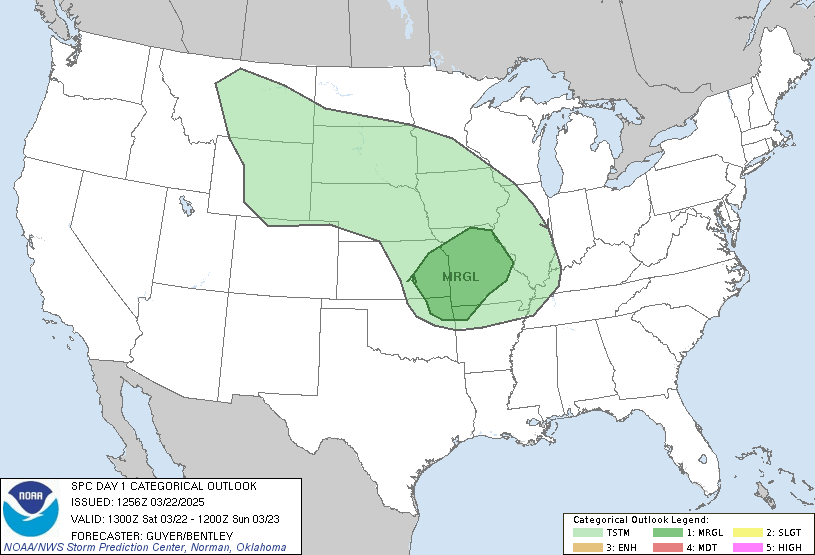
The National Weather Service Storm Prediction Center has quite a forecast for severe weather today. The “High” risk area on this map comes out very rarely. The last time that included part of Wisconsin was June 7, 2007, the day of the F3 tornado in Shawano, Menominee and Oconto counties.

This is a worse-looking forecast than Sunday’s, which got progressively more foreboding as the day went along. If you live in Iowa, which got hammered by tornadoes Sunday, you’re really not going to be pleased to see this, particularly the tornado forecast of a 30-percent chance of an F2 to F5 tornado within 25 miles of any point. As for those of us in Northeast Wisconsin, the forecast, which didn’t initially include us in the severe weather area, now does, mainly for hail.

As of this morning, severe weather is a possibility for Friday too.

(For review of what all this means, go here.)

One wonders if Severe Studios, which follows storm chasers, qualifies as the Jim Cantore of tornadoes. (For those who don’t know, Cantore is the Weather Channel meteorologist who goes into hurricane areas while people with any sense are leaving them.) As the Weather Channel biography on Cantore says, “When he shows up, you know the weather is going to get interesting.” Or: If you see him, or them, in your area, leave immediately.

3 p.m. update: Friday now looks like it’ll be stormy in most of Wisconsin, particularly to the south.

* What does this mean? This.

Graduates of the Class of ____ …

Several jobs ago, I wrote a sample graduation speech for a weekly newspaper graduation section. I’ve had the chance to do this speech once, and this is the middle of the college and high school graduation season, so …

Members of the Class of 20__:
Let me be among the first to congratulate you on your impending graduation. This event is called “Commencement,” not “Graduation,” because, even though you are ending something today, you are supposed to begin something new after today.

I am under no misapprehension about my role here today. I fully realize that, in most cases, the only thing graduates remember about their commencement speaker is how long he or she spoke. I therefore resolve to give a speech that fits in between the two poles of speaking — between “Why did we bother inviting him if he was going to say that little?” and “Can you believe how long he talked?”. I also realize that I am one of the few people standing between you and your graduation party. So you can determine for yourselves if Shakespeare was correct in “Hamlet” when he had Lord Polonius say that brevity is the soul of wit.

I have three pieces of advice to give you today. You are, of course, free to follow this advice, or not.

The first is to stand up and speak out. Today, fewer than half of people bother to vote, and a larger percentage than that — most people, in fact — don’t bother to express themselves on issues of the day, whether that’s in a government meeting, the letters to the editor section of the local newspaper, or on a Web site. More than 1 million American soldiers died to preserve your right to stand up and speak out, whether or not — and perhaps, especially if not — your views adhere to conventional wisdom or are politically correct. Remember the words of Edmund Burke: “All that is necessary for the triumph of evil is that good men do nothing.” It is not that those who oppose your point of view are evil, but no one listens to the silent.

My second piece of advice is something it took me a long time to learn. You may be sick of where you are right now, ready to get out of school; you may think to yourself that, if I could only get out into the work world, or if I could get a higher educational degree, then my life will really begin. And then you may find your first job out of school is not only not what you really had in mind upon graduation, but that this job of yours is clearly beneath you, and you may think to yourself, if I could only find a better job than this,
then my life will really begin. Or you may be dissatisfied with your social life, and you may think to yourself, if I could only meet a special someone, then my life will really begin. Or you may not really like where you live, and you may think to yourself, if I could find a bigger and better house, then my life will really begin.

I hope you can see where this point is going. Your life is what is happening while you’re waiting for your idealized life to begin. There’s nothing wrong with self-improvement, with looking to better your circumstances. But ultimately your circumstances should not define who you are or how you feel about yourself or your life. And if you’re determining your overall level of contentment based on your job, or your status, or how much stuff you have, I predict that you will have an ultimately unfulfilling life.

Finally: Go home. (I’ll pause now while your parents recover from the shock.) What I mean by “go home” is to remember where you grew up. A lot of you may have plans to move to a bigger metropolitan area — Chicago or Minneapolis–St. Paul, for instance — with the idea in mind that you’ll have more opportunities there. You should remember, though, that your education up through high school was paid for by your parents and your neighbors, whose tax dollars footed the bill for the education you have. More to the point: If you feel any connection to the area where you were raised, you should realize that if you want to see, for instance, jobs where people of your educational level can work, and jobs where people can afford to live in the same place where they work, or vice versa, it may be up to you to provide them. There are few places in the world where that kind of opportunity exists today. This is one of them.

Congratulations, good luck, and thanks for listening.

May 28, 2008

Weather, ideology and news

I noted on Friday that my Memorial Day plans included attending a regularly scheduled catfish fry on the Mississippi River. As it happened, my Sunday plans got blown up by the severe weather that blew up in eastern Iowa and southwest Wisconsin, including tornadoes, one of them an F5, that killed seven people in two Iowa communities. (This might have been the first time I recall Lancaster, where my in-laws live, and Ripon, where I live, being in the same tornado watch. At one point, tornado watches were in effect from Texas to northern Minnesota, and 50 tornadoes were reported from northern Texas to northern Minnesota Sunday.)

In news that is likely to make emergency government managers and property and casualty insurers nervous, this tornado season is already the deadliest in 10 years, and, according to National Weather Service Storm Prediction Center warning meteorologist Greg Carbin, "Right now we're on track to break all previous counts through the end of the year."

That's interesting to note given that this has been a cold spring, or at least it seems that way. Actually, that may be a contributor to the storm-filled spring, given that, as we all know, clashing warm and cold air masses is what causes thunderstorms. We've certainly experienced the cold half of that equation this year (this morning's low was 36 in Appleton and 34 in Green Bay), with only two instances where the high has jumped above 80, and more below-normal temperatures predicted the next 10 days and in June.

On Sunday, the three TV stations — KWWL, KGAN and KCRG — in the Waterloo–Cedar Rapids TV market were on the air continuously from 4:22 p.m., when the first tornado warnings were issued, until midnight or later. They were doing what TV (and radio) is supposed to do — keep the public informed in the event of emergencies. Those stations have a policy, as some TV stations in this area do, of continuous coverage of tornado warnings, unlike the old days, when TV stations would break in for storm warnings, then go back to regular programming. In their case Sunday, that meant continuous coverage of continuous tornado warnings from about 4:25 to 10:30 p.m., and then again from about 11 p.m. until midnight after another round of tornado warnings. Those stations also had to figure out a way to coordinate warnings from three different National Weather Service offices, in Des Moines, Iowa, the Quad Cities of Iowa and Illinois, and La Crosse.

(The local tie-ins: KWWL’s Jeff Kennedy is a native of Oshkosh, and KCRG’s Joe Winters grew up in Princeton; both are University of Wisconsin graduates.)

In contrast, there is the Weather Channel, which touts itself as the CNN of weather. While storms were ripping up eastern Iowa, the Weather Channel instead was showing a marathon of “Forecast Earth,” their global warming propaganda show. Apparently, actual weather was not as interesting as showing off people driving what appeared to be a four-passenger golf cart, not to mention eco-friendly fashions.

One of the anchors of “Forecast Earth” is Heidi Cullen, whose confidence that we humans are ruining the planet is so complete that she has advocated that TV meteorologists who dare not sing from the global warming hymnal lose their accreditation from the American Meteorological Society. (A good analysis of this issue can be found here.) One wonders what the reaction of Cullen or her bosses would be if someone suggested a good way to combat global warming would be to turn off TV sets and computers.

So, Memorial Day morning, we picked up the Dubuque (Iowa) Telegraph Herald expecting to see in-depth coverage of Sunday’s tornadoes, especially since there were several tornado reports within the Telegraph Herald’s circulation area. What we got instead was one not-very-detailed story buried inside the newspaper about the Iowa tornadoes and one even shorter blurb about one tornado report east of Dubuque, also not on the front page — and an Associated Press blurb at that, not even generated by the newspaper itself.

When you read analyses questioning whether newspapers can keep up in the digital age, the deadline structure required to print a daily newspaper, for which the 24/7 news cycle is not convenient, could be the reason. But when a newspaper just doesn’t bother to exert itself, even on a holiday weekend, to cover news in its own coverage area, is that their digital disadvantage, or just laziness or poor management?

May 27, 2008

Patrolling the state budget

One week ago in Oconto, I met state Sen. Dave Hansen (D–Green Bay), who made a valid point about those of us who believe government spends too much money.

Hansen correctly pointed out that there are many people who advocate that government spend less money, without saying what they specifically prefer less government spending.

Some would argue, also correctly, that that is a job for our elected officials. But lest I be accused of hypocrisy, I’m willing to take up the challenge. I should point out that this is a challenge that already has been taken up by Jo Egelhoff, proprietor of FoxPolitics.net and now candidate for the Assembly. Egelhoff has questioned the scope of four-year-old kindergarten, which, thanks to a veto from Gov. James Doyle, now must be offered to all students within any school district that offers it, instead of targeting it to students who would benefit the most.

My proposed budget cut would not only save money, but provide a particular and popular function of government much more efficiently:

Eliminate the Wisconsin State Patrol.

The State Patrol is an odd function of state government, because the State Patrol is not really a law enforcement agency in the same way that county sheriff’s departments are, or for that matter state police departments in other states. The State Patrol, which is part of the state Department of Transportation, “enforces criminal and traffic laws, conducts criminal highway interdiction programs, and helps local law enforcement agencies with traffic safety, civil disturbances and disasters (natural and man-made).” In other words, the stormtroopers of the state highways enforce the laws created by the busybodies in Madison and Washington, including mandatory seat-belt laws at a time when any idiot ought to realize they are safer wearing belts than not, to ridiculous levels, such as, in one case I was told by a trusted source, ticketing someone for driving 3 mph — yes, 3 mph — faster than the speed limit. The State Patrol also operates the state’s truck weigh stations, which rarely seem to be open whenever I drive past them.

State troopers (the State Patrol is authorized to have 399 of them) are sworn police officers, but they have no police responsibilities that aren’t related to motor vehicles, and they are legally subordinate to the county sheriff. (Like all bureaucracies, though, the State Patrol is looking to grow itself, having created a K–9 unit for which it had no legislative authorization. And like other bureaucracies, the State Patrol has a public relations arm that distributes news releases and creates pretty-looking reports in which it takes credit for things for which it doesn’t deserve credit, including a drop in traffic crashes.)

The State Patrol might have more of a reason for existence if its jurisdiction were limited to the state’s four-lane highways, the most traveled roads in the state, but that is not now the case. There is no evidence that crime in Wisconsin (particularly crime of a statewide nature) is at such a level as to warrant expanding police powers to the State Patrol, either. It would be helpful if the State Patrol did its job better as well, in contrast to their apparent performance during a large snowstorm that stranded motorists on Interstate 39/90 for up to 12 hours this past winter.

Other than inspecting tractor–trailers and operating the State Patrol Academy, there is nothing the State Patrol does that county sheriff’s departments don’t do, and could do more efficiently with dollars the state currently spends on the State Patrol. That is already occurring in one place, in fact: The State Patrol is really the State-Except-Milwaukee-County Patrol, because the State Patrol has no responsibilities to patrol Milwaukee County freeways, and if they don’t patrol the freeways of the largest metropolitan area in the state, what is their purpose?

Interestingly, I've talked to a lot of people about this idea — elected officials, political observers, and taxpayers. I've yet to have a single person say that this was a bad idea, particularly the part about giving the money the state spends on the State Patrol to county sheriff's departments. (Perhaps that State Patrol PR arm isn't working so well after all.)

At this point, I’d like to tell you that the state spends X dollars on the State Patrol. I can’t do that, because the State Patrol’s budget is well hidden within the Department of Transportation budget. I do know that county sheriff’s departments, which are responsible for their own counties instead of the whole state, would spend dollars being used on the State Patrol more wisely. In fact, that already happens in Milwaukee County, which gets $3 million in state fund to patrol Milwaukee County freeways.

In a previous state budget, Doyle proposed creating a state police force under the Justice Department, which would have combined the State Patrol, the Justice Department’s Division of Criminal Investigation, and the Department of Administration’s Capitol Police and State Fair Park Police. Such a department perhaps could include the University of Wisconsin police departments on the Madison, Oshkosh, Eau Claire, Milwaukee, Parkside, Platteville, Stout and Whitewater campuses. (I’ll pause while you mull over that bureaucratic snarl.)

That is one of those ideas that seems good in theory until you consider one fact: That statewide police department would be run by the Attorney General. Doyle, who was elected attorney general in 1990, and his one-term successor Peg Lautenschlager grossly politicized the Justice Department as Democrats seem to want to do. The history of Democrat Kathleen Falk, a former associate attorney general and public intervenor (the taxpayer-funded anti-development bottleneck that no longer exists), indicates that that would have continued had Falk not (fortunately) lost to Republican J.B. Van Hollen in 2006. Doyle and Lautenschlager did nothing to assist actual working law enforcement, but did wander off into areas that, whether or not you agree with their positions, were not about law enforcement. (Doyle, for that matter, spent most of his 12 years in office running to replace Gov. Tommy Thompson. Van Hollen seems content to use DCI officers as personal bodyguards during the upcoming Republican National Convention.)

Either the State Patrol should have its responsibilities expanded, or it should be disbanded. In an era of state budget crises but not rampant statewide crime, the latter is the preferred route.

May 23, 2008

The first three-day weekend


Today starts Memorial Day weekend, the first of this year’s three three-day weekends and historically in Wisconsin, the three-day weekend of the most dubious weather, although this weekend’s forecast sounds pretty good (so far).

This is the point where some commentators harrumph that Memorial Day, which is supposed to honor those who died in military service to our country, has instead become the unofficial first weekend of summer. It’s not clear to me why those two things need to be mutually exclusive. It’s also not clear to me what setting Memorial Day at its old date, May 30, would accomplish.

The reason for Memorial Day was stated by Supreme Court Justice Oliver Wendell Holmes in 1884:
… It celebrates and solemnly reaffirms from year to year a national act of enthusiasm and faith. It embodies in the most impressive form our belief that to act with enthusiasm and faith is the condition of acting greatly. To fight out a war, you must believe something and want something with all your might. So must you do to carry anything else to an end worth reaching. More than that, you must be willing to commit yourself to a course, perhaps a long and hard one, without being able to foresee exactly where you will come out. All that is required of you is that you should go somewhither as hard as ever you can. The rest belongs to fate. One may fall — at the beginning of the charge or at the top of the earthworks; but in no other way can he reach the rewards of victory.
Memorial Day is a reminder of the cost of the reality that there are some things worth fighting for. As has been said by many others, freedom is not free. At the World Economic Forum in Switzerland in 2003, former Secretary of State Colin Powell was asked by the then-Archbishop of Canterbury whether the U.S. relied too much on “hard power,” the military, instead of “soft power,” diplomacy. Powell’s answer:
“We have gone forth from our shores repeatedly over the last hundred years and we’ve done this as recently as the last year in Afghanistan and put wonderful young men and women at risk, many of whom have lost their lives, and we have asked for nothing except enough ground to bury them in, and otherwise we have returned home to seek our own, you know, to seek our own lives in peace, to live our own lives in peace. But there comes a time when soft power or talking with evil will not work where, unfortunately, hard power is the only thing that works.”
(More from Powell on Memorial Day can be read here.)

In contrast, the live version of Bruce Springsteen’s remake of Edwin Starr’s “War” begins with these deep thoughts: “… Blind faith in your leaders, or in anything, will get you killed.” (Did he mean his wife, his family, God or whatever religion he has, too?) As for the premise stated in the song’s refrain — “War! Huh! What is it good for? Absolutely nothing!” — the survivors of several concentration camps and other victims of Nazi Germany may have a different opinion. For that matter, the fact that one-fourth of the Cambodian population was killed after the end of the Vietnam War suggests that U.S. withdrawal from Southeast Asia may not have been the best thing for Southeast Asia.

You can argue the merits of the war in Iraq, or how the Bush Administration is prosecuting the war on terror. You can even argue whether World War I accomplished anything except for paving the way for World War II. The idea, however, that war is something that can be eliminated if we just all resolve to get along assumes that human nature can be defeated, and that there’s no moral difference between sides. Would pacifists be pleased with a country where the southern third of it owned slaves and no one did anything about it because all viewpoints, even enslaving human beings, are valid?

John Stuart Mill put it best:
War is an ugly thing, but not the ugliest of things. The decayed and degraded state of moral and patriotic feeling which thinks that nothing is worth war is much worse. The person who has nothing for which he is willing to fight, nothing which is more important than his own personal safety, is a miserable creature and has no chance of being free unless made and kept so by the exertions of better men than himself.
As with many things, the real spirit of Memorial Day can be best found in small towns. (In a general sense, those who live in small towns seem much more rooted in reality and traditional values than the big-city elites.) Back in my weekly newspaper days, I wrote an annual story previewing Memorial Day events, with members of the American Legion and Veterans of Foreign Wars visiting any cemetery in which a veteran was buried. The observance culminated in a small parade and program at the high school, where “In Flanders Fields” would be read and “Taps” would be played. (I was a bugler in Boy Scouts, so I played “Taps,” though never at a funeral.)

Our traditional Memorial Day weekend plans are to head southwest to the in-laws, so my wife can see her sisters and brother and our children can see their aunts, uncles and cousins. The added bonuses are that the fourth Saturday of most months is the scheduled date for the steak fry held by the Jacob J. Berg–Albert A. Averkamp VFW Post 5276 in Potosi, across the street from the original site of the Potosi Brewery. I have been attending Potosi steak fries for 18 years, usually preceding them with a Brandy Old Fashioned, the official mixed drink of Wisconsin. One day later is the annual Glen Haven Fire Department Catfish Fry, with my four favorite words: “All You Can Eat.” Glen Haven is, I believe, one end of Wisconsin, just as Northport is the other end — the county highway that goes into Glen Haven dead-ends into a Mississippi River boat landing, and even though there are roads northwest and southeast out of Glen Haven, it feels like that’s the end of the state.

Memorial Day has turned into an occasion to remember not just military dead, but members of the family who have passed on as well. The weekend includes a visit to my in-laws’ section of Hillside Cemetery in Lancaster. Most years, if it works schedule-wise, I stop this weekend at Resurrection Cemetery in Madison, the gravesite of my older brother, who died of a brain tumor before his second birthday, a year before I was born. The saddest part about that is that he is buried in a section of the cemetery that was reserved in the early 1960s for babies and young children. And yet there’s something about having your own children running around a cemetery — strange as it sounds, it’s a reminder that life does go on.

Resurrection Cemetery is also the final resting place of someone who grew up in Madison the same time I did, comedian Chris Farley. (I highly recommend his biography, The Chris Farley Show: A Biography in Three Acts, cowritten by his older brother. Since I read it, I’ve been trying to figure out where our paths crossed; he was born and raised in the Madison area and attended Edgewood High School, graduating one year before I graduated from La Follette High School. I think our paths might have crossed at an Edgewood–La Follette football game in 1980 or 1981; he played defensive line, and I played trumpet.)

This weekend makes one think what this nation’s military dead died for. “They died for our country” is the obvious answer, but what does that specifically mean? Joseph Campbell defined a hero as “someone who has given his or her life to something bigger than oneself,” which our military dead certainly did. In the case of this country, “something bigger” isn’t just the flag or something that symbolizes our country; it’s all the things, great and small, that make up our way of life — our right to make a living the way we want, to live where we want, to express opinions about the state of things and to express ourselves in other ways — even something seemingly mundane like three-day weekends.

Jack Buck, one of the great sportscasters of the first 50 years of TV, was a World War II veteran who survived the Battle of the Bulge. He visited Normandy, the site where the Allied invasion of Europe began on D-Day, and, upon seeing visitors to the cemetery in a less-than-solemn mood, penned this poem (from his autobiography That's a Winner):
They chatter and they laugh as they pass by my grave
And that's the way it should be.
For what they have done, and what they will do, has
nothing to do with me.
I was tossed ashore by a friendly wave
With some unfriendly steel in my head.
They chatter and they laugh as they pass by my grave
But I know they'll soon be dead.
They've counted more days than I ever knew
And that's all right with me too.
We're all souls in one pod, all headed for God
Too soon, or later, like you.
President Benjamin Harrison gets the last word about the holiday formerly known as Decoration Day:
I have never been able to think of the day as one of mourning; I have never quite been able to feel that half-masted flags were appropriate on Decoration Day. I have rather felt that the flag should be at the peak, because those whose dying we commemorate rejoiced in seeing it where their valor placed it. We honor them in a joyous, thankful, triumphant commemoration of what they did.
Animated U.S. flag courtesy 3dflags.com

May 22, 2008

Ryan for President

Wednesday's Wall Street Journal featured an absolutely brilliant column by U.S. Rep. Paul Ryan (R–Janesville), a demonstration that not all Republicans are merely Democrat Lite — wanting the same programs as Democrats, but slightly smaller with slightly less taxes.

Ryan is one of the seemingly few politicians to realize the demographic time bomb that awaits a country that fails to do anything about how entitlement spending is gobbling up larger portions of the federal budget and the economy. By the time Ryan's children reach his age, 38, to fund Social Security, Medicaid, Medicare and other government functions "will require more than doubling the average tax burden of the past 40 years just to keep the government afloat. Continuing down this path will eventually strangle our economy."

So how do you change that? With "A Roadmap for America's Future," which deals with the entitlement crises and our hideously complicated tax system:
  • A refundable tax credit of $2,500 for individuals and $5,000 for families to pay for health insurance, which would take ownership away from the government and businesses to individuals.
  • Convert Medicare for those younger than 55 to an annual payment of up to $9,500 (the amount based on income) to purchase coverage, and allowing states flexibility to alter their Medicaid programs to fit the states' individual needs.
  • Giving workers younger than 55 the option to invest more than one-third of their Social Security taxes into individual accounts.
  • Give taxpayers a choice to use the present tax system or a two-level tax system, featuring larger standard deductions and personal exemptions, a tax of 10 percent on income of up to $100,000, and a tax of 25 percent above that level. ("Income" would not include capital gains, dividends or estates.)
  • Replace the corporate income tax, which Ryan notes is second highest in the industrialized world, with a business consumption tax of 8.5 percent.
The details obviously are subject to the political process. I quibble only with the last point, which I would change to "eliminate the corporate income tax." It is, as we all know, not a tax paid by businesses; it is passed on to consumers, which is one reason why the corporate tax rate has grown to the second highest in the industrialized world — like sales taxes, it isn't apparent to the consumer, but the consumer is paying it nonetheless.

The business consumption tax plan is probably in there so that Ryan can say this: "Based on the analysis of government actuaries, this plan is projected to make the Social Security and Medicare programs permanently solvent. It will lift the growing debt burden on future generations, and hold Federal taxes to 18.5 percent of GDP," which is actually less than the historic tax level of 19.5 percent of GDP, regardless of tax rate structure.

The Social Security and health insurance initiatives are particularly laudable. Social Security is a giant ripoff for those of us in our 40s or younger, who face the likely scenario of having no Social Security at all when we reach retirement age, since it will start to pay more out in benefits than it collects in taxes in just nine years. Even if that weren't the case, Social Security is still a giant ripoff since there is no property right to Social Security — we get it, or not, at the whim of the government. (Since I began working, my age for eligibility has been increased from 65 to 67, and it's likely to increase further.) As has been pointed out more than once, any investment company that set up a retirement fund as Social Security is set up and funded would be in prison. Similarly, the health insurance market would work much better if individuals had the ability to change coverage and insurers as easily as we can change our car insurance, but that doesn't happen in a market where third parties pay for coverage.

"Levels of projected debt threaten to bankrupt the country, there are trillions of dollars of unfunded liabilities in the government’s major benefit programs, and Americans face an accelerating erosion of their health care and retirement security," says Ryan. "This will burden not only the Federal Government, but the U.S. economy as well, threatening its ability to continue raising standards of living, or to compete successfully in an increasingly international marketplace. This is a future in which America's best century is the past century. Unless we act."

On May 15, Karl Rove wrote a Wall Street Journal column, "The GOP Must Stand for Something." The federal and state Republican Party has done a great job standing only for their own power and reelection prospects, and it has gotten them to lose control of Congress and one house of the Legislature, with prospects for November looking even worse than they were two years ago. Republicans are preferable to Democrats when they act like Republicans and support Republican themes, not when they are Republicans In Name Only. The purpose of being in politics should be to improve things, not to have power, and that is something many Republican leaders appear to have forgotten.

The Republican Party's greatest success of the 1990s was the Contract with America, which spelled out what the Congressional GOP stood for. It was so successful that it led the way to 12 years of Republican control of Congress, despite a popular Democratic president opposing all its tenets, and despite its main author, former House Speaker Newt Gingrich, leaving the house in 1999. Even in the cynical sport of politics, ideas mean something. Ideas got Ronald Reagan elected in 1980, and ideas got Republicans Congress in 1994.

Ryan's plan is what the Congressional GOP and presidential candidate John McCain should stand for. And Wisconsin Republicans need to come up with a similar roadmap to deal with Wisconsin's fiscal challenges, including some of the highest taxes in the country and our own deficits.

May 21, 2008

Your Tax Dollars at Work, Gas Prices Edition

In a previous post here, I wrote that “Anyone who thinks Democrats are going to do anything to reduce gas prices hasn’t been paying attention.”

Apparently I was mistaken. U.S. Rep. Steve Kagen (D–Appleton) has come up with a new approach, something he got 323 of his colleagues in the House of Representatives (one of whom is Rep. Tom Petri (R–Fond du Lac)) to sign on to — sue OPEC:
The Gas Price Relief for Consumers Act sponsored by Congressman Steve Kagen, M.D. was approved overwhelmingly [Tuesday] by the House of Representatives by a vote of 324-84. One hundred three Republicans supported the bill that would put in place the means to crackdown on possible anti-competitive practices that could be contributing to the current record-high gas prices.

The Gas Price Relief for Consumers Act of 2008 would allow the United States to sue foreign oil cartels for anti-competitive price discrimination. It would also allow the Department of Justice Antitrust Task Force to aggressively investigate both gas price gouging and market manipulation.

“Until we finally have an energy policy other than drill-and-burn, this bill will begin to set things right for the American people,” Kagen said. “We cannot drill or grow our way out of this energy crisis. We must begin to think differently in America. That includes loosening the stranglehold other nations have on our economy and exploring new forms of energy.”

The Gas Price Relief for Consumers Act of 2008 … authorizes the creation of the Department of Justice Petroleum Industry Antitrust Task Force. Among its responsibilities, the Task Force will examine such issues as the existence and effects of price gouging in the sale of gasoline, anticompetitive price discrimination by petroleum refiners, actions to constrain oil supplies in order to inflate prices, and possible oil price manipulation in futures markets. …

“This legislation will address the loopholes and exemptions that oil companies exploit at the great expense of our citizens,” said Kagen. “By passing The Gas Price Relief for Consumers Act, the House agrees that it is time to give U.S. authorities the ability to prosecute anticompetitive conduct committed by international cartels that restricts supply and drives up prices. OPEC, the world’s most well known oil cartel, accounts for more than two-thirds of global oil production, and OPEC’s oil exports represent about 65 percent of the oil traded internationally.”

Words fail me as to how laughable, stupid and naïve this really is. I’m curious as to which court outside the U.S. Kagen believes would hear this case. Kagen may be shocked to find out that the jurisdiction of U.S. courts does not extend beyond the borders of the U.S. or to non-American citizens. (Apparently, none of Kagen’s colleagues who are lawyers bothered to tell him this.) Kagen also may be surprised to discover that not even an act of Congress can overturn the laws of supply (artificially restricted due to bans on drilling and environmental regulations that have prevented new refineries from being built) and demand (increasing from growing economies outside the U.S.).

The White House says targeting OPEC in the courts “would likely spur retaliatory action against American interests in those countries and lead to a reduction in oil available to U.S. refiners.” I’m not sure if that’s the case (why would OPEC shut off one of its largest customers?), but it certainly will not do anything at all to reduce gas prices. Had Kagen’s Democratic buddies not prevented U.S. oil companies from being able to drill for oil in new locations in this country over the past three decades, then gas prices might not have increased, in Wisconsin, 65 percent since Democrats took control of Congress in early 2007.

“As the Federal Trade Commission has reported, changes in world oil prices have explained 85% of the changes in the price of gasoline in the U.S.,” says U.S. Rep. Steve King (R–Iowa). “The price of gas at the pump closely tracks the price of a barrel of oil in the world market. Further, the FTC has repeatedly found that there is no broad-based collusion to fix prices or engage in price gouging in the retail sale of gasoline.”

If I were in Congress, I would be embarrassed to have my name attached to Kagen’s waste of time. Kagen must have a low estimation of the intellects of Eighth Congressional District voters to believe this will get him more votes in November.

Kagen is right about one thing: “We must begin to think differently in America.” That should begin with sending Kagen back to his medical practice Nov. 4.

UPDATE: July light crude futures sold today for $133.17 per barrel, up $4.19 from yesterday. Apparently the world oil markets are unimpressed with Kagen’s bill as well.

How government should work

Those who are regular readers of this space have read in the last week how I feel about our elected officials in Madison and the circular firing squad that was last week’s budget “fix.”

So I thought it might be refreshing to discuss a municipality where government actually works well. The mayor of Ripon, Aaron Kramer, was on Ripon’s radio station Monday talking about how city government was going to address the city’s … surplus, of nearly $200,000.

(Full disclosure: Yes, I live in Ripon, and I served with Kramer on Ripon’s Plan Commission for four years. I am also an on-air voice for Ripon’s Channel 19, the government access channel funded through cable TV franchise fees. My wife works for the Ripon Public Library, which gets you no tax breaks. I am not writing this to curry any favors with city leaders.)

This surplus was not generated from excessive taxation, incidentally. The city’s 2007 mil rate of $7.10 per $1,000 valuation ranked 94th of the 196 Wisconsin cities, and a bit more than the $6.93 per $1,000 city average, according to the Wisconsin Taxpayers Alliance. (The city’s overall mil rate of $21.77 per $1,000 was 59th highest among Wisconsin cities; the reason for that can be found 11 paragraphs from now.) The city has received more revenue than forecast, a result of economic growth, and has spent less than budgeted, thanks to what Kramer calls “a frugal group of department heads, who were not operating under the all-too-familiar model of spending every available dollar at the end of a budget cycle in order to receive additional money the next time around.” The city’s forecasted 2007 deficit of $140,000 (which was to be covered by carryover funds earmarked for specific projects) turned into a surplus of $70,000, thanks to project bids lower than estimated, not spending contingency funds, selling the city’s Senior Center and making money on the city’s invested funds.

The city’s business park, expanded two years ago following a decade-long debate on how to expand and where, is going to fill rapidly. Two residential subdivisions — the second and third subdivisions to be created in the city in the past 40 years — are being built. A Tax Incremental Financing district on the city’s west side has generated almost $8 million in new development and $177,000 a year in new property taxes. On Tuesday, Ripon Medical Center announced it is moving its hospital (across the street from a certain business magazine editor) to the city’s business park.

And it’s not as if no infrastructure improvements are occurring. The city has borrowed 20 percent of its allowable general obligation debt limit to pay for its share of a new fire station and street and sewer improvements. The city’s outstanding debt has been dropping thanks to a policy of paying off more debt than is taken on in any particular year.

Ripon has four specific advantages, including the particular quality of life that comes from being in a college town (although city–college relations haven’t always been entirely positive). The city has a large industrial sector highlighted by one major manufacturer, Alliance Laundry Systems (they build Speed Queen washers and dryers); a major plastics packaging company; food processors Ripon Pickle, Smuckers and Bremner Foods (the Rippin’ Good Cookies people); and two large service companies, a printer and a company that makes prison security automation equipment. The city’s location on a railroad spur obviously is quite convenient for manufacturers. And unlike many cities around its size, Ripon has a downtown worth visiting, thanks in part to its being part of the state Main Street program. (This is despite the fact that there is no street called Main Street in Ripon.)

Unlike other cities in the area, however, Ripon has little developable waterfront area, and the city isn’t on a four-lane highway. (For that matter, getting through the city can be a challenge due to the fact that it has no through streets.) Thanks to decisions, or lack thereof, of past city leaders, the city hasn’t grown in population for decades, and economic growth was minimal until relatively recently.

Ripon’s recent successes show that there is no substitute for actual leadership. Kramer would be the first to tell you that Ripon’s growth has been a team effort, including city government management and staff, a new economic development director, and others. Interestingly, though, other than the economic development director, most of the people on staff were there during previous administrations, where very little growth occurred. The approach that has worked in Ripon is that the part-time mayor leads in determining general future direction, while the full-time city administrator, Steve Barg, applies and executes that vision. The relationship between elected officials and professional staff in Ripon seems appropriate — city staff doesn’t appear to run the show, as in some municipalities, but city staff is also not micromanaged by elected officials whose reach exceeds their grasp.

One thing that changed besides the mayor was that aldermen and members of appointed bodies with a we-don’t-care-about-growth attitude have been replaced by those who do, or maneuvered into appointed bodies where they can do less damage. (Evidently Kramer has read Machiavelli.) Ripon supposedly has a weak-mayor form of government, but you’d never know that from what’s happened in Ripon over the past five years. The city also has been able to withstand employment losses from more than one major employer over the past few years.

Ripon also is an example of the positive things that can happen in government without party labels
(that’s an observation I’ve heard from mayors all over Northeast Wisconsin’s political spectrum) and without careerist politicians. Down in Madison, in contrast, spats have occurred between parts of the same party for more than a century. (Wisconsin was dominated by the Republican Party in the early 20th century, but the GOP was divided among more conservative Stalwarts and the considerably more liberal Progressives started by Robert M. “Fighting Bob” La Follette.) Before Tommy Thompson took the word “veto” to new heights as governor, the previous gubernatorial leader in vetoes was Gov. Anthony Earl, a Democrat who had a Democratic majority in both houses of the Legislature all four years he was governor. Earl and legislative Democrats were rarely on the same page on budgeting issues.

Kramer has an actual full-time job, and Ripon’s aldermen either have full-time jobs or are retired. In contrast, the words “full-time legislator” appear far too often in the Wisconsin Blue Book section of legislators’ biographies, both Democrat and Republican. Neither the Founding Fathers nor those who founded Wisconsin intended the phrase “full-time legislator” to be part of the political lexicon.

Ripon is not perfect. The city could be in better shape today had previous leaders not made decisions based on the attitude that they liked the city just the way it was. There is no such thing as “just the way it was,” or is, because communities are organic — they grow in real terms, or they shrink. What’s happening today is reversing, finally, shrinkage in real terms (as demonstrated by zero population growth when nearly every community in Northeast Wisconsin has grown in population) over the years.

There is a belief, not without some justification, that Fond du Lac County leaders occasionally forget that Ripon is in Fond du Lac County. (Ripon has a new county park on the city’s east side that consists of a field and a parking area. Still, I shouldn’t complain given that Fond du Lac County manages to operate county functions with average county mil rates but without a county sales tax.) The school district is good but, contrary to their vision statement, not “one of Wisconsin’s outstanding school districts,” although
school district taxes are outstandingly high. (Relations between the school district and its teachers are similar to relations between the U.S. and the Soviet Union around 1962.) I’d like to see Ripon grow by about 1,400 population and expand to about 36 square miles of land area. (That is a comment about a municipality near Ripon previously referred to in this space.)

The City of Ripon is an example of the truism that government works best when responsibilities are handled at the lowest practical level.
Ripon also is a cautionary tale that the quality, or lack thereof, of elected officials and administration makes a real difference in whether a community grows, or does not. Nothing city leaders have done appears to qualify as rocket science, but Ripon is certainly better off than many cities in Wisconsin, thanks to progressive leadership.

There are a lot of self-styled progressives in Madison, but nothing that goes on in the state Capitol qualifies as “progressive” in a positive way, unless your definition of “progressive” includes vast structural deficits and accounting tricks played to mask the financial hole into which the state has fallen. There are political leaders (as opposed to “politicians”) out there whose goal is to better the communities they serve, instead of sticking it to their opposition. Few of them, apparently, can be found in Madison.

May 20, 2008

Analysis of the Day

Last month in this space, I reprinted a Marketplace of Ideas column from my first term as editor (Editor 1.0?), "The way things should be." That column reprinted a 1993 quote from an economist, W. Kurt Hauser, who noted that since World War II, regardless of what income tax rates were, tax collections totaled about 19.5 percent of Gross Domestic Product.

David Ranson in the Wall Street Journal reintroduces what he calls Hauser's Law, with this punch line:

What happens if we instead raise tax rates? Economists of all persuasions accept that a tax rate hike will reduce GDP, in which case Hauser's Law says it will also lower tax revenue. That's a highly inconvenient truth for redistributive tax policy, and it flies in the face of deeply felt beliefs about social justice. It would surely be unpopular today with those presidential candidates who plan to raise tax rates on the rich — if they knew about it. ...

Because Mr. Hauser's horizontal straight line is a simple fact, it is ultimately far more compelling. It also presents a major opportunity. It seems likely that the tax system could maintain a 19.5% yield with a top bracket even lower than 35%.

Someone sign up Barack Obama for a Wall Street Journal subscription. (Or, better yet, sign him up for Marketplace; then he can see what life in the Bitterness Belt is really like.)

May 19, 2008

The fix that fixes very little

I’m not ready to call our governor Deficit Dumping Doyle, but qualified praise is due to Gov. James Doyle for doing a better job at addressing the state budget shortfall with his vetoes than the Legislature did in creating the budget repair in the first place.

Doyle cut through veto an additional $201 million of the Legislature’s pathetic $69 million in budget cuts to address the state’s $652 million budget deficit. He also vetoed the accounting trick of delaying $125 million in school aid payments into the next budget cycle, which helps decrease (though not by much) the structural deficit. He also increased reserves from the Legislature-approved $25 million to $100 million, which is more responsible (though not by much).

The “qualified” part comes from Doyle’s grabbing another $101 million from the transportation fund, which increasingly does look like, as someone else first put it, the State Capitol branch of a payday loan store, or, perhaps, the state’s version of the Social Security Trust Fund. He also cut a property tax cut provision for low-income housing, a bad move except that the tax cut provision didn’t belong in the budget repair in the first place; the tax cut should be approved as ordinary legislation, not in the budget. He left in a tax increase on “certain rental and interest payments by businesses to related entities,” which is a bad idea and something that also didn’t belong in the budget repair. Another provision required the state to negotiate smaller salary increases with state employees; he vetoed that on the grounds that current state employee contracts have come in $25 million less than estimated in the current budget.

Doyle also left in another provision he should have vetoed — the requirement that any school district that provides four-year-old kindergarten must offer it to all students in the school district, instead of targeting it to students who need the early help. The jury is out on the effectiveness of four-year-old kindergarten (which my oldest son did at a private preschool and which my youngest son is doing in public school), but if you believe it would help some children, then taxpayer-funded 4K should be offered to those children and not necessarily every child, when it becomes taxpayer-funded daycare. This and the state employee contracts are Doyle’s usual sop to, respectively, the teacher unions and the public employee unions, proving once again that, in politics, you are who your supporters are.

Doyle might be Wisconsin’s original Third Way politician. He has learned from Bill Clinton how to triangulate — to place himself between Republicans and more liberal Democrats — for his own political benefit more than his party’s. As with Clinton, through Doyle’s six years as governor, Democrats have controlled one house of the Legislature only once, the Senate since 2007. Wisconsin also has as many Democratic constitutional officers as before he took office. (In 2006, Republican Treasurer Jack Voight lost to Democrat Dawn Marie Sass, but Democratic Attorney General Peg Lautenschlager was replaced by Republican J.B. Van Hollen.)

Budget-cutting can be simple, depending on your approach, but it is not easy. The estimated budget shortfall totals almost 5 percent of the budget, which one could eliminate by cutting every budget item by the same 5 percent. Remove schools from budget-cutting, though, and everything else must be cut 10 percent. Remove schools and the University of Wisconsin System from cuts, and now everything else must be cut 20 percent. And as Wisconsin Taxpayers Alliance President Todd Berry pointed out, only 17 percent of state spending is for state government. We are paying for spending excesses that go back into the 1980s and 1990s, and of course there remain those who think we’re not spending enough on their pet project or cause.

This budget crisis illustrates the political importance of who is where, and also demonstrates that where politics is concerned, there is no such thing as being too cynical. Governors cannot create legislation, although Doyle, with the most veto power of any American governor, can do the next best thing through his use of the line-item veto. (Wisconsin governors used to have more veto power, but that was taken away through the constitutional amendments ending the “Vanna White” and ”Frankenstein” vetoes.) Doyle wants to enact a new tax on hospitals, believing that somehow the federal government and not those paying for health care will pay for it, but couldn’t get that through the Republican-controlled Assembly. Doyle got a party-line vote (with one exception) in the Senate, but needed to cobble together a majority of, but not all, Republicans and enough Democrats to get Assembly approval.

As German chancellor Otto von Bismarck put it, “Politics is the art of the possible,” so it makes one wonder what kind of state government we’ll have if the Assembly shifts from Republican control to Democratic control with the Senate after Election Day Nov. 4. One also wonders what will happen should Doyle decide not to run for reelection in 2010 and, without the pressures reelection efforts bring, decides to let his inner liberal come out.

Even if this turned out better than it could have, this is far from the preferable way to address state budget issues. Doyle’s vetoes only slightly affected the structural deficit and had no discernible effect on the accrual deficit, which total almost $4 billion. Rep. Dean Kaufert (R–Neenah) and others believe the time has come for a public participation process in which the state’s budget functions are prioritized to allow elected officials, in Kaufert’s words, “to find out which programs are viewed by the public as low priorities or expendable and would help balance the budget in real terms” to avoid making this a yearly occurrence. A smaller scale version of this has been done in Sheboygan County.

Remember what I said that where politics is concerned, there is no such thing as being too cynical? Unfortunately, public participation in any budgeting process, as the Public Policy Forum points out, usually devolves into “significant participation from union members and advocacy groups, but little from regular citizens.” When faced with the question of should taxes be cut or should your favorite government function be maintained, voters more often than not answer yes. At least in this state, too many Republicans are RINOs (“Republicans In Name Only”) or Eisenhower Republicans — they like the same programs Democrats like, but they want to spend a little less on them, and they want people to be taxed a little less. And since the primary motivation of politicians is reelection rather than serving the public, making responsible decisions (the Taxpayer Bill of Rights, for instance) inevitably loses out to pandering to the politicians’ favorite special interest groups (who believe that any dollar cut from their cause will be the end of the world as we know it).

Big decisions will have to be made that will affect a lot of people, and those decisions get increasingly difficult the longer they are put off. Since the biggest expense of state government is personnel costs, real budget cuts must include cutting government jobs, as well as reducing the Rolls–Royce benefit packages government employees get. Government programs are programs, not “investments,” and need to be arranged in order of what is really important and what isn’t, and those that aren’t important need to either be severely cut or eliminated. And government needs to be funded by direct, transparent taxation, not indirect taxation such as business taxes, which, as all of us (but not this misguided writer) know, are not paid by businesses, but are paid by consumers.

What’s the alternative? A longtime elected official I talked to last week says the alternative is to watch, perhaps in the next two decades, Wisconsin turn into “Alabama with high taxes” — a state with crumbling infrastructure but high taxes, a state in which any native with the wherewithal to leave for better climates (whether milder winters or better economic prospects) will leave.

May 16, 2008

Analysis of the Day

Michael Novak on what a Barack Obama presidency would be like by 2012.

To boldly do business where no one has done business before

Stardate 10837.3

I have always been a fan of the TV series “Star Trek.” Those who are not are just … illogical. (Even Star Trek non-fans should understand that reference.)

Star Trek was a groundbreaking science fiction TV series during the tumultuous 1960s. Just four years after the Cuban Missile Crisis, when it seemed as though the U.S. and Soviet Union were intent on leaving the world suitable only for cockroaches, here was a TV series that suggested that people of both sexes and all races would not merely survive, but thrive to explore “strange new worlds … to seek out new life and new civilization … to boldly go where no man* has gone before.” It also suggested a logical destination of the space race, which culminated in the 1960s with man on the Moon, continuing to, in the setting of the original series, faster-than-light-speed travel to be able explore millions of planets suitable for supporting human life.

* The word “man,” of course, referred to “mankind,” not just men. Remember that this was written in the 1960s. Later versions changed “no man” to “no one.”

Star Trek has had a huge impact on pop culture for a series that lasted just three seasons, the last of which forgettable at best. It was the first serious science fiction TV series that featured a world different from this one (“The Twilight Zone” and “The Outer Limits” were usually set on present-day Earth) as its setting. The format allowed drama, action and adventure, and even comedy interspersed with metaphorical explorations of issues of the turbulent 1960s. Some of the era’s greatest science fiction writers wrote scripts for the original series.

Yes, this is merely a TV series, although no other TV series spawned five spinoff series, 10 movies, hundreds of fiction and nonfiction books, and an entire subculture that started with just 79 hour-long episodes. (Not bad for a series that couldn’t beat such competition as “My Three Sons,” various movies on CBS, “The Tammy Grimes Show,” “Bewitched,” “Gomer Pyle, U.S.M.C.” — for those who think Star Trek is a fantasy, imagine the Marines allowing Gomer Pyle to enlist — “Hondo” and “Judd for the Defense” in the Nielsen ratings.) As with any entertainment set in a period different from the present, attitudes in the series do reflect, in the case of the original series, the 1960s, with, in some cases, unfortunate results.

There is also a perception that the acting style of, specifically, star William Shatner was over the top, but if you watch other TV series from the ’60s, the acting style of Star Trek actors is consistent with the ’60s TV drama standard, which was closer to stage acting than movie acting. (Shatner was a Shakespearean stage and movie actor of note when he was cast as Capt. James T. Kirk.) The byplay among Kirk, Spock and Dr. McCoy makes all but the worst episodes (more on that later) worth watching.

My favorite episodes, in the order that they appeared: First pilot “The Cage” (which was not used as the pilot, but was turned into a two-part episode in the series’ first season), second pilot “Where No Man Has Gone Before,” “The Corbomite Maneuver,” “Balance of Terror,” “Arena,” “Tomorrow Is Yesterday,” “Court Martial” (which is supposed to be on WLUK-TV Sunday at 11:30 p.m.), “A Taste of Armageddon,” “Devil in the Dark,” “The Alternative Factor,” “The Changeling,” “Mirror, Mirror,” “The Doomsday Machine,” “Journey to Babel,” “Obsession,” “The Trouble with Tribbles,” “A Piece of the Action,” “The Immunity Syndrome,” “Patterns of Force,” “The Ultimate Computer,” and “The Enterprise Incident.”

I watch TV and movies (sorry, “films”) and listen to music for entertainment, not usually for deeper messages. There is, however, one facet of Star Trek (other than the completely disastrous third season of the original series) that didn’t bother me when I started watching the series, but now gets my attention. It is the same quality that sinks many predictions of the future — the idea that human nature will be somehow defeated in the future.

Most characters in each iteration of the series are either Enterprise crew members, scientists, people the Enterprise meets in their explorations, or aliens. The original series (with the exception of two episodes featuring miners and one featuring a bar/trading post owner) has just two characters who could be considered businessmen, and shady ones at that — Cyrano Jones, who introduced the 23rd century to tribbles, and Harcourt Fenton “Harry” Mudd, who didn’t let the law interfere with, for instance, human smuggling.

The next series, “Star Trek: The Next Generation,” goes even farther. A first-season episode features the discovery of a satellite inside which three people from the 20th century were cryogenically frozen. One of them was a Donald Trump-type who discovered that all his wealth had disappeared, but that was OK because, in the words of the captain, in the 23rd century “We have eliminated need.” That series also introduced the Ferengi, which “have a culture which is based entirely upon commerce”; more accurately, the Ferengi combine the worst stereotypical abuses of unfettered capitalism with the worst stereotypical abuses of patriarchy. Suffice it to say that it is not a positive portrait.

It would be a fair statement to say that the economics of Star Trek are clearly utopian, at least vaguely socialist, certainly based on central planning, and sufficiently redistributionist to be able to supposedly “eliminate need.” Others would go farther and claim that the Star Trek universe is a communist (note the small C) society, featuring the abolition of property rights; state control of transportation, communication and industry; the elimination of religion (or replacement of it with a religion that worships technology and humanism); a two-class system with military, politicians and scientists in one class and everyone else in the other class (just like the U.S.S.R. was); inordinate military control and influence (ditto); and “enforced social uniformity.” Other than the military part, think of John Lennon’s “Imagine.” (More on the philosophy of Star Trek, which could be described as “universal humanism,” can be read here and here.)

One person actually created what he thought was the economic history of the United Federation of Planets (the 23rd century’s answer to the United Nations), based on an economic concept called “participatory economics.” As this person put it:

As far as I know, the creators and owners of Star Trek have never made specific the economic system that is used in the Star Trek universe. I doubt they have much of an idea, other than it’s not capitalism, doesn’t use “free” markets, and is probably quite just. From various quotes from movies and the TV shows, we know that they don't use money (Star Trek IV), they use “credits” (Deep Space Nine), that the encouraged point to life is self improvement, not aggrandizement by wealth (The Next Generation) …

This, of course, is where you know it’s fiction. One of the main premises of the series is that nation–states have been superseded by nation–planets, beginning with Earth. It may be a stretch to suggest that planetary unity is absolutely impossible, but consider this planet, a collection of nations, ethnicities, cultures, languages and religions, at least one of which (radical Islam) having as its goal the conversion or destruction of those who don’t adhere to that religion. World War II ended not because the Allies and the Axis agreed that their differences were not as important as their similarities; World War II ended because the Allies defeated the Axis. The Cold War ended not because the West and the Warsaw Pact had a kumbaya revelation; the Cold War ended because the West’s superior military and economic power forced the implosion of the Soviet Union and its satellite countries, helped in large part to those satellite countries’ citizens figuring out that life away from Communist control was a whole lot better than life under Communist control.

You may think that’s a grim view of history. (Not as grim as Star Trek’s version, though, which includes eugenics wars during Bill Clinton’s presidency — you’d think I’d remember that from my first stint as editor of Marketplace, but somehow I don’t — and a third world war with 600 million dead and nuclear winter in the middle of this century.) It is a realistic view of history and not grim because, fortunately, the correct side — the side that values freedom and individuality — has prevailed so far. To paraphrase John F. Kennedy, a unified world cannot exist half-nonfree and half-free. To have a unified world, either both sides have to have the same values, or one side has to prevail. So far, totalitarian governments and movements, whose values are certainly different from ours, have lost to governments based on freedom. And there’s that pesky link between economic freedom and political freedom (one of the personal freedoms) that keeps popping up despite the best efforts of governments to break it or claim it doesn’t exist.

The notion that enterprise and money will go away in the future is similarly dubious, requiring you to believe that resources eventually will become unlimited, but still must be administered by an all-powerful all-encompassing government. (If resources are unlimited, then why does anyone have to administer them?) Commerce goes back more than 2,000 years on this planet, starting millennia before anyone figured out theories of economics, capitalism and markets. One Web page terms “a planet-wide government that runs everything, and has abolished money” as “a veritable planetary DMV.” (That is a line I will probably appropriate to categorize any new government venture — say, nationalized health care.)

As another observer/fan puts it:

The basic problem is that Leninist workers paradises don’t work. That's why the Soviet Union early on abandoned its efforts to have a cashless society and reintroduced the use of money.

Money plays a vital role: It tells you how much somebody wants something that is in short supply. Person A wants to have something that Person B also wants to have (say, a nice fluffy tribble that has been safely neutered). Who wants it more? Money is the best way to settle that. (Fisticuffs not being a good way.) You want this tribble? How much are you willing to pay for it? Supply and demand. …

A society of humans couldn’t be more advanced than us and yet lack money. Whether cash or electronic, money is the most efficient way of settling how wants what how much and thus who gets it. It’s the best way to organize resources on a wide scale. Any other system is going to be inefficient and result in the misallocation of resources and greater human suffering.

Then there's that sticky issue of religion, which is as fundamental a flaw in the concept of Star Trek as its pseudoeconomics, as this writer points out:
NO human civilization has been able to erase the religious impulse from the minds of the majority of its people. NO human civilization has successfully combined lock-step totalitarian government with soft, fuzzy good feelings and compassion. NO human civilization has successfully combined excellence in all areas of human endeavor with collectivist, socialist economics and politics. I just can't believe it.

First of all, no society in the history of the world that has been Marxist, as the Fed[eration] clearly is, has achieved anything worth a darn. The only ones that have been even close to successful are the Soviet Union (now extinct, or at least dormant) and China (which is a stable society with roots far deeper than its present government). In the Trek timeline, there was a period of horrific genocidal war in the 21st century followed by a worldwide dark age. What motive could get humanity all the way to the stars by the 23rd? What got Western civilization through the "dark age" that followed the sack of Rome? Sunny confidence in the essential goodness of human nature? A love for scientific exploration? Baloney. There are basically two motives behind all human progress: economic advancement (for either survival or profit) and religious belief. Both were absolutely essential to the successful Middle Ages that followed. Both were necessary for the birth of modern science in the Renaissance. A society must be very advanced and leisured indeed to produce philosophers that churn out anti-capitalist and anti-religious ideas and a rarefied intelligentsia that takes them seriously.

Star Trek could be, probably unintentionally, an exploration of the tension between freedom and security. Humans, Vulcans and other sentient beings in the 23rd century can have the bottom two levels of Maslow’s hierarchy of needs satisfied by the mighty Federation, leaving them to strive toward the top three levels. That, however, sounds like a sterile and pretty uninteresting, not to mention completely self-absorbed, life. Forget about creating something; never mind about meeting the needs of others. (Oh, that’s right — there will be no need by then!) And, by the way, your choices will have been guided, if not predetermined, by the Department of All. Your freedom of choice, after all, includes your freedom to make what others might consider to be the wrong choice. President Gerald Ford, not known to be a Star Trek fan, nailed it nonetheless: “A government big enough to give you everything you want is big enough to take from you everything you have.”

Star Trek creator Gene Roddenberry, who was a visionary to merely think of the concept (which he described as “Wagon Train to the stars”), fell into the utopian trap of believing that not only would things change in the future, but human nature would change. The characters of Star Trek are idealized people (not surprising given that they are staffing the flagship of their fleet), when the reality is that we flawed humans make mistakes, have always made mistakes, and will always make mistakes, some even with disastrous consequences. We have to consciously choose to do the right thing, every time we have a choice. That ability to make choices not only makes us human; it gives us reasons to get up in the morning.

In the episode “A Taste of Armageddon,” Captain Kirk has destroyed the computer that allows one planet to wage war with another without using actual weapons; their “war” is a computer game until Kirk puts a stop to it. When the planet’s ruler claims that, like humans, they are “a killer species” and thus unable to not wage war, Kirk answers:
All right — it's instinctive. But the instinct can be fought. We’re human beings, with the blood of a million savage years on our hands. But we can stop it! We can admit we’re killers, but we’re not going to kill today. That’s all it takes. Knowing that you’re not going to kill … today. Call Vendekar [the other warring planet]; I think you’ll find them just as horrified, shocked, as appalled as you are — willing to do anything to avoid the alternative I’ve given you — peace or utter destruction. It’s up to you.
And on that note … peace. Live long and prosper.

Additional reading, for those who care:

May 15, 2008

What Assembly Republicans should have said

In fact, as Charlie Sykes points out, one Republican, Rep. Leah Vukmir (R–Wauwatosa), did:

Much has been said about how the national economy brought about our budget woes. In some ways — that statement is true. However, the real problems with the state budget are entirely of our own doing.

Economic downturns happen, often without warning — it is our job to be prepared for them. We were not, never have been and at this rate, we never will be prepared or capable of dealing with economic challenges. This body cannot even control its spending in the good times — let alone the bad times.

The Senate Joint Finance Co-Chair offered his budget strategy in this morning’s paper. He said legislators should “cross our fingers” and “hope there is no new economic downturn.”

That’s exactly what happened last October when this house passed a budget compromise. We saw the telltale signs that our economy was slowing and we knew our revenue projections were unrealistically optimistic, yet this body passed a budget without any spending adjustments with their fingers crossed, while hoping for the best.

Members proclaimed that we had “passed a budget the taxpayers could afford.” That laughable claim hasn’t been true for a decade — but this time the claim was proven wrong within two months. I guess the taxpayers just aren’t working hard enough to meet the spending priorities the legislature set, because it is quite clear they cannot afford them.

We warned you then. We told you we would not meet our revenue projections and we told you we would be back here with a repair bill. And we may very well be back again very soon because we have repaired precisely — nothing. This compromise leaves us in a precarious fiscal position and it is clear that the only strategy being offered today is — crossed fingers.

What we need to do is exactly what taxpayers are doing right now — adjust our spending priorities. If we cannot find the resolve to actually cut spending during an economic slowdown, we never will.

Wisconsin’s families are feeling the burden of higher prices and they are adjusting their household budgets, reprioritizing their spending and cutting back. They expect the same from us as stewards of their tax dollars.

Businesses all over Wisconsin are trimming expenses and working to run more efficiently and more lean. They are in a struggle for survival. In the end, as the economy improves, their business will be more competitive and more effective.

This is exactly what the State of Wisconsin must do and now is the time to do it. We need to cut spending, trim waste and become more efficient — government needs to become lean. Instead, this budget repair compromise just borrows more, delays payments, raises taxes, and amazingly, manages to spend even more money. This isn’t a repair, this is a sham.

We are quickly running out of tricks and one-time funding sources — the day of reckoning is coming soon. But that’s okay, we have it under control, and we have our fingers crossed.

This compromise represents the abandonment of fiscal responsibility for the purpose of political expediency. Rather than starting the long process of addressing our real budget problems, we defer, delay and deny — just to get through another election cycle. When we come back for the next budget, we will again defer, delay and deny — fingers crossed and singularly focused on political expediency.

The repair bill also gives us tax increases. Of course, because no one wants to admit that they are tax increases, we claim we are merely closing tax loopholes. Some of you may believe it, but the taxpayers know better. This bill eliminates a tax deduction that’s valid for federal tax purposes. Make no mistake, this is a tax increase.

This tax is being pushed by the Senate’s myopic hatred of big-box stores, particularly Wal–Mart. Wal–Mart of course is guilty of the crime of being non-union and apparently needs to be punished.

Unfortunately, this new tax on interest and rental income will impact far more than a few big-box retailers. The tax is far more expansive than the talking points or LFB [Legislative Fiscal Bureau] have indicated. These tax policy changes also mark a new era for businesses in Wisconsin. A business will now be required to demonstrate that their “primary motivation” for a particular business practice was not simply to reduce their state tax burden. But, what if the businesses primary motivation for reducing their tax burden is to expand their business and create jobs? Well, we don’t know, this will be up to the bureaucrats at the Department of Revenue.

This provision is outrageous and sets an awful precedent that is sure to have serious consequences on our economy. These are the kinds of tax policies one would find in Venezuela, not Wisconsin. I would have said the former Soviet Union, however these changes are retroactive to the beginning of this year and the Soviet Constitution prohibited retroactive taxation.

If this tax increase isn’t bad enough, the compromise also contains a non-fiscal policy change that will result in the elimination of a 30-year-old property tax exemption for senior living facilities.

I have been fortunate to have bipartisan allies standing with me as we defeated effort after effort to go after our seniors over the past several years. I would also like to thank the many members from the Democratic side of the aisle who joined me to prevent similar legislation from making it to the floor in the final days of this session.

This property tax provision has no place in this budget compromise. It will not have a positive state revenue impact. In reality, putting thousands of seniors on the tax rolls will make them eligible for the Homestead Tax Credit. It will also have the very unfortunate consequence of driving hundreds of seniors onto Title 19 which will increase our MA costs.

The property tax provision will expand the exemption for low-income for-profit corporations, but it will also effectively eliminate the exemption for not-for-profit, benevolent senior housing. How does this even begin to make sense?

These facilities support under-reimbursed nursing homes that offer a continuum of care for our seniors. Many of them will be unable to afford the increased rent. These seniors have chosen to invest their life-savings, typically the proceeds from selling their homes, into their long-term care. They chose to be self-reliant rather than divesting of their assets and becoming dependent on government for their care. And for this, we are going to punish them by removing a thirty-year-old property tax exemption. This is wrong!

What a great message for this legislature. We protected for-profit corporations at the expense of non-profit religious homes for seniors.

I am ashamed that this provision is in this budget repair and I am ashamed at the tactics that were used. This is little more than a sop for a single lobbyist.

When I look around these chambers and recall the sanctimony of those who were going-on-and on about how we need to protect SeniorCare, I am amazed that any of you could vote for this today.

SeniorCare could have been reformed. In fact, moving most of the enrollees to Medicare Part D would have cost the seniors less money; actually it would cost them no money at all, and it would have saved the state money. But that is an issue for a different day.

The effect that this provision will have on our seniors is far more reaching.

This budget repair is no repair at all. For these reasons, I will be voting no, and I won’t have to cross my fingers, but I will rely on hope. I am hopeful that the Governor will veto this tax exemption provision. In fact, I am hopeful that he vetoes the entire bill. We need to start over, we need to get serious and we need to address our fiscal problems right now.

This blogger gives those who voted for this train wreck an F.

McCain–Huckabee? Obama–Hillary?

With the presidential primaries wrapping up, the new pundit game is guessing who the presidential candidates’ running mates will be.

U.S. News & World Report reports that John McCain’s list of VP candidates is topped by Arkansas Gov. Mike Huckabee. McCain’s former rival is said to be an attractive choice because he “He is a great campaigner and communicator who could both shore up support in the South among social conservatives (Huckabee is a former Baptist minister) and appeal to working-class voters in the critical ‘Big 10’ states of Pennsylvania, Michigan, Wisconsin, and Ohio,” and is seen to care more for “people like me” (their quote, not mine) than, say, Mitt Romney. The supposition is also that “Economic conservatives and supply-siders may balk, but the threat of four years of Obamanomics and higher investment, income, and corporate taxes might be enough to keep them on board.”

Really? McCain and Huckabee are not the same person, but it seems to me that McCain’s negatives to conservatives would only be worsened with Huckabee as his VP choice, thanks to, for instance, Huckabee’s positions against free trade and in favor of more government involvement in health care and education. How one would reconcile the tax positions of the governor known as “Tax Hike Mike,” who favors the “Fair Tax” national sales tax, and McCain, who favors making the Bush administration tax cuts permanent, would be interesting to watch. Paradoxically, Huckabee’s appeal to moderate and independent voters would disappear as well in choosing a vice presidential candidate who doesn’t believe in evolution at all. (Not to get into a religious argument, but belief in God and belief in evolution is not as incompatible as some people believe.) If it is possible for someone to be simultaneously too conservative and insufficiently conservative at the same time, that’s Huckabee.

A much better choice is just down the road — U.S. Rep. Paul Ryan (R–Janesville). The Capital Times’ liberal columnist John Nichols, of all people, sees Ryan as being able to counter the complaints about McCain: “Ryan is so fresh-faced, upbeat and energetic that he sometimes seems a good deal younger than his 38 years. … Yet Ryan is, by most reasonable measures, more experienced than McCain when it comes to dealing with domestic economic, tax and budget issues. While the presumptive presidential nominee has freely admitted that he has little knowledge of — or interest in — fiscal affairs, Ryan knows his way around the balance sheets better than just about any Republican in the Capitol. As a key player for the better part of a decade in budget debates, he was a heavy-lifting member of the House Ways and Means Committee when Republicans were in charge of the chamber. And the congressman is still taken seriously now that the Democrats are in charge.”

Ryan’s not the only good choice for vice president (Louisiana Gov. Bobby Jindal would be had he not been in office for just one year, although his political experience is far more vast than that), but conservatives would certainly be happy with Ryan, and Ryan also would be a plus, I would think, in trying to win swing Midwest states.

Moving to the left, there are those who want Barack Obama to name Hillary Clinton as his running mate, a supposed Democratic dream ticket (or nightmare, depending on your perspective). There are at least two reasons this will not happen.

First, as Bill Clinton’s former advisor Dick Morris points out, Hillary Clinton would be a bad choice for Obama. (Morris describes it as “terminal insanity.”) Those who have voted for Clinton are either “true believers,” who will vote for Obama if he ends up being the nominee anyway, or those who “worry that he might be a closet black radical,” and are not likely to vote for Obama in November. Adding Hillary to the ticket isn’t going to add any swing votes. Moreover, the negatives Clinton would bring to the ticket — the Clintons’ complete lack of ethical grounding, for one thing — would be compounded by the negatives of Obama that having Hillary as his running mate would show off, namely Obama’s complete lack of legislative accomplishment in his political career and his lack of appeal to the white blue-collar voters who have supported Clinton. (As it is, for your supposed nominee-in-waiting to get hammered in primary elections this late in the campaign isn’t a good sign.) And then there’s the reality of having Hillary Clinton in government, which means having the uncontrollable Bill Clinton in government. (The Clintons in government is an entire ship full of loose cannons.)

It is also impossible to imagine that Hillary Clinton would accept being vice president. Her entire campaign has been about poking holes in Obama, which is the gift that keeps on giving to McCain and Republicans. This post wondering if Hillary Clinton would have been more successful had she done 10 things differently includes a somewhat jaw-dropping conclusion:
... in the end the success or failure of any electoral venture rests mainly on the candidate herself. For Clinton, this will undoubtedly be the hardest truth to grasp. But if she hopes to do better next time—and trust me, there will be a next time—grasping it fully will be essential.
Do the math. Clinton is 61, which means she’ll be 65 during the 2012 presidential campaign, and 69 during the 2016 presidential campaign, the campaign she’d be in if Obama was elected this year and reelected in 2012. Not even the Clintons are so self-centered to run against a Democratic incumbent (are they?), and they saw what happened when Ted Kennedy’s 1980 primary challenge helped torpedo Jimmy Carter’s reelection effort in 1980, not to mention Pat Buchanan’s 1992 primary challenge that helped Bill Clinton beat George Bush. This is, however, one of a growing list of suggestions (here’s the first, written before the Indiana and North Carolina primaries) I’ve seen that Hillary Clinton may be positioning herself for a presidential run in 2012, which also is the last year of her current Senate term.

The Clintons have demonstrated during this campaign that you can’t really even call them Democrats — they are Clintons, a party unto themselves, totally self-absorbed and self-obsessed, willing to do and say anything, including playing the race card and doing a complete flip on positions taken only a decade ago (for instance, free trade), to return to the White House. Neither Clinton worked very hard for 2004 Democratic nominee John Kerry, and I doubt either Clinton will work very hard for Obama, at least if Hillary isn’t on the ticket. I would suggest that the one good thing an Obama victory in November would do is to end the Clintons as a political force, except that, as this primary campaign demonstrates, the Clintons are also vampires, practically impossible to make go away.

If I had to pick right now, I would predict that Obama’s vice presidential choice will be New Mexico Gov. Bill Richardson, Bill Clinton’s ambassador to the United Nations. (To use the words “irony” and “politics” in the same sentence is increasingly redundant.) Richardson is Hispanic, which plays well to those who play identity politics, the official position of the Democratic Party. Unlike Obama, he also has an actual record, as governor of New Mexico (incredibly, he cut taxes, something his gubernatorial colleague James Doyle is incapable of doing) and at the federal level as UN ambassador, secretary of energy and congressman. Richardson is also believed to be more centrist than Obama, which theoretically should help with those swing voters.

The fix that fixes nothing, part II

To go with the 17 profiles in non-courage who voted to support the insupportable budget repair bill, add, from the Assembly, Reps. Joan Ballweg (R–Markesan, my state representative, who will be hearing from me about this), Garey Bies (R–Sister Bay), J.A. Hines (R–Oxford), Steve Kestell (R–Elkhart Lake), Phil Montgomery (R–Green Bay), Jeffrey Mursau (R–Crivitz), Al Ott (R–Forest Junction), Gary Tauchen (R–Bonduel), John Townsend (R–Fond du Lac), Karl Van Roy (R–Green Bay), and Steve Wieckert (R–Appleton), who helped make up the 51–46 (wrong-headed) majority.

Of those 51 Yes votes, 31 came from Republicans. If you wonder what the difference between Republicans and Democrats is in those 31 cases, well, you're not alone. In fact, instead of Republicans and Democrats, this is an example of the Majority Party and the Minority Party — the Majority Party being made up of Senate Democrats, all but one of whom voted for approval, and Assembly Republicans, 31 of whom voted for approval.

Those 31 Republicans had better not say one word of complaint should they lose their reelection bids this fall, because they just demonstrated that, in their cases, if voters are looking for fiscal restraint and responsibility, they're looking in the wrong place. Then again, as I had to note before, cutting taxes and spending is nearly culturally impossible in the People's Republic of Wisconsin.

The motto of this state is "Forward." When has that been less appropriate than now?

NOTE: The first version of this post incorrectly identified Rep. John Nygren (R–Marinette) as voting for the budget repair bill, when he voted against it. My apologies to Rep. Nygren.

May 14, 2008

The fix that fixes nothing

Here is the easiest headline that can be written for an opinion about the state budget repair deal created by legislative leaders Monday, approved 17–16 by the Senate Tuesday, and scheduled to be voted on by the Assembly Wednesday:

Deal or no deal?

No deal

I would opine that the agreement to fix the estimated $652 million state budget shortfall is an example of state government’s financial chickens finally coming home to roost, except that this appears to be a yearly occurrence in this state. In fact, this has been an annual occurrence since 1997, the year after the last time a budget that included no commitments to future budgets, or “structural deficit.”

How awful is this “deal”? Let us count the ways (thanks to Boots and Sabers):
  1. The cuts in this budget total less than one-half percent of the budget. That’s the budget equivalent of cutting the last cup of coffee from your daily consumption, if that.
  2. But it includes a $15 million tax increase by eliminating deductions for “certain rental and interest payments by businesses to related entities.”
  3. It includes yet another raid on the transportation fund, $50 million, creating a transportation fund deficit of $28 million, which in turn will obligate taxpayers to pay back the bonds (with interest) that are covering that transportation fund deficit.
  4. Delaying $125 million in school aids into the 2009–11 budget cycle creates an instant $125 million addition to the state’s structural deficit (more about that later). That’s on top of the $125.4 million in debt payments being pushed out of this budget cycle into the ’09–11 budget cycle, so now a $250 million budget crisis next year is under way.
  5. And speaking of schools, it requires that any school district that operates a four-year-old kindergarten program offer it to all students instead of, for instance, students who go to schools in low-income areas or students deemed to need four-year-old kindergarten. The name for that is “unfunded mandate.”
  6. It also delays until 2009–11 the implementation of the federal Real ID act. Which might seem insignificant except that vehicle registration fees increased a year ago to pay for the Real ID act, which means our increased registration fees are also now part of the budget fix.
  7. A state that already has insufficient reserves (according to the Wisconsin Taxpayers Alliance, states average almost $1 billion in budget reserves, but Wisconsin’s are estimated at $65 million at the end of the 2008–09 fiscal year) now will have just $26.26 million in reserve funds as of June 30, 2009 — $1.26 million more than the legally required $25 million balance. (That $25 million requirement is reduced from the previous $65 million balance requirement, which apparently was needed to fix this budget hole.)
Apparently Republican-leaners are supposed to be happy because the budget doesn’t include the proposed hospital tax, which would be a tax increase, of course, on those paying for health care — the readers of this magazine and Web site. It also doesn't include combined reporting, in which businesses would be required to pay taxes on all their income, not just income generated in Wisconsin. (Don't assume either of those ideas is dead, though.) From here, those are the only good thing about this entire mess.

You can’t disagree with Rep. Stephen Nass (R–Whitewater), who says,
“Any legislator that supports this kind of budgeting malfeasance is guilty of political fraud on the taxpayers of this state.” Which, as of Tuesday night, includes 17 state senators, including, in Marketplace's circulation area, Sens. Roger Breske (D–Eland), Dave Hansen (D–Green Bay) and Julie Lassa (D–Stevens Point).

None of this does a thing to deal with the state’s real budget deficit, either — the deficit based on Generally Accepted Accounting Principles, upon which most states, but not Wisconsin, base their budget calculations — and that deficit is estimated at $2.15 billion. Pushing spending into another budget cycle also worsens the state’s structural deficit, which now sits at $1.7 billion.

The temptation is to just throw up your hands and assume that state government is not only broken, but can’t be fixed at all.
I see no state legislators with the courage to propose $652 million in budget cuts, which would total less than 5 percent of state General Purpose Revenue spending. (And to all those who claim that, well, yes, we have high taxes, but we have a high quality of life: Our quality of life has absolutely, positively NOTHING to do with government. And to all those who claim that, well, yes, we have high taxes, but we have high-quality government services: Prove it.)

Yet, “What is not readily understood is that the cost of operating state governments accounts for only 17 percent of general fund expenditures,” says Wisconsin Taxpayers Alliance
President Todd A. Berry. “The public and press often presume that cutting state agency budgets can solve a budget problem, yet the uncomfortable truth is that more than four of every five dollars in the state budget are spent elsewhere.”

As much as I’d love to see, say, the State Patrol eliminated (the state would be financially better off sending the money it spends on the State Patrol directly to sheriff’s departments), or cutting, say, 16 percent of state employees or the state payroll (see the next paragraph), Berry’s observation shows why fixing state finances can’t stop at state finances. In Wisconsin’s federal-like system, with as much money the state gives to municipalities, counties and school districts, the state has the right to decide how much gets spent, and on what. (The late Gov. Lee Dreyfus had his own version of the Golden Rule: “He who has the gold makes the rules.”) A Taxpayer Bill of Rights that sets spending limits on every level of government in Wisconsin, not just state government, and limits that are almost impossible to circumvent, is long overdue. The fact that, for instance, Wisconsin teachers get 50 percent more employee benefits than the national average helps explain why our taxes are out of sight, and yet the state lives in a perpetual state of budget crisis.

Given the impact of lower tax revenues from a slowed-down economy (the Legislative Reference Bureau estimates tax revenue growth at only 2 percent, less than half of the average of 5.5 percent), it’s unlikely that the state’s long-term budget impacts can be addressed at all until the economy picks up again. And if state legislators are unwilling to suggest cutting the state budget by 5 percent to cover the cash deficit, how likely are they to suggest cutting state spending by 16 percent to cover the GAAP deficit?

The Wisconsin Policy Research Institute wrote this:
The current budget shortfall will require the Governor and the Legislature to make deep cuts that will affect nearly every citizen. One would never have imagined a problem of this magnitude a few short years ago, when the economy was robust and state government seemed able to attack nearly every problem with a new spending initiative. The feast-or-famine nature of Wisconsin’s budgeting practices is extraordinary and stands to disrupt the lives of millions of citizens.
I forgot to add something to the first sentence of this paragraph: The Wisconsin Policy Research Institute wrote this ... in 2003. What has changed since then?

The WPRI’s 2003 study had several recommendations:
  • Create a long-range plan to determine “how much state government (or state and local government) can spend and tax its citizens over an extended period of time,” preferably included in the state Constitution and including provisions that prohibit governors or legislatures from exceeding the limits.
  • Create an Economic Council, made up of the directors of the Legislative Fiscal Bureau and the Legislative Audit Bureau, the state budget director and the secretary of revenue (both of who are appointed by the governor), plus “three financial experts from the university and business communities,” which would provide the state’s official economic forecast and create spending parameters for each budget based on the spending plan. (I would support this if I didn’t suspect it would be an excuse to add another 100 state employees.)
  • Require a 2 percent reserve in each budget. (In contrast, the budget fix would leave a budget reserve of 0.19 percent.)
  • Use one-time revenues (for instance, the tobacco settlement) to fund the budget reserve, not new spending.
  • Reduce the aforementioned GAAP deficit with the goal of eventually changing the state budget from cash accounting to accrual accounting.
Those are all long-term goals. The first thing to do is for either the Legislature to kill, or Gov. James Doyle to completely veto, this non-fix budget fix, which only makes the state’s financial fix worse, and to go back and create a real budget repair that doesn’t use accounting tricks, doesn’t raid from funds that are not supposed to support general spending, and doesn’t make things worse.

To quote the Wisconsin State Journal, “
If you find yourself in a hole, the first thing to do is stop digging.”

May 13, 2008

Something to sneeze at

Originally printed in Marketplace May 13, 2008

Hello. My name is Steve, and I’m a user of a controlled substance.

As I age, I’ve discovered that I am prone to getting sinus infections from the bug du jour or from wherever else, thanks probably to my amazing luck in inheriting bad sinuses from both of my parents. (The latest such case arrived my first day at Marketplace.) I rarely go to my doctor for treatment, because I don’t believe in running to doctors every time I get a malady, and I certainly don’t believe in taking antibiotics to fix every cold I have.

The only thing that provides real relief for my sinus maladies is pseudoephedrine, found in such products as Sudafed, Mucinex D and Claritin. I’ve tried several alternatives, but products with pseudoephedrine are the only thing that allows me to breathe without causing excessive drying (a problem for those of us who wear contact lenses), or the other effects of antihistamines. Pseudoephedrine has been used for years for those who suffer from allergies and prefer not to take medications that induce drowsiness.

But pseudoephedrine is one of the ingredients of methamphetamine, thus requiring, in the mind of legislators continually running for reelection, bold and decisive action to prevent the ill among us from getting relief without running to the doctor … I mean, to protect us citizens from the scourge of meth-heads invading Wal–Mart for ingredients for their next fix.

2005 Wisconsin Act 14 requires that pseudoephedrine be sold only by pharmacists or employees working under registered pharmacists, and that no one can purchase more than 7.5 grams within a 30-day period without the approval of a physician, dentist, or veterinarian. The pharmacy is required to get photo ID from the buyer, and must record the buyer’s name and address and how much he or she purchased; those records must be kept by the pharmacy for two years. Similar legislation was passed by Congress as part of the renewal of the Patriot Act in 2006.

This law — unanimously passed in the Senate and passed 92–6 in the Assembly — is an inconvenience, to say the least, to the ill, in addition to being a burden on business. In the week that I started getting this, I (1) was barred from purchasing the correct medication because the pharmacy was closed even though the store was open; (2) had to have my wife get it with the usual legal third degree, and (3) stood in line at another pharmacy with other sick people so that I could buy a medication that does not require a prescription. Can’t sleep because you can’t breathe? To quote a former coworker of mine, then it sucks to be you.

I suppose I should be grateful that I can still get pseudoephedrine, since Oregon, where this began, makes pseudoephedrine available only by prescription. As it is, cold medications with pseudoephedrine are now not available in any store that doesn’t have a pharmacy, which includes most grocery stores and convenience stores — a case of government telling businesses what they can and cannot sell to their customers. Some countries are phasing out pseudoephedrine. Drug manufacturers have also removed pseudoephedrine from some cold medications or replacing it with phenylephrine, which does not work.

This is all because meth is the current popular target in the “war on drugs”: “With the help of the press, they're once again frightening the public with tales of a drug so seductive it instantly turns masses of upstanding citizens into addicts who ruin their health, their lives and their families,” wrote the New York Times’ John Tierney in 2005, when state legislatures were falling over each other trying to regulate pseudoephedrine. This is the same non-thinking that has helped turn flying into such a drill-holes-into-your-skull experience, when grandmothers and babies are subject to random searches because they could be terrorists. A 42-year-old man who can barely breathe apparently is a potential meth-head, so let’s inconvenience everyone and invade the privacy of the ill for this supposed wave of the use of the popular drug of the day.

The rationale, as always, is that, to quote Hillary Clinton, “We’re going to take things away from you on behalf of the common good.” Or, to quote U.S. Sen. Evan Bayh (D–Indiana), who sponsored the Senate bill, “Your ordinary, law-abiding citizen isn’t going to object.” Evidently Bayh feels no need to be bothered by constitutional rights.

Or whether pseudoephedrine overregulation will actually work. Just one-fifth of the meth in this country is domestically produced, which means this law will do almost nothing to combat meth use. There is always a way for the motivated druggie to get more drugs — in the case of meth, from Mexico (whose organized crime has gotten quite a shot in the arm, so to speak, from efforts to curb domestic production, according to the New York Times), or by purchasing the ingredients on the Internet.

This, as usual, does nothing to curb the demand for illegal drugs. And, as always, the Law of Unintended Consequences applies: Burglaries in one Iowa county “skyrocketed,” according to the New York Times, after a state crackdown on large meth labs, since what cost $50 to make on a stovetop ended up costing $800 to $1,500 on the street.

Using the same logic, the state should ban alcoholic beverages, since alcohol leads to drunk driving. Then again, perhaps I shouldn’t have written that, since a Missouri legislator in 2007 proposed similarly heavily regulating a key ingredient in crack cocaine … baking soda.

May 12, 2008

OCYKTMW! part II

An example of Florida’s tax dollars at work:

A county health department employee has accused director Jason Newsom of being a danger to doughnuts.

In an e-mail complaint sent to the media and Florida Surgeon General Ana Viamonte Ros, the anonymous staff member wrote that Newsom is so “obsessed” with nutrition that he has alienated much of his staff by constantly harping on unhealthy foods.

Among the litany of complaints: He recently banned junk food from staff meetings and the department’s vending machine, routinely throws out doughnuts he finds in the employee lounge, and even reprimanded an employee who brought doughnuts to work.

The story reports that Newsom focused on smoking and unhealthy food, and since smoking is decreasing, he’s focusing on his secondary target. (Others have noted that America’s weight gain rate has been increasing as its smoking rate has been decreasing.)

If this were a private workplace belonging to Newsom, it would be a simple issue — if you don’t like the rules, leave. This, however, is a government workplace, which means Newsom is using Floridians’ tax money to be his office’s Culinary Censor. I certainly would not want to work for a boss who has so little confidence in my judgment that he would say something like this: “You can eat whatever you want as an individual, but you cannot promote unhealthy food to your co-workers. That creates a decision that all your co-workers would rather not have to make.”

There is no such thing as “unhealthy food.” There are unhealthy amounts of food, and there are unhealthy eating habits (habit: something you do more than once in a while), but an occasional doughnut will not kill you. I would suggest that having someone with as much time on his hands as Newsom to play the office nutritional nanny is a good example of too much government in Florida.

So what does this have to do with Bill Clinton? (Glad you asked!) One of the pop psychology attempts to explain Clinton’s White House philandering suggested that, instead of being a character flaw of Bill’s, it was Hillary’s fault, in that, upon their arrival in Washington, Hillary decided to play diet cop, eliminating his favorite snacks and hiring a cook who would cook “healthy food.” The analysis suggested that Bill, not satisfied with what he was eating, decided to, shall we say, seek satisfaction in other areas.

The most unfortunate part of the story (and it’s not clear if Newsom or the reporter is responsible for this reference): “He acknowledged he has taken steps against junk food at the health department, but he dismissed the complaint Thursday by saying he believes he is like Richard Nixon, supported by the silent majority.” I seem to remember Nixon’s political career ending badly …


The important part of “drunk driver” is “driver”

Thursday’s post on how voters feel about lengthy prison sentences was written in part due to efforts to stiffen the state’s drunk driving laws in the wake of three charges of homicide by intoxicated driving faced by a former doctor.

Two efforts are under way — one would stiffen penalties for drunk driving, and the other would make it easier to impound the vehicles of chronic drunken drivers. You've heard the phrase "Good cases make bad law," and I wonder if that isn't about to happen now with this compelling argument for much stiffer drunk driving sentences.

These efforts also come in the wake of published reports that Wisconsin has the highest rate of people who admit to driving under the influence in the U.S. (This interactive map shows Wisconsin in comparison with other states.) "Driving under the influence" is not necessarily the same thing as drunk driving, of course; otherwise, more than 26 percent of Wisconsin adults would already have drunk driving convictions on our driving records. Those who believe drunk driving is the number one scourge of society tend to forget that distinction.

There is a difference between criminal penalties that actually work and penalties that are enacted by politicians looking for votes. An example of the latter was the reduction of the legal definition of drunk driving from 0.10 to 0.08, which the National Motorists Association calls "the DWI equivalent of the 55 mph speed limit."

I make that claim based on my experience in covering courts and police for a county-seat weekly newspaper, where one of my weekly duties was going to the courthouse and collecting information for news items on, among other things, drunk driving convictions. I would say that the average BAL of a convicted drunk driver was between 0.15 and 0.20, up to twice the legal intoxication level, and I doubt that’s changed very much. Given that police aren’t allowed to stop people without probable cause, and given that Wisconsin doesn’t have sobriety checkpoints, the conclusion one draws is that some people are able to drive at a legally intoxicated level without appearing to be driving drunk (as in driving too fast or too slow for conditions, inability to stay in your lane, etc.). That is also why reasonable-sounding proposals to reduce allowable BAL for those who have already been convicted of drunk driving won’t work (unless one plans to suggest random BAL checks for convicted drunk drivers, which would seem to constitute unconstitutional and unreasonable search and seizure).

Under section 346.63 of the Wisconsin statutes, first- or second-offense drunk driving charges in Wisconsin are civil offenses if no one was hurt, with mandatory jail time on the second through fourth offenses, and felonies if someone was hurt or killed, or for fifth and later offenses. Winnebago County has a special provision where second- and third-offense drunk drivers can have their sentences reduced upon completion of “a period of probation that includes alcohol and other drug treatment.” Fines are multiplied for blood alcohol levels beyond twice the 0.08 limit, and for BALs above 0.20 and 0.25. And none of this, of course, includes what happens to the auto insurance of the convicted intoxicated driver.

It is interesting to note in this case that the defendant in this case is not accused of drunk driving; he was allegedly driving after having taken “five pills of the anti-anxiety medication Xanax, five Ambien pills (a sleep aid), and one oxycodone pill (a painkiller)” earlier that day. Obviously the lower BAL law didn’t affect him at all, and one wonders if, had he not allegedly rear-ended the car where the people died, police would have noticed his impaired driving either.

Only five other states treat first-offense drunk driving as a traffic ticket; most assess drunk driving charges as misdemeanors for the first couple or few charges, and felonies after that. The significant drunk driving problem, however, is repeat offenders, of whom the defendant is one. Gov. James Doyle, a former district attorney and attorney general, is right when he says that “The only way to protect the public from multiple offenders is to keep them off the streets.”

Four state legislators, including Rep. Bob Ziegelbauer (D–Manitowoc), are introducing a bill to revoke driving privileges, confiscate vehicles, and impose jail time on third-offense drunk drivers.
“Immediate, permanent confiscation of the vehicle, any vehicle driven after a revocation by multiple DUI offenders will be the kind of game changer we need,” Ziegelbauer told the Journal Sentinel.

The crimes Operating After Revocation and Operating After Suspension and an entire chapter of statutes (Chapter 351, for the curious) on Habitual Traffic Offenders already imply that many people don’t let losing their driver’s license stop them from driving. Judges already have the option to impound vehicles for third and subsequent offenses. But to take away the violator’s vehicles, either through impoundment or even confiscation, would prevent such violators only from driving that vehicle. It certainly wouldn’t prevent them from driving, and, as Waukesha County District Attorney Brad Schimel told the Milwaukee Journal Sentinel, impounding vehicles creates other problems:
Generally, the vehicles have very little value; they are expensive to seize since there is a civil process that must be abided by; the justice system would have to pay any lien on the vehicle and when it has been done, the offender just gets another car, he said.
Schimel told the Journal Sentinel he believes “the focus should be on prevention and treatment,” as shown in Winnebago County and in Waukesha County, which has an alcohol treatment court with similar provisions as Winnebago County. The problem is that alcohol assessments are already required for all drunk driving convictions, and that evidently doesn’t work in many cases, such as the two people sentenced to three and 1½ years respectively for their 10th drunk driving convictions.

Other states require ignition interlocks for the vehicles of chronic drunk drivers, or special license plates or license plate stickers. Such measures are worth considering, but only if they're proven to work; in the latter case, some states that created drunk-driver license plates shelved those programs after they were not proven to work.

At some point during this debate, I suspect the subject of sobriety checkpoints, which are used in some states, will come up. Sobriety checkpoints, besides being a blatant violation of the rights of the non-drunk driver and a way to prevent police from being able to respond to actual crimes, are an excellent way to make sure that people who suspect they might be intoxicated will work to avoid the checkpoints; do you really want to encourage intoxicated drivers to run through back streets and side roads to avoid the cops? (Mothers Against Drunk Driving favors “highly publicized” sobriety checkpoints, which would seem to defeat their purpose.

If taking away the chronic intoxicated driver’s vehicles won’t work, and other proposed measures are either ineffective or unconstitutional or both, what’s left? Prison, and that’s where legislators’ efforts should focus. Taking away the vehicle of the drunk driver won’t work nearly as well as taking away the freedom of the drunk driver, by sending that criminal to prison for a long time. Jail time beyond what someone might endure to get bailed out after an arrest, of a length sufficient to get the message across (say, 48 hours), is an appropriate response for first-offense drunk driving. Those who get more than two drunk driving arrests clearly don't care about the danger they represent to the driving public, and should be sentenced correspondingly.

There is a danger, however, that oversentencing creates another unintended consequence -- encouraging such additional crimes as hit-and-run and evading police. It is for the same reason that proposals to extend the death penalty to non-murders may not be a good idea -- if, say, kidnapping becomes a capital crime, does not that encourage the criminal to kill the victim so that the victim can't testify? In the same way, if, say, a year in prison awaits someone already nailed twice for drunk driving who now is floating down the road with an 0.20 BAL, that would seem to be powerful incentive for that person to do what it takes to avoid being arrested.

As someone who once was the victim in a drunk driving crash, I do not want drunk drivers on the road any more than anyone else does. No one, however, should favor either unconstitutional measures, or ineffective measures, to get drunk drivers off the road.

May 11, 2008

For those who don’t like the candidates

Around this time of a presidential campaign, when the final choices are becoming apparent, there is a tradition of buyer’s remorse, in which people wonder why we’re stuck with these choices for president, instead of someone who seems like a much better choice?

To answer that, here are three perspectives:
  1. Ann Coulter: “Three months ago, I was sitting with a half-dozen smart, successful conservatives whose names you know, all griping about this year’s cast of presidential candidates. I asked them, one by one: Why don't you run for office? Of course, none of them would. They are happy, well-adjusted individuals.”
  2. David Broder of the Washington Post once suggested that anyone willing to do what it takes to run for the presidency is automatically unfit to be president.
  3. Judges 9:8–15: “The trees were determined to go out and choose a king for themselves. They said to the olive tree, ‘Be our king!’ But the olive tree said to them, ‘I am not going to stop producing my oil, which is used to honor gods and men, just to sway above the other trees!’ So the trees said to the fig tree, ‘You come and be our king!’ But the fig tree said to them, ‘I am not going to stop producing my sweet figs, my excellent fruit, just to sway above the other trees!So the trees said to the grapevine, ‘You come and be our king!’ But the grapevine said to them, ‘I am not going to stop producing my wine, which makes gods and men so happy, just to sway above the other trees!So all the trees said to the thornbush, ‘You come and be our king!’ The thornbush said to the trees, ‘If you really want to choose me as your king, then come along, find safety under my branches! Otherwise may fire blaze from the thornbush and consume the cedars of Lebanon!’”

May 9, 2008

Don't say you weren't warned

Barack Obama says he will raise your taxes if he's elected president.

Then again, those who have been paying attention already know that.

A subject for casual Friday

The Milwaukee Journal, one of the two predecessors of the Milwaukee Journal Sentinel — whose parent company, Journal Communications, owns Journal Community Publishing Group, publisher of Marketplace — once began an editorial by asking this question: “What fiend out of hell invented the necktie?”

To tie or not to tie is a debate that’s been going on since the 1960s, as this 1976 Time magazine column shows. One explanation, which is biased against ties, for how we came to wear ties, blames the French. One can find rationales all over the Web for wearing or not wearing ties, including in really humid areas. The choice seems to be between traditional class and individual style — or, in less florid terms, wearing a tie and giving the appearance of being stuffy, or not wearing a tie and appearing sloppy. Women seem to encourage men to wear ties, perhaps because, since appropriate workplace apparel is more difficult for women to figure out than men (suit and/or blazer and pants, plus shirt), women want men to feel their pain.

As everyone who wears them knows, neckties are a pain in the neck. They make you hot and, if tied too tightly, cut off blood flow to your head (although that may be more the fault of your shirt than your tie). For that matter, excessively tight ties are reputed to cause higher blood pressure within the eye, a contributor to glaucoma. (Then again, someone can come up with a theory about how everything you wear increases risks to your health.)

If I am able to tie a tie the first time that looks right and is the correct length once in a week, that’s a good month for me. For those who have, shall we say, rounder profiles, ties don’t hang straight without a (currently out of style) tie clip. Those of us with long torsos have to buy long ties, which, natch, cost more than the standard-length tie. They are magnets for your coffee or whatever meal you’re eating. It took until relatively recently for me to figure out how to drive with a necktie on (put the tie over the shoulder belt, which makes getting out a challenge, but at least the seat belt won’t drag over your tie). And, of course, wearing a tie makes you a target for the opinions of others about your tie.

Some of the aforementioned objections to wearing ties can be dealt with by choosing a bow tie, described by Slate.com’s Rob Walker as “the nose ring for the conservative,” but then, as Dress for Success author John Molloy wrote, “If you wear a bow tie, you will never be taken seriously, and no one will ever trust you with important business.” (Perhaps that explains in part why bow tie aficionado Anthony Earl served just one term as governor of Wisconsin.)

The New York Times has determined that neckties are now fashionable among men in their 20s and early 30s, perhaps a sign that men of those ages have little experience with wearing them on a daily basis; they will soon make the same discoveries as “men in their 40s and 50s, who after years of wearing a tie to work, finally won the right to hang up the old choke chain.” For that matter, the skeptic in me wonders if those who announce that more formal dress is back actually see a trend or are trying to create one to increase their sales of more formal dress.

And yet, there are cultural signs that, outside the U.S., a tie is a statement about how one feels about the U.S. Iranian president Mahmoud Ahmadinejad is never seen wearing a tie. Back in 1996, Iran’s government decided to exercise more control over Iran’s film industry, including, in a chapter called “Forbidden Frames and Sounds,” a rule that “no actor is allowed to wear ties or neckties.” Iran definitely seems to have a long-standing thing about neckties; four years before that, “an influential Iranian religious figure attacked Tehran’s doctors for wearing neckties,” and this was before studies found that neckties harbor germs. (Solution? Antibiotic neckties, of course.) Japan’s three largest banks have abandoned ties and business wear so they can increase their buildings’ temperatures to 82 degrees, and European Community bureaucrats got to ditch their neckties last summer for the same reason. Is that to combat (alleged) global warming, or is that a subtle jab at us tie-wearing Americans?

I may not be the appropriate person to comment on this (then again, that’s never stopped me before), since I work in a profession where the traditional dress code has been that you should wear clothes. It is true that wearing a tie to a meeting is a sign of respect for the person with whom you’re meeting. Ties are signs of authority and power. It is also true that judging someone based on whether or not they wear a tie is judging someone based on that person’s appearance, a good way, in an era of labor shortages, to lose out on a prospective employee or to mistakenly choose an empty suit whose competence is only in his or her choice of clothing.

To tie or not to tie is simply an issue of appropriateness. Some would argue that one should dress for the job he or she wants next — which, besides making one wonder how a CEO should dress, is not helpful for those who have jobs where there is no opportunity for advancement. More important than having someone’s definition of the correct choices in clothing is to look put together, and the unfortunate reality is that’s not easy for those who are a different size from the average size person. (My personal list: Standard-length ties, shirts that pull out of my waist, the small number of stores that offer 18–36 shirts, shirts that wrinkle 45 seconds after they’re put on, and white shirts that yellow after a few washings. And for those who would suggest custom shirts and dry cleaning: Remember, I’m a journalist.)

There is also the not insignificant matter of a tieless collar on a dress shirt designed to have a tie within it. Those of us with more body hair than the norm either have to shave larger areas than most or force others to view our chest hair. The shirt alternatives — the collarless dress shirt, the mock turtleneck or the real turtleneck, to name three — either are inappropriate for certain seasons or have other issues, including the conflict between shirt collar and jacket collar. And even though I wore a white Nehru jacket to a formal dinner a decade ago (I called it the “Chairman Mao dinner jacket”), the rest of the fashion world still equates Nehru jackets with either a ’60s refugee or, well, Dr. Evil.

A coworker of mine, who used to work in menswear, says he really enjoys ties … particularly when they’re hanging on his tie rack.

The author of this entry was not wearing a tie when he was writing it.

May 8, 2008

Crime and (more) punishment

OpinionJournal.com, the outstanding Wall Street Journal opinion site, has discovered something it calls the “Fox Butterfield effect,” named for the New York Times reporter who writes stories of a theme noted in this headline: “Despite Drop In Crime, An Increase In Inmates.”

Butterfield’s inability to put cause and effect in the right order has been passed on to others at his newspaper. The Times reported April 23 that the U.S. has the most prisoners of any country in the world*, which reporter Adam Liptak reported reflects “
a relatively recent and now entirely distinctive American approach to crime and punishment. Americans are locked up for crimes — from writing bad checks to using drugs — that would rarely produce prison sentences in other countries. And in particular they are kept incarcerated far longer than prisoners in other nations.”

* Well, uh, there’s one little inaccuracy there: The term “prisoner” doesn’t include a category the U.S. doesn’t have but the non-free countries do: political prisoners. And, of course, those countries that imprison people for political crimes, such as China, don’t report how many political prisoners they have.

Liptak did manage to observe something Butterfield traditionally missed:

There is little question that the high incarceration rate here has helped drive down crime, though there is debate about how much.

Criminologists and legal experts here and abroad point to a tangle of factors to explain America’s extraordinary incarceration rate: higher levels of violent crime, harsher sentencing laws, a legacy of racial turmoil, a special fervor in combating illegal drugs, the American temperament, and the lack of a social safety net. Even democracy plays a role, as judges — many of whom are elected, another American anomaly — yield to populist demands for tough justice.

Wisconsin is a good example of the last point. In the late 1990s, some legislators proposed “truth in sentencing” laws that were to take place in two parts — parole was to be eliminated, which meant that prisoners would have to serve their actual sentence, but sentences would then be reduced so that criminals would serve the same amount of time they were serving before. State law at the time set the first date of parole eligibility at one-fourth of the sentence; if you were sentenced to five years in prison, your first parole eligibility date came after one year and three months. Criminals who received a life sentence got first parole eligibility after 20 years.

On the way to their two-part “truth in sentencing” plan, part two disappeared thanks to legislators who figured out that voting to reduce sentences would be campaign fodder for their opponents in the next election. Prisons and county jails have gotten considerably more crowded since the beginning of 2000, as prison sentences stayed the same but parole disappeared — more than 30 percent beyond capacity according to a two-year-old estimate.

You may notice that there is not a public clamor to empty out Wisconsin’s prisons and county jails — or prisons and jails anywhere else in the U.S. The voting public remembers what happened when more enlightened crime and criminal justice policies were enacted in the 1960s and early 1970s — crime rates shot upward. Imprisonment rates have increased from the mid-’70s onward until today, the U.S. has 2.3 million criminals behind bars, or 751 in prison for every 100,000 people, or 1 in 100 Americans.

The U.S. has one of the higher violent crime rates in the world, but “relatively low” nonviolent crime rates. Still, the Times story notes, someone convicted of burglary serves an average of 16 months in prison here, vs. seven months in England and five months in Canada. The number of people in prison for drug crimes has ballooned from 40,000 in 1980 to almost 500,000 now. Add it all up, and between 1981 and 1996, while the imprisonment rate increased, the crime rate decreased — an obvious cause-and-effect to almost everyone.

Crime and punishment is a no-brainer issue to all but the most liberal politician. The latter category includes former Wisconsin Supreme Court Justice Louis Butler, who discovered that being tagged as “Loophole Louie” was not a ticket to winning an election, even an election to a judicial seat that focuses much more on civil justice issues than criminal justice issues. One important reason Bill Clinton was able to convince a plurality of voters twice that he was not a typical liberal Democrat was his support of the death penalty. During the 1992 presidential campaign, Clinton dramatically flew back to Arkansas to sign the death warrant for a man sentenced to death for killing a police officer.

This appears to be one of those “issues” that attracts the attention of the U.S.-is-bad crowd and advocates on a particular political issue (for instance, drug legalization) and no one else.
Indeed, a better argument is that not enough people are in prison — or at least, not enough people who commit such crimes as drunk driving. Had, for instance, Mark M. Benson been in jail for his third-offense drunk driving conviction, he wouldn’t have had the opportunity to now be facing three counts of homicide by intoxicated use of a motor vehicle and other charges. And there’s the case of the two men who will be spending, respectively, three and 1½ years in prison after they were convicted of their 10th drunk driving charges. How otherwise can you stop someone who apparently can’t be rehabilitated or otherwise prevented from driving drunk? (For that matter, to use an example of the Times, how do you stop someone who apparently can’t be rehabilitated or otherwise prevented from passing bad checks?)

Wisconsin has always been thought of as a state with a low crime rate, but that’s not the case anymore in the state’s two largest cities — Milwaukee, which has crime rates higher than the national average in most categories, and Madison, which is seeing its crime rate increasing. Wisconsin and Illinois are the only states that ban concealed carrying of firearms (Gov. James Doyle keeps vetoing proposals the Legislature passes). If the state isn’t going to allow people to protect themselves, then the people have a reasonable expectation that the police and courts will actually do their jobs, and legislators who want to remain legislators realize that.

The argument can be made that the statute books are too large in such areas as whatever aspect of the war on drugs you don’t like. That, however, is an issue for our elected representatives in Congress and the Legislature to address, because they create the laws; the police and courts enforce them. Those who enforce drug laws will tell you that prison sentences are essential for those convicted of drug crimes to try to reduce the demand for drugs and because the drug trade leads to other crimes.

The U.S. has a higher crime rate most likely because we have more freedom than most countries. I don’t think Americans are willing to exchange our criminal justice system and our rights for, say, Russia’s, even if Russia has a lower crime rate. At the same time, people want to be protected from criminals (despite the claims of “experts,” the number of people who believe criminals of any kind can be rehabilitated seems to be dropping like a rock, perhaps because we keep reading about repeat criminals, such as Benson, who now has, authorities allege, killed three people). To date almost no one has complained about the expense of housing prisoners, since the best way to be protected from criminals is to keep them out of society. Until the majority of voters change their minds, they’ll prefer to keep criminals away from themselves and their loved ones and neighbors.

Incidentally: The new mayor of London is leading an effort to pursue a “zero-tolerance” approach to crime, including the hiring of more police. Great Britain, which bans handguns, has been weathering a crime spree involving not guns, but knives.

May 7, 2008

Good news for C students

The New York Times reported Tuesday that “Fruit flies who were taught to be smarter than the average fruit fly tended to live shorter lives.” Times columnist Verlyn Klinkenborg follows up today:

Intelligence, it turns out, is a high-priced option. It takes more upkeep, burns more fuel and is slow off the starting line because it depends on learning — a gradual process — instead of instinct. Plenty of other species are able to learn, and one of the things they’ve apparently learned is when to stop.

Is there an adaptive value to limited intelligence? That’s the question behind this new research. I like it. Instead of casting a wistful glance backward at all the species we’ve left in the dust I.Q.-wise, it implicitly asks what the real costs of our own intelligence might be.

Give this the importance you think appropriate (but don’t think too hard lest you expire at your desk).

Analysis of the Year to Come

Ben Stein wrote this after the Iowa caucuses, but it covers everything from then up to Election Day, and beyond:
Every single Presidential candidate is promising that he or she will make our lives better if we elect him or her to the White House. He or she will give us change, offer us hope, make our breath sweeter, make us more prosperous, more productive, happier, better educated, and healthier if we cast our votes for him or her. It’s a fun show but inside the White House, there is no Santa Claus.

Presidents simply cannot change much for most of us. For the huge majority of Americans, how much we earn, how healthy we are, how well our kids are educated is up to us, not the federal government. No government program will make us middle class or rich if we don’t get educated in some way and work hard. No government program will make us healthy if we eat too much or smoke or don’t get exercise. No one in the White House will make our kids put down the video games and do their homework. The government cannot provide a lavish retirement for us if we don’t save and invest well. Oh, and all of that money the candidates promise to spend? That's YOUR money, not their money they’re spending.

In the free society, what we are and who we are depends on us, except for the very most poor among us — where the government can indeed make a difference. But for the huge bulk of us, no matter what any Republican or any Democrat promises, it’s up to the people in our house, not the White House.

Barack can talk about “real change” but the only meaningful change comes from within. … Politicians really cannot change much unless they start or stop wars. For most of us, what the politicians say is just side show barking. When the circus leaves town, we have to get back to the basics: work, save, and teach your children well. And enjoy the political show, but know that it’s just show business, not real business.


Save money? Never mind

There’s no better way to start this item than to just print the first five paragraphs of this Associated Press story:

The headline-grabbing claim from Gov. Jim Doyle in March 2005 couldn't have been clearer.

At a news conference, Doyle said his administration would save taxpayers up to $200 million over four years through better management of the state bureaucracy under the so-called ACE Initiative.

The state would negotiate new contracts to buy goods and services for less money. It would sell off surplus property. And it would consolidate a number of other functions across state government to find savings.

"Every dollar we save on the office functions of state government is a dollar we can invest in our priorities," Doyle said.

But three years later, a review shows the goals outlined by the governor have not been met. His administration quietly killed the initiative last year after faulty projections, unexpected problems and bureaucratic resistance hampered the effort.

A representative of AFT–Wisconsin, one of the state’s state employee unions, claimed the project wouldn’t work because it relied on private contractors. Actually, I believe any kind of cost-reduction initiative that involves state employees is doomed to fail because there is no incentive for state employees to find savings and consolidation that might result in their losing their jobs, which is in fact the point.

I doubt the initiative looked at, for instance, what state and local government pay their employees in benefits, but the Wisconsin Taxpayers Alliance did:
State-local government employees in Wisconsin received an average of $12,171 in fringe benefits in 2005, exceeding benefits for private sector workers by more than 50%. Public benefits cost Wisconsin taxpayers $4.62 billion in 2005, or an average of more than $800 per person. These are the key findings of the latest Wisconsin Taxpayers Alliance (WISTAX) study, "Public and Private Benefits in Wisconsin." Celebrating its 75th anniversary, the nonprofit WISTAX keeps Wisconsin citizens informed through nonpartisan public-policy research.

In every state, public benefits are greater than those in the private sector. However, Wisconsin’s gap (50.1%) was much larger than the nation’s (34.9%). It was also larger than the gaps for all states bordering Wisconsin: Illinois (34.5%), Iowa (45.8%), Michigan (18.4%), and Minnesota (30.1%). The largest gap was in Oregon, where public benefits were nearly triple those in the private sector. If Wisconsin’s state-local employees received the same level of fringe benefits as the state’s private workers, Wisconsin governments would have spent $1.54 billion less in 2005, WISTAX said.

In addition to costing more, public benefits have also grown faster than private ones. From 2001 to 2005, Wisconsin’s public benefits per worker climbed 41.6%, or an average of 9.1% per year. Private benefits have also grown quickly (up 34.8%, or an average of 7.8% per year), but at a slower rate than public benefits.

You’ll be shocked — shocked! — to see that Doyle’s goal was not to save taxpayers money, but to spend more tax dollars — I mean, “invest in our priorities,” “our” certainly not meaning, say, anyone who reads this magazine.

The note in the story about selling off surplus property is worthy of comment. The state has managed to sell only one-fourth of the projected $36 million in surplus property it was going to sell off. Meanwhile, the state budget includes annual spending, between July 1, 2010 and June 30, 2020, totaling $860 million in land purchases through the Knowles–Nelson Stewardship Fund. I’m not sure what $860 million in land purchases gets you, but that will be $860 million in land on which no property taxes will be paid, and will be off limits to anyone who might use land for something other than “nature-based outdoor recreation.” In an era in which the state has an annual deficit based on Generally Accepted Accounting Principles of $2.15 billion, and a structural deficit of between $1.4 billion and $1.6 billion, how responsible is this?

May 6, 2008

A must-view

Having not seen the DVD (but having attended one of the games, a game Matt Hasselbeck probably remembers bitterly), I predict nonetheless that THIS will be the favorite Christmas gift throughout Wisconsin.

Analyses of the Day

First, the Washington Post asks eight questions about today’s Democratic presidential primaries in Indiana and North Carolina. The eight questions (go there to get the Post’s answers):
  1. Has Obama put the Rev. Jeremiah Wright controversy behind him?
  2. Will the gas tax holiday proposal help or hurt Clinton?
  3. Will a Clinton win in either contest guarantee that the race will go to the convention?
  4. After today, which state will be most important in determining the Democratic contest?
  5. Is there a person whose endorsement could make a difference in the race?
  6. If Obama wins the nomination, can he win working-class white votes in November?
  7. If Clinton wins the nomination, will black voters support the Democratic ticket?
  8. Who do Republican leaders see as the tougher opponent — Obama or Clinton?
Then, New York Magazine has a piece analyzing the media’s crush on Obama. As you know, crushes usually end badly.

(Both analyses brought to you by Charlie Sykes.)

New York also has, for those who like presidential candidate trivia, the Electopedia, which encompasses everything from political accomplishments to high school and college grades (“McCain: Disrespected His Elders,” which doesn’t go over well at the service academies) to “Marital Issues” (“Clinton: Where to Begin …” the understatement of, well, you can’t count that far back) to diet preferences (“Obama: Hold the Beets”).

The recession that isn’t

Part I: Brian Wesbury and Robert Stein of First Trust Advisors LP ignore what you read in the media and take a look at economic indicators, good and bad, and say that …

Rather than dwelling on the bad news coming from the financial and housing sectors, we believe it is important to look at the underlying drivers of the economy. And those look very solid.

Wesbury and Stein argue that the key pair of statistics to look are the unemployment surveys, specifically the payroll survey (sent to employers) and the household survey (sent to, natch, households):

Back in 2002-03, the household measure of civilian employment was much stronger than the payroll survey, signaling economic recovery. However, at the time, many prominent economists, including Alan Greenspan, (wrongly) argued that the payroll survey was right about the economy, not the household survey.

Then, in late 2007, the household survey was weaker than payroll growth, signaling slower growth and gaining some adherents now that it was showing weakness. But in the past few months, the household survey – which we have followed closely all along – has turned up strongly. In the first four months of 2008, when the payrolls survey shows a loss of 65,000 jobs per month, the household survey shows a gain of 179,000 per month.

Read more HERE.

Part II: This fortnight’s Forbes magazine includes “Strange Behavior,” which notes that, with oil hitting (as of Monday) $120 a barrel, there are some things about the energy markets that don’t make much sense. Or maybe they do.”

The first strange thing is that, with gas prices lurching toward $4 a gallon, and with diesel prices over $4 a gallon, the Department of Energy expects that U.S. petroleum demand will drop this year by … less than 1 percent. One reason is that, with manufacturers building better (and more expensive) cars, the average age of a U.S. car was 9.2 years old as of 2006. The story also mentions the inconvenient truth that improvements in car fuel economy have led to more driving. It also notes that fuel is, to probably most people’s surprise, not the top expense of owning a car, even at today’s gas prices.

Read it yourself HERE.

As always, the facts that count are the facts that apply to you personally — how you are doing financially, and how your customers and vendors are doing financially. The mainstream media, being based on the East Coast and having a fascination with the West Coast, tends to inflate what’s happening on the coasts (case in point: The post-Operation Desert Storm recession of the early 1990s, which had essentially zero impact in the Midwest and was over anyway about the time that George Bush was being blamed for it), and tends to ignore what it calls “flyover country” unless a politician is visiting or a disaster occurs. Keep that in mind (and the editors of the local newspapers should keep that in mind) the next time you read another economic doom story on the front page of your local daily newspaper.

May 5, 2008

Smart Growth and the next mortgage crisis

The Heritage Foundation has an interesting perspective on the subprime mortgage crisis, a contributing factor that the mainstream media hasn’t noticed: “In the ongoing debate over the causes and cures of the mortgage meltdown, one of the most important factors has been virtually absent: the role of excessive land use regulations in exacerbating the extent of losses.”

The question that last sentence asks, of course, is: Well, what is “excessive” in land use regulation? Wendell Cox, the writer of the piece, defines “excessive” as policies that serve to reduce the amount of land that can be developed,
“such as urban growth boundaries, huge areas recently declared off-limits to development, building moratoria, confiscatory and unprecedented impact fees, and excessively large minimum lot sizes.” Reducing the amount of land that can be developed creates scarcity (more demand than supply), which increases the price of not just developable land — land that could be used for housing — but existing housing as well. High and increasing housing prices are great for existing homeowners; they’re not so great for prospective buyers.

The subprime mortgage crisis still has more to do with personal finance and credit decisions than with land use decisions, as Cox points out. (The fact that both apparently were better thought out here than on the East and West coasts is why the subprime crisis has been much less of a crisis here, though not without impact.) Note that the biggest impact of the subprime crisis has been on the coasts, which are also, as Cox points out, where the most extensive use of “excessive land use controls” has been:

Places like California, the Northeast, the Northwest, and Florida have implemented excessive land use controls. As a result, their land use planning systems have not been able to accommodate the stronger demand created in the more profligate lending environment. At the same time, as a result of its more relaxed land regulation, much of the rest of the nation was far better able to accommodate the higher demand. This includes the high-income world's three fastest-growing metropolitan areas with a population of more than 5,000,000: Atlanta, Georgia, and Houston and Dallas-Fort Worth, Texas.

This is illustrated by developments in the nation's 50 largest metropolitan markets. Between 2000 and 2007, house prices increased an average of more than $275,000 compared to incomes (house price to household income ratio) in the 10 markets with the greatest price escalation or the greatest affordability loss. Among the second 10 markets with the greatest affordability loss, prices rose $135,000 relative to incomes. By contrast, in the markets with the least affordability loss, house prices increased only $5,000.

What the 20 markets that have lost the most affordability have in common is excessive land use regulation. … From 2000 to 2007, the gross value of the U.S. housing stock rose $5.3 trillion relative to household incomes. It is estimated that $4.4 trillion of this increase occurred in the 20 most escalating markets, all of which are characterized by excessive land use planning. In each of four markets (Los Angeles, New York, San Francisco, Washington, and Miami), the aggregate escalation above incomes was a third of a trillion dollars or more. …

If the distribution of mortgage exposure increase tracked with the increase in excess value noted above, then 83 percent is attributable to the 20 most escalating markets—again, all with restrictive land use planning or smart growth. Stated another way, if price-escalating smart growth policies had not been adopted in state capitals, county courthouses, and local planning commissions, the financial risk in the current crisis would be at least $4 trillion less.

There are two ways to fulfill someone’s wish for owner-occupied housing — purchase an existing house, or build a new house. That gets to the subject of land-use planning in Wisconsin.

Between terms here at Marketplace, I served for five years on the City of Ripon Plan Commission, the body charged with “
matters regarding the physical development of the city, such as site development, conditional use, planned unit development, re-zoning, etc.” It was a real education for me in, for instance, seeing the fine line between improving how the city looks — where major building projects go, which uses of buildings are permitted where, how new construction on corridors into the city should look — and overregulation. One thing I learned, or perhaps had reinforced, is that many people are fans of the free market more in theory than in practice — one alderman, for some reason, seemed to get the majority of contacts from constituents disturbed about the state of a neighbor’s property, whether it was how the house looked, the neighbor’s definition of “junk” located on the property, or whatever else. Land use planning needs to strike the appropriate balance between property rights and the interests of the larger community to have it look like the community wants to look.

Ripon’s Plan Commission also approved the construction of four new subdivisions, the second through fifth subdivisions that had been built in the city in 30 to 40 years. Like a lot of small Wisconsin towns, Ripon is full of homes that are 40 or more years old. Some, like Ripon’s “painted ladies,” have high resale value; a larger group have problems by today’s standards — too small, not enough garage stalls, previous-generation electrics and plumbing, inadequate insulation, etc. With so little new home construction over the decades — due in large part, I believe, to slow-growth policies of previous city leaders — people who wanted to move to Ripon were faced with three choices: fork over a lot of money for an old but high-priced house, fork over money for a less expensive but deficient house, or don’t buy a house in Ripon (in many cases, just outside the city in the Town of Ripon). Not surprisingly given those choices, in an area that has seen huge population growth in the past 20 years, and a state that has seen consistent population growth as a whole, Ripon’s population shrank below 7,000.

Wisconsin municipalities have spent the better part of this decade creating or renovating their own master land use plans under the state’s Smart Growth law. By Jan. 1, 2010, all communities that do their own land use regulation are required to have a comprehensive plan that includes issues and opportunities; economic development; natural, agricultural and cultural resources; housing; transportation; utilities and community facilities; intergovernmental cooperation; land use; and implementation plans.

The idea is, according to the state Department of Administration, to “make land use decisions much more predictable.” Smart Growth-generated land use plans are supposed to coordinate “community activity,” understand “the past and present” while laying out “a roadmap to the future” in a “proactive rather than reactive” way, save money through showing opportunities to eliminate service duplication and promoting “intergovernmental cooperation,” preserve “local control” and “local autonomy,” promote “economic development” and “property rights” (because land use decisions will be “much more transparent and open to the public, including landowners, than prior to the law”), and protect resources.

As always, the devil is in the details, and particularly who is deciding those details. There is also the small matter of getting a developer interested in the land you’d like developed, but, to paraphrase “Field of Dreams,’ if you don’t allow it, he won’t come. The devil also is in the fact that this is an exercise in predicting and attempting to control the future, and the future stubbornly resists predicting in a lot of areas. You did not, for instance, drive a flying car to work today, and you’re not spending your next three-day getaway on Mars. Then again, you’re reading these words from a worldwide computer network on a computer sized between an attaché case and a suitcase. Your non-flying car has more computer power than found on the Apollo spaceships that flew 31 men into space and brought all of them back safely.

Virginia Postrel, author of The Future and Its Enemies, didn’t write her book about land use planning, but what she wrote applies to land use plans that “assume the very things they try to enforce: that the world is simple and easily controlled, that it changes only in predictable ways, that it can be mastered. They suppose that the planners have all the relevant information and know exactly how the world works.”

Those who focus on land use to obsessional levels (who frequently tsk-tsk at large houses on large lots) harp on the importance of density and the evils of sprawl. (And what is sprawl? As Cox says, “To paraphrase the late Premier Deng of China, whatever urban planners don’t like they call sprawl. … Sprawl is nothing more than suburbanization.”) Interestingly, Wisconsin is more dense in population per square mile than the national average — 98.8 people per square mile vs. the national average of 79.6 people per square mile. That surprises me because, even with as much development as has occurred in the past 20 years, there still are places in this state where you can find little evidence of human habitation. (I’m not referring to the one-sixth of state land owned by federal, state or local government, either.) The group Cox refers to is a subset of the group I’ve written about before that deems itself to be the appropriate arbiters of how we should live our lives, whether it’s our personal habits or our buying decisions or our lifestyle choices.

Land use planning is, let’s be honest, telling people, including future landowners, what they can and can’t do with their own property. To some extent, that’s appropriate since, even to the most radically libertarian, the effects of what someone does on his or her land don’t always stop at his or her lot line. But land use plans need to be living documents flexible enough to be changed as appropriate. For a plan to be truly comprehensive, the plan needs to allow that different people may have different ideas about the homes they’d like to live in; some prefer condominiums, some prefer the character of older homes, some prefer a more suburban and more modern setting, and some have the means to build that large house on that large lot. Land use plans should guide growth, not control it, and not limit it. Limiting growth was what “smart growth” plans accomplished on the coasts, with the unintended consequences Cox points out:

The tragedy is that when most of these decisions were made, there was not the slightest consideration of economics — the upward pressure on house prices — or the number of households that would be denied home ownership in the years to come. Yet these local decisions played a major role in what The Economist magazine called a near global collapse.

Simply put, without smart growth, the international financial crisis that has raised so much appropriate concern would have been much less severe. Thus far, the policies of the Federal Reserve Board have failed to take notice of this important connection. Any serious effort to prevent a repeat of such destructive price volatility will require removing these destructive land use regulations that have done so much to destroy housing affordability in many markets while adding inordinately to the financial distress that is being felt around the world. Economics-challenged state and local politicians must not be permitted to steer the international economy into an iceberg.

Unless those doing the land use planning decisions in Wisconsin are smarter about “smart growth” than their coastal counterparts were, one of two things could happen in Wisconsin. The next crisis of excessive land values and the resulting financial cataclysm could happen here too. Or, if bankers are smarter here than they apparently were on the coasts, people will simply be crowded out of the housing market because their strained personal finances won’t allow them to purchase overvalued homes. Given the benefits society, communities and individuals all get from home ownership, the latter isn’t desirable either.

May 2, 2008

“Another challenge for the Green Hornet ...”

Our subject today is the depiction of print journalists — or, as we like to call ourselves, “ink-stained wretches” — in the entertainment media.

This isn’t exactly a Golden Age of journalists in entertainment, but it’s interesting to note how many of them are being depicted on TV now, including in “Ugly Betty,” “Dirt,” “My Boys” and the now syndicated “Just Shoot Me.” Magazines particularly are attracting the attention of TV scriptwriters these days, as shown in “Ugly Betty” (and the movie it seems to have been based on, “The Devil Wears Prada”), “Dirt” and “Just Shoot Me.”

Many other movies and TV shows have featured journalists as characters, but neither “The Odd Couple” movie nor TV series is about newspapers. In most cases, journalists are plot devices to move the story along — for instance, “Then Came Bronson,” a 1969 series about a newspaper reporter who decides to travel around America after a friend of his commits suicide and leaves him his motorcycle. (Travel the country on a reporter’s salary — that’s how you know it’s fiction.)

Charles Foster Kane, the lead character in “Citizen Kane,” was based on newspaper mogul William Randolph Hearst, but “Citizen Kane” is not a newspaper movie. “All the President’s Men” chronicled the Watergate investigation by Washington Post reporters Bob Woodward and Carl Bernstein, who are to Watergate what any number of TV reporters were to the John F. Kennedy assassination. “All the President’s Men” helped create the brief genre of reporters as rock stars, due no doubt to casting Robert Redford and Dustin Hoffman as Woodward and Bernstein, but it’s arguable whether it’s a newspaper movie or political thriller. Jack Webb, creator of “Dragnet,” did one newspaper movie, “-30-” (which reporters typed at the end of their stories to indicate to the typesetter that that was the end of the story), which imdb.com describes as depicting an “implausibly active day in the life of a metropolitan newspaper.”

My favorite in the newspaper movie genre is “Deadline USA,” with Humphrey Bogart as the editor of a daily newspaper about to be sold. “Deadline USA” ends what might be one of the best endings of any movie: The bad guy, a mobster, is about to be exposed in the pages of the newspaper, and as he’s threatening editor Bogart on the phone, the newspaper’s press begins to run. When the mobster says he can’t hear Bogart’s character due to the noise, Bogart’s response is: “That's the press, baby. The press! And there's nothing you can do about it. Nothing!” (The movie also includes another line: “A journalist makes himself the hero of the story. A reporter is only a witness.” That contrasts to the definition I heard in college of “journalist”: “an out-of-work reporter.”

The best known TV series about newspapers is probably “Lou Grant,” which also is notable for taking a character from a sitcom (the title character’s boss, a Minneapolis TV station news director, on “Mary Tyler Moore”) into a drama. Ed Asner played the TV news director-turned-Los Angeles newspaper city editor, the lead character in one of TV’s first ensemble drama casts. “Lou Grant” was loved by critics and those who give out awards; the series won 13 Emmy Awards, three Golden Globe awards, a Peabody award and nine other awards in its five-year run. (The first season can be seen at hulu.com.) The series was canceled, despite its being in the top 10 of the Nielsen ratings in its last month, largely because Asner used both his role in the series and his office as president of the Screen Actors Guild as a soapbox for his views on the U.S. presence in central America, to the discomfort of CBS and advertisers.

The cult classic “Kolchak: The Night Stalker” is an example of the genre of journalist as investigator, a detective armed with a notebook and a camera instead of a gun. (Of course, police detectives carry notebooks and guns, and sometimes cameras too.) In fact, just as there are more serial killers on TV or in movies than in real life, there may be more investigative reporters depicted on TV than actually exist in real life — for instance, Raymond Burr got out of his wheelchair on “Ironside” to play the title role in “Kingston: Confidential,” described thusly: “An investigative reporter, backed by the head of a newspaper and TV chain, uncovers a plot to utilize nuclear power plants in a scheme to take over the world.” (I wonder if the staff of the Green Bay Press–Gazette or the Manitowoc Herald Times Reporter is aware of this fiendish plot involving those nuclear power plants along Lake Michigan.)

Other TV shows that have featured journalists as major characters include:

  • The Adventures of Hiram Holiday,” a 1956 series about a newspaper proofreader (a position unknown at Gannett Wisconsin Newspapers) who is “thought to be a meek-little nobody by everyone around him” until he’s “discovered to have a range of skills that would make James Bond green with envy.” The publisher of said newspaper, “recognizing the sales potential of Hiram's story, sends the young man on a trip around the world” with a reporter “to document his adventures for readers back home.”
  • Big Town,” also known as “Byline Steve Wilson,” about “The Illustrated Press, the largest and most influential newspaper in Big Town, whose driving force was crusading editor Steve Wilson.” (Every TV series set at a newspaper has a crusading publisher and/or editor, you see.) This was one of the first TV series featuring the print media, on at the same time as a series called either “News Gal,” “Byline,” or “Your Kaiser Dealer Presents Kaiser–Frazer ‘Adventures in Mystery’ Starring Betty Furness in ‘Byline.’” (For those who think advertiser tie-ins are bad now, they used to be worse.)
  • Deadline” (not to be confused with this “Deadline,” or “Deadline for Action,” or “Deadline Midnight”), a 2000 series about a New York tabloid newspaper that got a lot of PR push from NBC, which was so successful that it lasted 13 episodes.
  • Hard Copy” (not to be confused with the “Hard Copy” tabloid “news” show), a series that CBS premiered after Super Bowl XXI in 1987. Despite the prime premiere time slot, it lasted six episodes.
  • The Name of the Game,” an example of the rotating-star series popular in the 1960s and 1970s, featuring Gene Barry as the head of a publishing company for whom “People Magazine” (no, not that People magazine) investigative reporter Anthony Franciosa and “Crime Magazine” editor Robert Stack worked.
  • Slap Maxwell,” a Dabney Coleman star vehicle about a stereotypical hard-bitten sportswriter. Coleman won a Golden Globe, which didn’t stop ABC from canceling the series after one season. This is not to be confused with "Buffalo Bill,” in which Coleman played a stereotypical egotistical talk-show host. That show too won a Golden Globe (costar Joanna Cassidy), and that show too was canceled after one season. A sportswriter not played by Coleman, the title character of “Everybody Loves Raymond,” fared much better, lasting 10 seasons, but then again, how often was Raymond depicted at his employer?

There have been a couple of journalist-as-superhero depictions. Clark Kent, of course, was a “mild-mannered reporter at the Daily Planet” when he wasn’t being Superman, either in one of the Superman movies or, on TV, “The Adventures of Superman,” “Lois and Clark: The New Adventures of Superman,” or the current “Smallville.” Some readers may remember “Electra Woman and Dyna Girl,” two reporters for something called “Newsmaker Magazine” when they weren’t battling “a bevy of costumed villains.”

My personal favorite of that genre is “The Green Hornet,” a comic book turned into a radio series, a film serial, and then a TV series featuring the publisher of a newspaper who fought crime on his off hours, dogged by one of his own reporters who was trying to find out the secret identity of the Green Hornet, thought to be a “ruthless criminal.” (Hint to reporter Mike Axford: He signs your paychecks.) Besides having a great theme written by trumpeter Al Hirt based on Nikolai Rimsky-Korsakov’s “Flight of the Bumblebee,” “The Green Hornet” TV series was the U.S. TV debut of martial artist Bruce Lee, who played the Green Hornet’s sidekick, Kato. (It should be noted that their favorite vehicle was not a green Hornet, but “Black Beauty,” comparable probably to a black Chrysler 300 of today, but with such special features as rocket launchers, smoke guns, etc.)

I’m sure you’re shocked — shocked! — to discover that Hollywood, well, Hollywoodizes its depictions of journalists. (For one thing, any media outlet depicted on TV appears to have far more staff than an actual media outlet of that size would have.) The reason there haven’t been very many good depictions of journalists is that most of what journalists do, though important, frankly isn’t very interesting to watch. Interviews, particularly hostile interviews, can be entertaining to watch, as demonstrated by CBS-TV’s “60 Minutes.” But the process of putting words on paper (or into word processing program now) isn’t very interesting to watch if you’re not in the profession, any more than the process of watching photographers take photos, radio reporters edit sound or TV reporters put a story together in an editing bay is interesting to watch. Nor is, say, sitting in a courtroom at a trial or at a city council meeting. And if you think those wouldn’t be interesting to watch, watching an editor come up with a story list for an edition of his or her publication, or editing reporters’ stories is as exciting as watching trees grow.

I haven’t seen very many non-TV reporters you’d want to see on the screen from an appearance standpoint either. (Guess where the phrase “you have a face for radio” came from.) Few are tall, baby-faced in a rugged sort of way, with graying curly hair, piercing blue eyes, facial hair that varies with the season … sorry, got lost in the moment there. The reporters and editors I’ve known over the years aren’t fashionably thin or, for that matter, thin at all or, for that matter, fashionable at all, and don’t have hot significant others, cool cars and funky living quarters. (Media types, however, are quite adept at violating traffic and parking laws, thanks to those pesky deadlines.) There are more married people than in your typical TV series setting (although journalism is known for its unpleasantly high divorce rate).

One of the most bizarre incidents mixing (fictional) TV and real life occurred in 1992 over "Murphy Brown," a sitcom set at a TV newsmagazine that looked a lot like "60 Minutes." The title character gave birth to a child with no father in the picture. That prompted Vice President Dan Quayle to blast the show during the 1992 presidential campaign for a depicting "a character who supposedly epitomizes today's intelligent, highly paid, professional woman — mocking the importance of fathers by bearing a child alone and calling it just another 'lifestyle choice.'" That was misread as an attack on single mothers who were not single by "just another lifestyle choice," criticized by others who praised the show for not having the title character get an abortion, prompted the series' creator to have her (fictional) show give a response to Quayle's comments, and then, from one to many years later, resulted in a series of admissions from places you'd never figure, including from Candace Bergen, who played Brown, that Quayle was, uh, right. (If this paragraph didn't make sense to you, nothing about that made sense at the time either.)

Most of the time, the personality of reporters doesn’t come across in their on-screen depictions. I find that to be too bad, because one reason I’ve liked working in the media is because of my fellow aberrant personalities in this profession. There is more drinking and smoking in journalism than in society as a whole (although media companies tend to frown on bottles in desks nowadays, and media owners have the same no-smoking-at-work policies as everyone else), and there is more, shall we say, use of colorful vocabulary than in your typical workplace. Black humor and situationally inappropriate humor is a trademark of this profession, as is automatic skepticism. Some media types seem to be engaging in a contest to see who can be more cynical than the next media type, particularly those who specialize in political reporting, for ample reason. That is portrayed better in "Dilbert," which isn't set in a media workplace, than in most TV and movie depictions I've seen.

May 1, 2008

Friday is Storm Day (again)

A followup to "The National Weather Service has issued ...": Severe weather is possible for southern Wisconsin Friday. Farther north, a lot of rain is in our forecast starting tonight — more than 2 inches in Fond du Lac County is possible by Friday night. (Remember: Heavy rains don't meet the National Weather Service's definition of "severe weather"; flooding is a separate issue to them.)

Followup to the followup: Heavy rains may not be severe weather, but now the severe weather line is inching northward (see map that is current as of 2:42 p.m.).

Speed kills … time

I do a lot of driving. It’s a good thing that I enjoy driving, because I drive a lot, and have ever since I started work after college in a county that is 100 square miles larger than Rhode Island.

My new commute from Ripon to Menasha is longer distance-wise, but only slightly longer time-wise, and infinitely more pleasant than my former commute from Ripon to Fond du Lac. The latter drive on Wisconsin 23 (a road that desperately needs upgrading to four lanes; the fact it isn’t may be a commentary on the effectiveness of western Fond du Lac County’s elected representatives in Madison) features two notorious speed traps, the Town of Ripon (which is separate from the City of Ripon) and Rosendale; slow trucks, farm equipment and elderly drivers on a road with few passing opportunities; and the choice between driving through Fond du Lac or taking the longer four-lane bypass around the city (a route that appears to compel bad driving, which has compelled some to incorrectly suggest adding stoplights and has compelled the Department of Transportation to redesign the bypass). Wisconsin 44 between Ripon and Oshkosh features only the Town of Ripon speed trap and a slowdown at Pickett (where my cell phone never seems to work).

I tend to push the edge between the speed limit and the speed at which the police notice you, a quality I seem to share with most drivers on U.S. 41. This is worth pointing out given that this morning (Law Day, incidentally) begins “Summer Heat,” a state Department of Transportation initiative through Sept. 30 to harass drivers and waste gasoline — I mean, ticket speeders and combat “other dangerous driving behavior” on 41 between Marinette and Menomonee Falls and Interstate 94 from Eau Claire to the Minnesota state line.

The DOT’s “Summer Heat” propaganda claims that speed “was a contributing factor in 37 percent of all fatal crashes” and “was a contributing factor in nearly 20,000 crashes.” For one thing, the DOT is guilty of bad writing; leaving out the word “excessive” before “speed ‘was a contributing factor’” seems to imply that any speed was a contributing factor, including 1 mph. More to the point, the DOT seems to be trying to inflate the importance of speeding beyond actual fact; it does the same thing by asserting that “alcohol is involved” in one-third of all fatal traffic crashes. Note that the DOT doesn’t say that excessive speed or drunk driving caused that many accidents; only that it was “a contributing factor.” I’ll bet “other dangerous driving behavior” doesn’t include people driving slower than the speed limit (a growing group of people who believe they get better gas mileage at slower speeds, a notion that will be dispelled five paragraphs from now), even though people who drive 10 mph slower than the speed limit are six times as likely to get into a crash than those who drive up to 10 mph faster than the speed limit. I’ve got a better statistic for you: Drivers are a contributing factor in 100 percent of automobile crashes. (The speeding and drunk driving numbers also make me think the DOT is double-counting, although simultaneous excessive speed and drunk driving certainly cause crashes.)

Most speed limits are not set at the traffic engineers’ standard of the 85th percentile — that is, the speed of 85 percent of unimpeded traffic. Speed limits are usually political creations incorporating revenue generation opportunities, which in Wisconsin begin at $160 for a ticket for speeding up to 10 mph over posted limits (one prediction: speed enforcement will increase if a Taxpayer Bill of Rights is ever enacted in this state), combined with constituent tachophobia — fear of speed, which is justifiable near schools and neighborhoods but nowhere else. One town of 1,400 people is so intoxicated with traffic ticket revenue from speed traps that it maintains a police department that actually loses money for the township, from what I’m told. I’m not going to say which township this is (although its name starts with the same letters as the word “ripoff”), but I’d advise watching your speed when you drive west from Rosendale, southwest from Pickett, or east from Green Lake. (If I were governor, speed traps outside of school zones would be illegal.)

Like anything else, a law is obeyed in direct proportion to the perceived reasonableness of that law — the more unreasonable the law is perceived to be, the less likely that law is to be obeyed. The federal government set a national speed limit of 55 mph in 1975, which was supposed to be a temporary response to the energy crisis of that time, enforced by the threatened loss of federal transportation funds for states that didn’t adopt 55. (That is a subject of a future blog entry.) Over the next dozen years, people voted with their right foot as to how reasonable 55 was, particularly on freeways with design speeds exceeding 70 mph. The speed limit was increased to 65 mph for Interstates in 1987 (other non-Interstate freeways later), and then the national speed limit was eliminated altogether in 1995.

Despite that, Wisconsin hasn’t touched its speed limit laws significantly since then, other than to extend 65 to non-freeway four-lanes, such as U.S. 10 west of Fremont and U.S. 41 and 141 north of Abrams. In fact, the freeway speed limit could be increased all the way to 80 mph without much effect on speed, according to a U.S. Department of Transportation study. Drivers usually will drive at speeds they consider to be reasonable, so artificially low speed limits serve to only increase the number of tickets written by local law enforcement, while simultaneously encouraging disrespect for the law in general and those charged with enforcing the law. (The speed limit on Interstate 94 between Chicago and the Illinois–Wisconsin state line is 55 mph. No one drives 55 on 94.)

Every time I see a county sheriff’s or Wisconsin State Patrol squad car sitting on the side of a road — as those of us who travel 41 apparently will see a lot more of with “Summer Heat” — I wonder how many actual criminals are not being caught because that police car is sitting in one spot instead of preventing actual crimes by its patrol presence. (And, by the way, speeding is not a crime — legally, it’s an ordinance violation, not a misdemeanor or felony. The difference is that, unlike crimes that require the prosecution’s proof of guilt beyond a reasonable doubt, speeding violations are based on a strict liability standard — if the officer proves you were speeding, you’re guilty unless you can prove some kind of error in speed measurement.)

What about fuel consumption, which usually increases beyond a certain speed? (We once owned a car where that was not the case — this car spent three weeks in Georgia during the 1996 Olympics, and got 33 mpg at 75 mph. My current car gets a quite acceptable to 27 to 28 mpg at my driving speeds.) Contrary to what U.S. Rep. Steve Kagen (D–Appleton) thinks, gas prices are where they are because of overseas demand, decisions to not drill in this country, the lack of refineries, and Wisconsin’s stupid minimum markup law. Cars with gas mileage meters also demonstrate that the largest amount of fuel is used not in maintaining speed, but in accelerating to highway speed.

What about safety? Setting higher speed limits on freeways encourages people to drive on freeways, which are, after all, designed for higher speeds, with ramps to get on and off and no cross or head-on traffic. Crash rates are much higher on two-lane roads, where drivers experience head-on traffic, intersections, driveways and passing into oncoming traffic, than on freeways. Cars and highways are also safer, which is why we don’t have the death rates of even 40 years ago. Between 1975, the year before the 55 mph national speed limit was mandated, and 1996, nine years after the end of said mandated national speed limit, the death rate per million miles driven dropped from 3.5 to 1.7. Driving at the prevailing traffic speed is safer than slavishly following the speed limit.

Even more interesting is the German autobahn, which has no speed limits at all over most of its nearly 7,000 miles. According to Mark Rask, author of American Autobahn, Germany’s auto death rate has dropped 70 percent since 1970, even with their speed non-limits. In 2001, Rask notes, the death rate per 100 million vehicle miles traveled was 0.59 in Germany, vs. 0.81 in the U.S. (One reason: Driver’s licensing requirements are much more stringent in Germany than here. Another, I believe, is that car safety improvements, such as air bags and antilock brakes, have had the unintended consequence of making drivers less careful, as though their vehicles will cover their own driver error.)

There are two areas in which Wisconsin has proven wiser than some other states; one is in not setting lower night and truck speed limits. Doing so is a recipe for more accidents, because high speeds do not cause crashes; variations in speed between vehicles cause crashes. The state also has resisted the push for remote cameras to generate tickets for speeding or running red lights or sobriety checkpoints, perhaps because someone in state government has figured out that both are blatantly unconstitutional (the Fourth and Fifth Amendments, to be precise).

Beyond all these arguments, the fact is that there is only one truly, provably finite and nonrenewable resource: time. (This fact will be deliberately missed on the idiot in the next Congress who introduces a bill to reimpose a low national speed limit under the guise of energy conservation.) Whether you save, on a 40-mile trip, seven minutes driving 65 vs. 55, or 14 minutes by driving 80 vs. 55, that is your own time to do with as you please. This is not insignificant because of another reality — life has a 100 percent death rate.